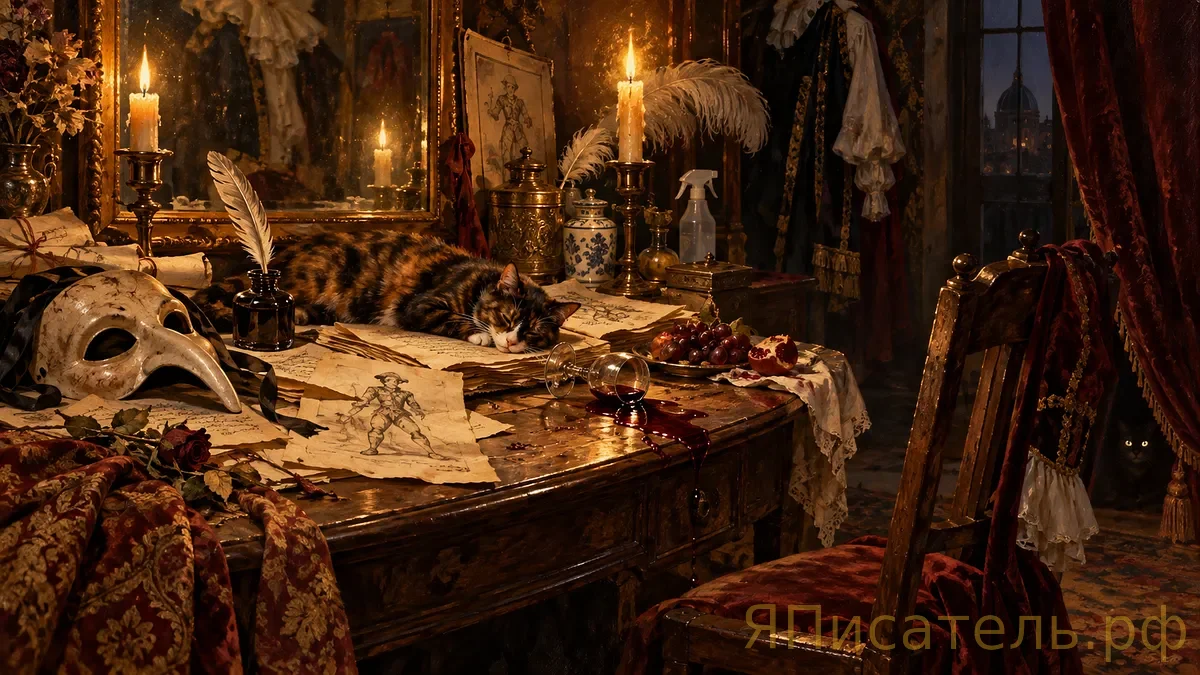
Molière Died On Stage — And Never Stopped Performing
On February 17, 1673, Jean-Baptiste Poquelin — known to the world as Molière — collapsed during a performance of his own play, The Imaginary Invalid. He was playing a hypochondriac. The irony is so thick you could cut it with a butter knife. Hours later, he was dead. And yet, 353 years on, every theater season proves this man simply refuses to leave the stage.
Here's the thing nobody tells you about Molière: he wasn't some dusty literary figure that schoolteachers force-feed you between geography and lunch. He was the seventeenth-century equivalent of a stand-up comedian who got cancelled — repeatedly — and kept coming back sharper each time. The Church wanted him silenced. The aristocracy wanted him humiliated. The doctors wanted him sued. He responded by writing plays that made all three groups look like absolute fools. And people loved it.
Let's talk about Tartuffe, the play that nearly destroyed him. Imagine writing a comedy about a religious con artist who worms his way into a wealthy family, seduces the wife, steals the estate, and does it all while quoting scripture. Now imagine performing it in 1664 France, where the Catholic Church had enough political power to ruin your life on a Tuesday afternoon. The play was banned — not once, but twice. King Louis XIV himself had to intervene to get it staged. Molière rewrote it three times over five years. Five years of battling censorship, death threats, and public condemnation. And what did he produce? One of the most performed comedies in human history. The word "tartuffe" entered the French language as a synonym for "hypocrite." When your fictional character becomes a dictionary entry, you've won.
But here's what makes Tartuffe terrifyingly relevant today: scroll through any social media feed and you'll find a dozen Tartuffes before breakfast. The influencer preaching minimalism from a mansion. The politician quoting family values while his third marriage collapses. The wellness guru selling detox teas that are essentially expensive laxatives. Molière didn't just write a play about religious hypocrisy — he wrote the blueprint for every grift that's followed since. The mechanism is identical: exploit people's desire to believe in something pure, wrap yourself in its language, and help yourself to whatever isn't nailed down.
Then there's The Misanthrope, which is arguably his masterpiece and definitely his cruelest joke. Alceste, the protagonist, is a man who despises social hypocrisy and insists on telling the truth at all times. Sounds heroic, right? Except Molière makes him insufferable. Alceste is self-righteous, exhausting, and — here's the knife twist — deeply in love with Célimène, the most socially manipulative woman in Paris. He hates everything she represents, and he can't stop wanting her. If that doesn't describe at least three people you know, you're not paying attention.
The Misanthrope asks a question that philosophy still hasn't answered satisfactorily: is brutal honesty a virtue or just another form of narcissism? When someone says "I'm just being honest" before demolishing your self-esteem, are they truth-tellers or sociopaths with good vocabulary? Molière didn't pick a side. He laughed at both — the liars and the truth-tellers — because he understood that humans are ridiculous from every angle.
And then there's The School for Wives, the play that kicked off the whole controversy machine. Arnolphe, a middle-aged control freak, raises a young girl in total isolation so she'll become his perfectly obedient wife. Naturally, the plan backfires spectacularly. Written in 1662, this is essentially a takedown of patriarchal ownership of women that wouldn't feel out of place in a modern feminist reading list. Molière caught hell for it — critics called it vulgar, immoral, an attack on marriage itself. He responded by writing The Critique of the School for Wives, a play about people arguing over his play. The man literally turned his haters into content. If that's not peak creative energy, I don't know what is.
What's genuinely remarkable about Molière is his method. He was an actor first, a writer second. He built his plays from the stage up, not from the page down. He watched audiences. He knew exactly when a pause would land, when a physical gag would elevate a verbal one, when silence was funnier than any punchline. This is why his comedies still work in performance when so many of his contemporaries read like furniture assembly instructions. Corneille and Racine wrote for posterity. Molière wrote for the laugh he needed on Thursday night.
His influence bleeds into everything we consider modern comedy. The sitcom structure — flawed characters trapped in social situations they've created for themselves — that's pure Molière. Larry David's Curb Your Enthusiasm is basically The Misanthrope set in Los Angeles. Every farce where someone hides in a closet while the wrong person walks in? Molière perfected that. Every comedy where the smartest person in the room is also the biggest disaster? That's his fingerprint.
But perhaps his most lasting contribution is the idea that comedy can be serious art. Before Molière, comedy was considered the lesser form — tragedy was where the real prestige lived. He fought that hierarchy his entire career, arguing that making people laugh at their own flaws was harder and more valuable than making them cry over fictional kings. He never fully won that argument in his lifetime. The Académie Française kept him at arm's length. The Church denied him a proper burial — his wife had to petition the king just to get him buried at night, in unconsecrated ground, with minimal ceremony.
Three hundred and fifty-three years later, the Comédie-Française — France's most prestigious theater — is still nicknamed "The House of Molière." His plays are performed more often than those of any other French playwright. The language itself bends around him: in France, French is sometimes called "the language of Molière," the way English is called "the language of Shakespeare." Not bad for a guy the establishment tried to bury in the dark.
So here's the uncomfortable truth Molière keeps whispering from his unmarked grave: we haven't changed. Not really. We still fall for charlatans dressed in virtue. We still confuse bluntness with integrity. We still try to control the people we claim to love. We still treat comedy as less important than tragedy, even though the comedian sees further than the tragedian ever could. Molière held up a mirror 353 years ago, and the reflection hasn't aged a day. The only question is whether we'll ever stop being funny enough to keep his plays relevant. My money says no.
Paste this code into your website HTML to embed this content.