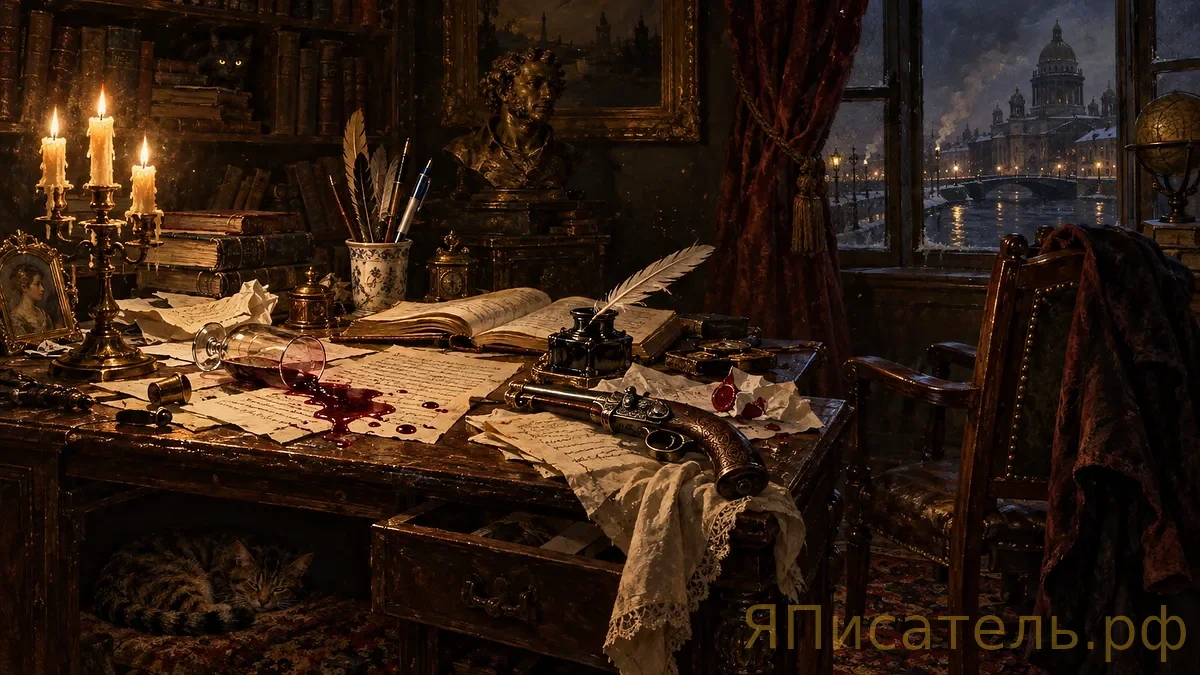
Pushkin Died in a Duel Over His Wife — And We Still Haven't Gotten Over It
On February 10, 1837, Alexander Pushkin bled out from a gunshot wound to the abdomen, killed in a duel he fought to defend his wife's honor against a French pretty boy named Georges d'Anthès. He was 37. That's younger than most people when they finally get around to reading him. And here we are, 189 years later, still talking about a man who essentially invented Russian literature the way Steve Jobs invented the smartphone — not from scratch, but in a way that made everything before him look like a rough draft.
Here's the thing that nobody tells you about Pushkin: he wasn't supposed to matter this much. He was an aristocrat with African heritage (his great-grandfather, Abram Gannibal, was an Ethiopian brought to Russia as a gift for Peter the Great), a notorious gambler, a serial womanizer, and a troublemaker who got exiled twice before turning thirty. If he were alive today, he'd have been canceled seventeen times before breakfast. And yet this chaotic, brilliant, infuriating man wrote works that literally define how Russians think about love, honor, fate, and what it means to be human.
Let's start with "Eugene Onegin," which Pushkin called a "novel in verse" — a phrase that sounds pretentious until you actually read it and realize he pulled it off. Written over seven years (1823–1830), it tells the story of a bored St. Petersburg dandy who rejects the love of a sincere country girl named Tatyana, kills his best friend in a duel (sound familiar?), and then realizes years later that Tatyana was the one. By then, she's married and tells him to get lost. That's it. That's the plot. And somehow, it's one of the most devastating things ever written. Tchaikovsky turned it into an opera. Nabokov spent years translating it, producing a four-volume commentary that's longer than the original poem. The Russian language itself was reshaped by Pushkin's stanzas — he created a verse form, the "Onegin stanza," that became as iconic in Russian poetry as the sonnet is in English.
But here's what makes "Eugene Onegin" terrifyingly relevant today: it's about a man who is so drowning in irony, so allergic to sincerity, that he destroys every good thing in his life. Onegin is the original "too cool to care" guy. He's the prototype for every emotionally unavailable person who ghosts someone who genuinely loves them, then shows up three years later with a "hey, I've been thinking about you" text. Pushkin diagnosed a disease of the modern soul almost two centuries before we had a word for it.
"The Captain's Daughter" (Kapitanskaya Dochka, 1836) is a completely different animal — a historical novel set during the Pugachev Rebellion of 1773–1775. On the surface, it's an adventure story about a young officer named Pyotr Grinyov who falls in love with the daughter of a fortress captain. But underneath, Pushkin is wrestling with questions that haunt every society: What do you owe your government? When is rebellion justified? Can a tyrant also be merciful? Pugachev, the rebel leader, is portrayed not as a monster but as a complex, magnetic figure — a man who knows he's doomed but chooses to live like a eagle eating fresh meat rather than a raven feeding on carrion for three hundred years. That metaphor alone is worth the price of admission. Tolstoy later said that all Russian prose "came out of Pushkin's overcoat" (borrowing Dostoevsky's famous quip about Gogol), and "The Captain's Daughter" is exhibit A.
Then there's "The Queen of Spades" (Pikovaya Dama, 1834), which is hands down one of the creepiest, most psychologically intense short stories ever written. Hermann, a German officer in St. Petersburg, becomes obsessed with learning the secret of three winning cards from an old countess. He terrifies the old woman to death, her ghost visits him with the secret, and when he plays the cards — the third one betrays him. Instead of an ace, he turns over the Queen of Spades, and on the card, he sees the face of the dead countess smiling at him. He goes insane. The whole thing is barely fifty pages, and it hits harder than most thousand-page novels. It's a story about greed, obsession, and the universe's dark sense of humor. Dostoyevsky's Raskolnikov, Stevenson's Dr. Jekyll, even Scorsese's characters in "Casino" — they all owe a debt to Hermann.
What strikes me most about Pushkin's legacy isn't just literary influence, though. It's how personal his work still feels. When Tatyana writes her letter to Onegin, pouring out her heart with zero self-protection, every person who has ever sent a vulnerable 2 AM message feels that in their bones. When Hermann stares at the Queen of Spades and reality fractures, anyone who has ever let an obsession consume them recognizes that vertigo. Pushkin wrote about the eternal human conditions — unrequited love, self-destructive pride, the gambler's delusion — with such precision that translation barely dulls the blade.
And let's talk about the duel for a moment, because it matters. D'Anthès, a French officer adopted by the Dutch ambassador, had been publicly flirting with Pushkin's wife Natalya for months. Anonymous letters mocking Pushkin as a cuckold circulated through St. Petersburg's salons. Pushkin challenged d'Anthès, was shot in the gut, and died two days later. D'Anthès survived, lived to 83, became a French senator, and died rich and comfortable. The good guy lost. The troll won. If that doesn't sound like the internet age, I don't know what does.
But here's the twist that makes the story perfect: d'Anthès is a footnote. Nobody names their children after him. Nobody reads his speeches in the French Senate. He won the duel and lost history. Pushkin lost the duel and won everything else. His face is on Russian currency. His birthday is a national holiday. Every Russian schoolchild can recite his verses. His name is shorthand for genius itself.
So, 189 years after a bullet took him from the world, what do we do with Pushkin? We read him. Not because he's a monument or a homework assignment, but because he understood something essential: that life is short, love is complicated, luck is a liar, and the only honest response to all of it is to write it down with as much truth and beauty as you can manage. Pushkin did that better than almost anyone. And the fact that a 37-year-old poet, dead from a pointless duel in the snow, still makes us feel things — still makes us argue, still makes us ache — well, that's not legacy. That's immortality.
Paste this code into your website HTML to embed this content.