Vows Written in Ash
The Moretti and Blackwood families had been at war for three generations — over land, over legacy, over a death no one would confess to. When a crumbling empire and mounting debts forced both patriarchs to the negotiating table, they found only one solution brutal enough to bind them: marriage.
Elara Blackwood learned of her fate on a Tuesday, over breakfast, as casually as if her father were discussing the weather.
"You'll marry the Moretti boy. The eldest. It's already decided."
She set down her coffee cup with exaggerated care, as though it might shatter if she gripped it any harder. "You can't be serious."
"The contracts are signed, Elara. The wedding is in six weeks."
Six weeks. Forty-two days to prepare herself for a life chained to the enemy. To Dante Moretti — the man whose family had burned her mother's vineyard to the ground, whose grandfather had driven her grandmother to an early grave. The man she had every reason to hate.
The man she had never actually met.
---
She saw him for the first time at the rehearsal dinner, three days before the wedding. The Moretti estate sprawled across the Tuscan hillside like a sleeping predator — beautiful, ancient, and unmistakably dangerous. Elara stepped out of the car in a midnight-blue dress, her dark hair pinned up to reveal the curve of her neck, and told herself she would not be afraid.
Then Dante walked out of the shadow of the doorway, and every rational thought left her mind.
He was tall — taller than she expected — with black hair that fell just past his jawline and cheekbones that could have been carved from the same marble as the estate's columns. But it was his eyes that stopped her. Dark, nearly black, holding a kind of quiet intensity that felt like standing too close to a flame. He looked at her the way a man looks at a locked door he fully intends to open.
"Miss Blackwood." His voice was low, unhurried. He extended his hand.
"Mr. Moretti." She took it. His grip was warm and firm, and he held on a beat too long.
"Dante," he corrected. "If we're going to pretend to love each other, we should at least use first names."
"Who said anything about pretending?" The words came out sharper than she intended.
A ghost of a smile crossed his face. "Ah. So you plan to openly despise me. How refreshing."
The dinner was agony. They sat side by side at the head of a long table while both families circled like wolves around a kill, watching their every interaction with predatory interest. Elara smiled when required, laughed when expected, and felt Dante's gaze on her like a hand pressed to the small of her back — constant, warm, impossible to ignore.
At one point, he leaned close enough that his breath stirred the loose strand of hair near her temple. "You're good at this," he murmured. "The performance. But your left hand has been clenched under the table since the appetizers."
She unclenched it immediately. "Don't pretend you know me."
"I don't. That's the tragedy, isn't it? We're about to promise each other forever, and we haven't even shared a single honest conversation."
She turned to face him then, close enough to see the flecks of amber hidden in his dark irises. "You want honesty? Fine. I think this marriage is a cage. I think your family is responsible for my mother's suffering. And I think you agreed to this for the same reason I did — because we had no choice."
Something shifted in his expression. The practiced ease cracked, just for a moment, revealing something raw underneath. "You're right about most of that," he said quietly. "But not all of it."
Before she could ask what he meant, his father rose to make a toast, and the moment dissolved like smoke.
---
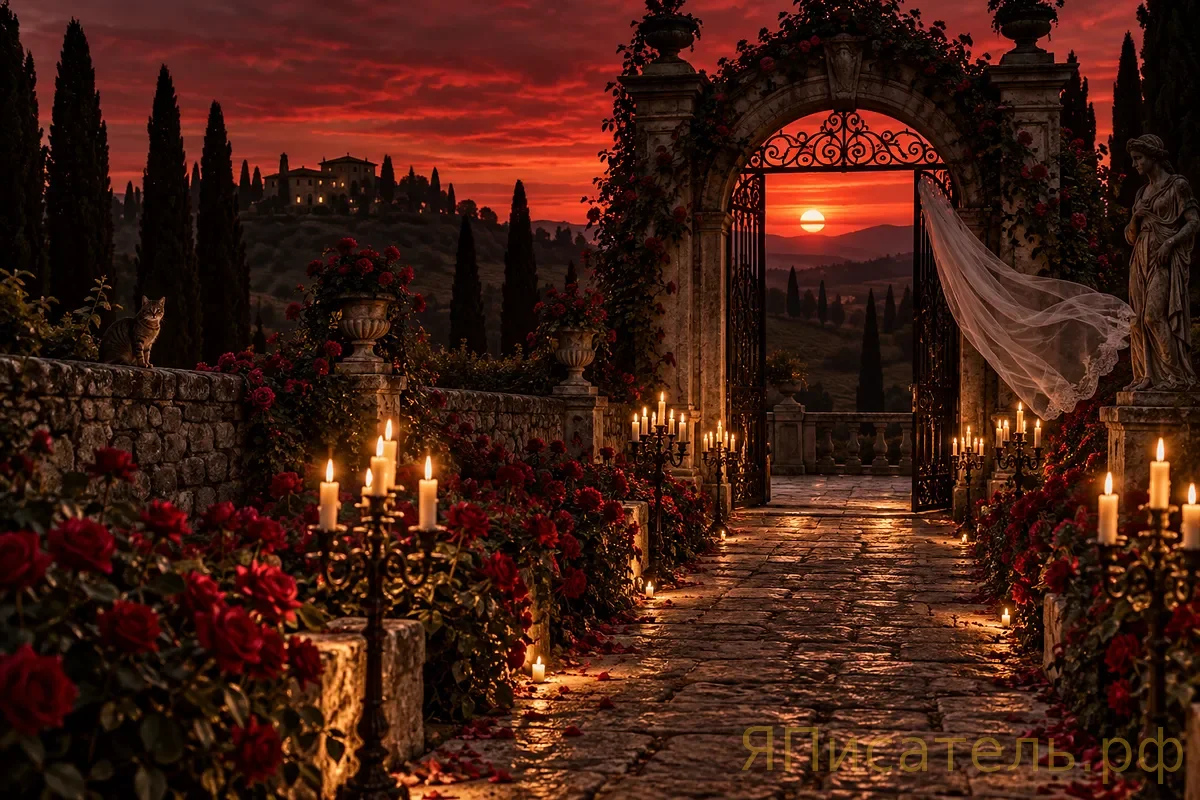
The wedding was held at dusk, in the garden between the two estates — neutral ground, as if even the earth itself needed to remain impartial. The sky bled crimson and gold as Elara walked down the aisle, her white gown trailing behind her like a surrender flag.
Dante waited at the altar in a black suit that made him look like he'd been cut from the evening itself. When she reached him, he took her hands, and she felt the slight tremor in his fingers. Nerves. From the man who had seemed carved from stone.
"You're shaking," she whispered.
"So are you," he whispered back.
They exchanged vows — words written by lawyers, not lovers — and when the officiant said he could kiss the bride, Dante cupped her face with a gentleness that made her breath catch. The kiss was soft, brief, and devastating. His lips tasted like wine and something darker, like a secret he was offering her without words.
The applause that followed sounded very far away.
---
Their first night as husband and wife was spent in the east wing of the Moretti estate, in a room with floor-to-ceiling windows that overlooked the valley. Moonlight spilled across the bed like liquid silver. They stood on opposite sides of the room, two strangers bound by ink and obligation.
"I won't touch you," Dante said, his back to her as he loosened his tie. "Not unless you ask me to."
"How noble."
He turned, and the moonlight caught the sharp lines of his face. "I mean it, Elara. Whatever this is — whatever it becomes — it will be on your terms. I owe you that much."
She studied him, searching for the lie, the angle, the manipulation. She found nothing but sincerity, and that frightened her more than cruelty ever could.
"Why did you agree to this?" she asked.
"My father gave me a choice: marry you, or watch him dismantle what's left of your family's holdings. The vineyards, the house, your brother's school. Everything."
The blood drained from her face. "He used my family as leverage against you?"
"Yes."
"So you married me to... protect us?"
Dante's jaw tightened. "I married you because the alternative was unconscionable. Don't make it romantic."
But it was. God help her, it was. Because in that moment, standing in the moonlit bedroom of her enemy's house, Elara Blackwood-Moretti realized that the man she was supposed to hate had sacrificed his freedom to save her family. And the look in his eyes — the one he kept trying to hide beneath indifference — was not the look of a man fulfilling an obligation.
It was the look of a man already falling.
---
The weeks that followed were a slow, exquisite unraveling. They orbited each other like binary stars — close enough to feel the gravitational pull, careful enough to never collide. Dante left her handwritten notes on the kitchen counter: reminders about the estate's schedules, recommendations for the library, once a single line that read, "The garden is beautiful at dawn. You should see it."
She went. The roses were in full bloom, crimson and heavy with dew, and she found him already there, sleeves rolled to his elbows, dirt on his hands. He looked up and something unguarded passed across his face — surprise, pleasure, a flash of vulnerability quickly concealed.
"You came," he said.
"Don't read into it."
"I wouldn't dare."
But the distance between them had begun to shrink. Dinners grew longer. Conversations grew deeper. She learned that he played piano — beautifully, secretly, always late at night when he thought no one was listening. She learned that his mother had died when he was twelve, and that he kept a photograph of her hidden inside a book of poetry he never let anyone else touch.
And he learned her. Her fury, her grief, her fierce loyalty to a family that had traded her like currency. He never flinched from any of it.
One night, she found him in the library, a glass of whiskey in his hand, staring at the fire. She sat in the chair across from him and said nothing, and they existed in silence for an hour, and it was the most intimate experience of her life.
When she finally stood to leave, he caught her wrist — gently, barely a touch.
"Elara."
"Yes?"
His thumb traced a circle against her pulse point. Her heartbeat stuttered. "I need to tell you something. About the fire — the one that destroyed your mother's vineyard."
Her blood went cold. "What about it?"
"It wasn't my family." His eyes locked onto hers with an intensity that pinned her in place. "I found documents in my father's study. The fire was arranged by someone inside your family. Someone who needed the insurance money, and who needed someone else to blame."
The room tilted. "You're lying."
"I have the proof. I was going to show you when the time was right, but there is no right time for this." He released her wrist and pulled a leather folder from beneath the chair cushion. "Everything is in here. Bank records, correspondence, a confession letter that was never sent."
Elara took the folder with numb fingers. She didn't open it. She couldn't. Not yet.
"Why would you show me this?" she breathed. "This could tear my family apart."
"Because you deserve the truth. Even if it costs me everything. Even if you hate me for being the one to deliver it."
She stood there, trembling, the folder pressed against her chest like a wound. The fire crackled. The shadows swayed. And Dante Moretti watched her with those impossibly dark eyes, offering her the one thing no one in her life had ever given her — the truth, with no strings attached.
She stepped toward him. Then another step. Then she was standing so close she could feel the heat radiating from his body, could see the way his breath hitched, could count the shadows his lashes cast on his cheekbones.
"I don't hate you," she whispered. "That's the most terrifying part."
His hand rose slowly — giving her every chance to pull away — and settled against the curve of her jaw. His thumb brushed her lower lip, and the touch sent electricity cascading down her spine.
"Then we're both terrified," he said. "Because I stopped pretending I don't feel this a long time ago."
The kiss, when it came, was nothing like the one at the altar. This one was fire and surrender, slow and searing, a question and an answer all at once. She fisted the fabric of his shirt and pulled him closer, and he made a sound low in his throat that she felt all the way to her bones.
When they finally broke apart, foreheads pressed together, breathing ragged, the leather folder lay forgotten on the floor between them.
"What do we do now?" she asked.
Dante's arms tightened around her. Beyond the library windows, the moon hung low and red over the valley, casting the world in shades of crimson and shadow.
"Now," he said, his voice rough with everything he'd been holding back, "we stop being enemies. And we figure out who the real ones are."
Outside, the wind shifted, carrying the scent of roses and ash. Somewhere in the dark, a secret waited to be uncovered — one that would either bind them together forever or burn everything they'd built to the ground.
But tonight, in the firelit dark of the library, with his heartbeat steady against her palm, Elara chose not to be afraid.
Tonight, she chose him.
Paste this code into your website HTML to embed this content.