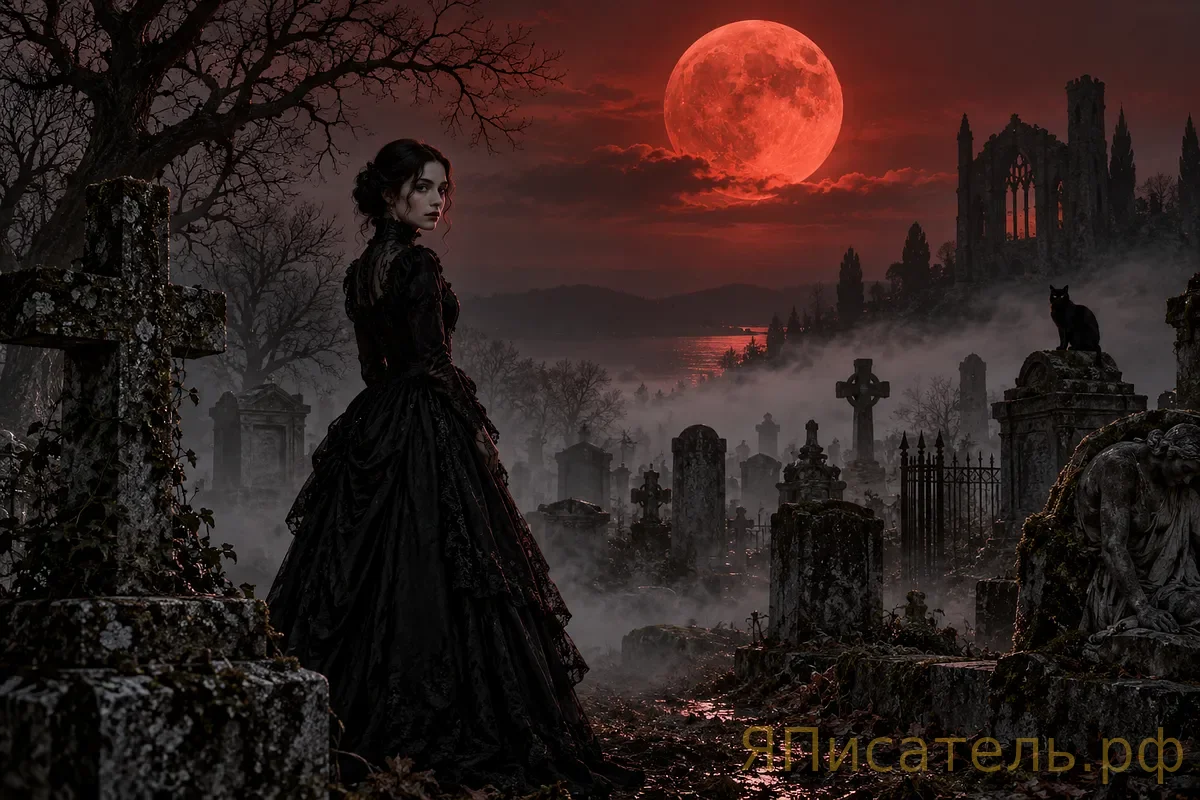
She Cursed Me with Eternal Love
I met her on the night of the blood moon, when the veil between worlds grew thin. She stood at the edge of the cemetery, her dark hair whipping in the wind like smoke, and when she turned to look at me, I knew I was already lost.
"You shouldn't have come here," she whispered, her voice ancient despite her youthful face.
I should have run. Instead, I stepped closer.
My name is Daniel Ashford, and three months ago, I was a skeptic—a professor of folklore who studied superstition without believing a word of it. I came to the village of Ravenshollow to research their legends of the Weeping Woman, a spirit said to haunt the old graveyard. Local legend claimed she was a witch who died for love, cursed to wander until she found a soul willing to share her burden.
I expected dusty archives and colorful stories. I found Lilith.
"The dead don't like visitors," she said that first night, her eyes reflecting the crimson moon like dark mirrors. "Especially handsome ones who don't believe."
"Who says I don't believe?"
Her laugh was wind through autumn leaves. "Your heartbeat. It's too steady. But that will change."
She vanished into the mist before I could respond, leaving only the scent of night-blooming jasmine and something older—something that smelled like centuries.
I told myself I returned to the cemetery for research. Every night for a week, I walked those winding paths between crumbling headstones, and every night, she appeared. We would talk until dawn painted the sky, her questions about the modern world oddly innocent, her knowledge of history impossibly vast.
"How old are you really?" I asked one night.
"Old enough to have loved and lost," she replied. "Young enough to want to try again."
The warning signs were everywhere. She never aged. She knew things about local history that hadn't been written in any book. Animals fled from her presence—all except the black cat that wound between her ankles, watching me with knowing eyes.
But when she touched me—just her fingers brushing my jaw—I felt more alive than I had in years.
"You're not human," I said finally, three weeks into our strange courtship.
"No," she admitted. "I was, once. Before love destroyed me. Before I became something else to survive."
"The Weeping Woman."
She flinched at the name. "That's what they call me. But I stopped weeping long ago. Tears accomplish nothing."
"What happened to you?"
Her story unfolded like a fever dream. Lilith had been a healer in 1743, accused of witchcraft when the village lord's son fell in love with her instead of his arranged bride. They burned her mother first, making Lilith watch. Then they came for her.
"He tried to save me," she said, her voice hollow. "Thomas, the lord's son. He died fighting his own father's men. They killed him right in front of me, and something in me... shattered. Then reformed into something else entirely."
"The curse."
"Not just any curse. I swore that I would never rest until I found a love strong enough to break the chains of death itself. The power of that vow twisted me into this." She gestured at herself—eternal, beautiful, terrible. "I am bound to this place, bound to watch centuries pass, bound to wait."
"Wait for what?"
Her eyes met mine. "For someone who would choose to stay."
I should have left then. I should have packed my bags, published my research, returned to my safe, rational life. But rationality had abandoned me the moment I first saw her silhouette against that bloody moon.
"What happens if someone chooses to stay?" I asked.
"They become like me. Eternal. Bound. We would walk the centuries together, trapped between life and death, belonging fully to neither world."
"That sounds like hell."
"It's been hell alone," she whispered. "With someone... it might become something else."
The weeks that followed were madness. I stopped sleeping. I stopped eating properly. My colleagues sent concerned emails that went unanswered. All I could think about was her—the way moonlight caught her cheekbones, the way her voice curled around my name, the way she looked at me like I was the first real thing she'd seen in centuries.
We didn't touch again after that first brush of fingers. She was careful about that.
"If you choose," she explained, "it must be truly chosen. Not influenced by magic or desire."
"Desire isn't magic?"
"It's the most dangerous kind."
One night, I found her weeping after all. She sat on a tomb, her shoulders shaking, her tears leaving trails of frost on the ancient stone.
"What's wrong?"
"You'll leave," she said. "They always leave. They see what I am, really see it, and they run. It's better if you go now, before—"
"Before what?"
"Before I can't let you go."
I sat beside her, close enough to feel the chill that radiated from her skin. "What if I don't want to leave?"
"You should. I'm selfish, Daniel. I've been alone so long, and you're... you're the first one who looks at me like I'm still human. If you stay much longer, I'll beg you to remain. I'll curse you with what I am."
"Maybe I want to be cursed."
She looked at me then, hope and horror warring in her ageless eyes. "You don't know what you're saying."
"I've spent my whole life studying stories about love that defies death. What good is knowledge if I'm too afraid to live the story myself?"
"This isn't a story. This is eternity. Cold eternity, watching everything you know crumble to dust while you remain unchanged."
"Unchanged? Lilith, I've changed more in these weeks with you than in my entire life before. I've felt more. Wanted more. Been more."
She stood abruptly, her form flickering like candle flame. "You need time. Go back to the village. Sleep. In the morning, if you still—"
"I won't change my mind."
"Then you're a fool."
"Probably."
I returned to my rented room, but sleep wouldn't come. Her face haunted me—both versions. The eternal, untouchable beauty and the vulnerable woman beneath, still mourning a love that died three centuries ago.
When dawn broke, I made my decision.
I found her in the crypt at sunset, waiting as if she'd known I would come. Perhaps she had. Perhaps she'd always known.
"Are you certain?" she asked, her voice trembling.
"No. But I'm certain I can't walk away from you."
"That's not the same thing."
"Maybe not. Maybe I'm making the biggest mistake of my existence—an existence that might now last forever. But Lilith..." I took her hand, and her skin was ice and fire at once. "I would rather spend eternity with you than another day without you."
The curse, when it came, felt like drowning in starlight. She spoke words in a language that predated memory, and the world fractured around me—reality reshaping itself to include me in its impossible design.
I felt death brush past me and keep walking.
I felt time loosen its grip.
I felt her, finally, truly felt her—not just her physical presence but her essence, centuries of loneliness and hope and terrible, beautiful endurance.
"What have you done?" I gasped.
"Cursed you," she said, tears streaming down her face. But she was smiling. "Cursed you with eternal love."
I should have been terrified. Instead, I kissed her—our first kiss, tasting of moonlight and promises that would outlast the stars.
That was a year ago. Or a century. Time moves differently now.
The village of Ravenshollow still tells stories about the cemetery—but now they speak of two spirits seen walking hand in hand. The Weeping Woman, they say, weeps no more. And her companion, the Professor, is said to smile like a man who has discovered a secret worth dying for.
They're half right.
I didn't die for love. I simply stopped living in the way mortals understand it. In exchange, I gained something more valuable than years could ever measure.
I gained forever with her.
Some nights, I wonder if I chose correctly. When I see the living going about their brief, brilliant lives, I feel a pang of something—not quite regret, but recognition of what I surrendered.
Then Lilith takes my hand, and eternity seems like barely enough time.
She cursed me with eternal love.
I have never been so grateful to be damned.
Paste this code into your website HTML to embed this content.