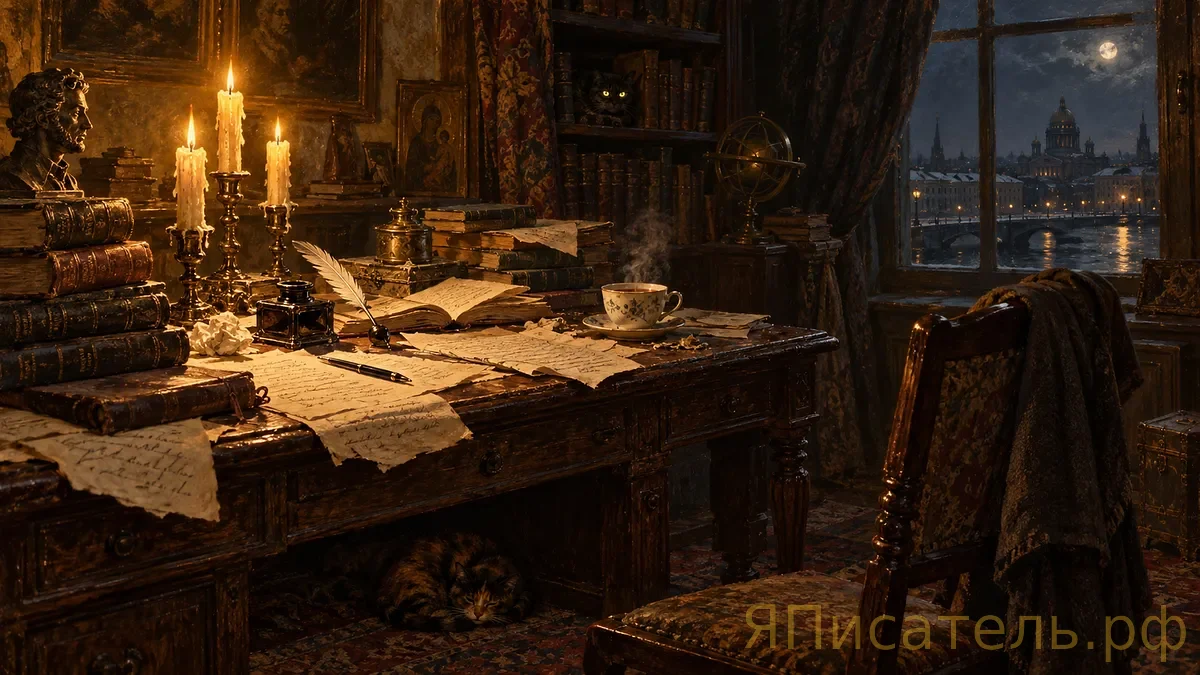
Dostoevsky Died 145 Years Ago — And Still Knows You Better Than Your Therapist
Here's the uncomfortable truth: a Russian guy who had epilepsy, a gambling addiction, and did time in a Siberian labor camp understands your 3 AM anxieties better than anyone you've ever met. Fyodor Dostoevsky shuffled off this mortal coil on February 9, 1881, in Saint Petersburg, and 145 years later, his books still hit like a freight train. Not because they're "classics" your professor told you to read, but because the man crawled so deep into the human psyche that he basically invented the user manual for modern neurosis.
Let's start with the elephant in the room — Crime and Punishment. You know the premise: broke student Raskolnikov murders a pawnbroker because he's convinced he's a Napoleon-type genius above moral law. Spoiler alert: he's not. But here's what's wild — scroll through any true crime subreddit and you'll find the exact same delusion playing out in real time. Every tech bro who thinks rules don't apply to them, every politician who believes they're the exception, every internet troll who hides behind anonymity — they're all running Raskolnikov's operating system. Dostoevsky didn't just write a murder mystery. He wrote the diagnostic criteria for modern entitlement.
And the punishment? That's the genius part. It's not the Siberian exile at the end. The real punishment is the paranoia, the guilt, the psychological disintegration that happens between the crime and the confession. Dostoevsky knew — because he'd literally stood before a firing squad in 1849, pardoned only at the last second in a staged mock execution — that the worst prison is the one inside your own skull. Every anxiety disorder, every spiral of rumination, every sleepless night you've spent replaying something stupid you said at a party — congratulations, you're living in Raskolnikov's apartment.
Now let's talk about The Idiot, a book whose premise sounds like it was pitched by a drunk screenwriter: "What if Jesus came back, but like, as a Russian prince with epilepsy, and everyone just destroyed him?" Prince Myshkin is genuinely, radiantly good — kind, honest, empathetic to a fault. And the world absolutely eats him alive. He ends up in a mental institution. Dostoevsky's point? Society doesn't just reject goodness — it pathologizes it. Try being genuinely kind and transparent on the internet for one week and see what happens. You'll understand The Idiot on a molecular level.
What makes this novel sting 145 years later is that we've built entire social systems that punish sincerity. Myshkin would get ratio'd on social media within minutes. He'd be called naive, a simp, a pushover. We've created a culture where cynicism is mistaken for intelligence, and Dostoevsky saw this coming from 1869. The man was basically a prophet with a pen and a seizure disorder.
But the real monster — the absolute magnum opus — is The Brothers Karamazov. If Crime and Punishment is a scalpel, Karamazov is a nuclear bomb. Three brothers, one murdered father, and every possible philosophical position on God, morality, and free will crammed into 800 pages. The intellectual Mitya, the cold rationalist Ivan, the saintly Alyosha — they're not just characters. They're the three voices arguing inside your head every time you face a moral choice.
Ivan's chapter "The Grand Inquisitor" is, no exaggeration, one of the most devastating pieces of writing in human history. Christ returns to Earth during the Spanish Inquisition. The Grand Inquisitor arrests him and explains, calmly and logically, that humanity doesn't actually want freedom — they want bread, miracles, and authority. Christ says nothing. He just kisses the old man on the lips. Read that chapter and then watch any political rally, any influencer selling certainty, any algorithm feeding you exactly what you want to hear. Ivan's nightmare is our Tuesday.
Here's what separates Dostoevsky from other "great writers" who collect dust on shelves: he was a mess. He wasn't some detached intellectual observing humanity from a comfortable study. He gambled away his advances, begged friends for money, married impulsively, and wrote most of his masterpieces under crushing deadlines to pay off debts. Crime and Punishment was literally written against a ticking clock because he'd signed a predatory contract that would have given a publisher rights to all his future works if he missed the deadline. His second wife, Anna, basically saved his career by transcribing as fast as he could dictate. The art came from chaos, not comfort.
And this is exactly why his characters breathe. Raskolnikov's feverish desperation isn't theoretical — Dostoevsky had been that desperate. The gambling addiction that consumes characters in The Gambler? Autobiographical to an embarrassing degree. The religious doubt and yearning in Karamazov? Dostoevsky wrestled with faith his entire life, especially after standing at that mock execution. He didn't write about suffering from a Wikipedia page. He wrote it from scar tissue.
The influence is everywhere, even if you've never read a page. Christopher Nolan has cited Dostoevsky as an influence on his exploration of guilt and moral ambiguity. Jordan Peterson built half a career lecturing on Crime and Punishment. Woody Allen, Cormac McCarthy, David Lynch — they all drank from the same well. Every antihero you've ever loved on a prestige TV show, from Walter White to Tony Soprano, is walking a path Dostoevsky paved. The concept of the "Underground Man" — the bitter, self-aware, paralyzed-by-overthinking loner — basically predicted internet culture 130 years early.
So here we are, 145 years after his heart gave out in that Saint Petersburg apartment, and the man's diagnosis of the human condition hasn't aged a day. We're still Raskolnikov, convinced our crimes don't count. We're still the crowd, destroying every Myshkin who dares to be sincere. We're still sitting across from the Grand Inquisitor, happily trading our freedom for comfort.
The question Dostoevsky keeps asking from beyond the grave isn't complicated. It's just uncomfortable: Do you actually want to be free, or do you just want to feel like you are? Good luck sleeping tonight.
Paste this code into your website HTML to embed this content.