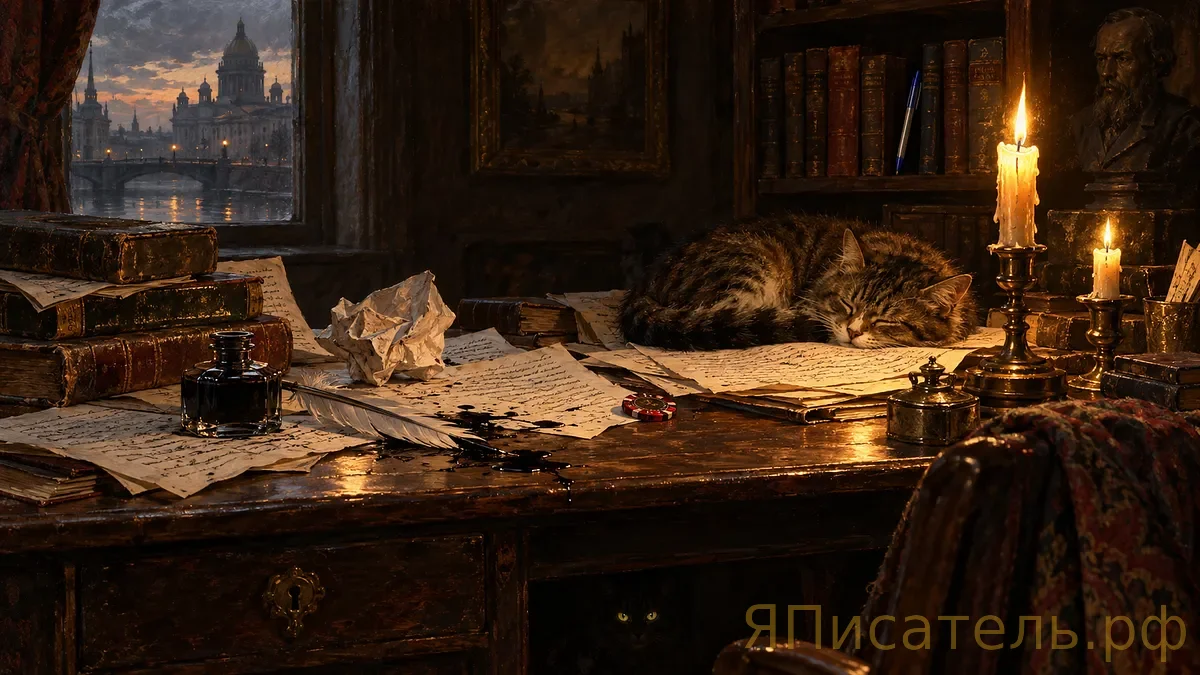
Dostoevsky Diagnosed Your Mental Illness 150 Years Before Your Therapist
On February 9, 1881, Fyodor Dostoevsky died in St. Petersburg. He was 59. The world barely noticed — Russia was too busy preparing for the assassination of Tsar Alexander II, which would happen just five weeks later. And yet, 145 years on, this epileptic ex-convict's books outsell most living authors. Here's the uncomfortable truth: Dostoevsky understood you better than you understand yourself, and that's precisely why reading him feels less like literature and more like being mugged in a dark alley of your own psyche.
Let's start with the elephant in the room. Raskolnikov, the protagonist of *Crime and Punishment*, murders an old woman with an axe because he thinks he's special. He's convinced he's a Napoleon-type figure, above ordinary morality. Sound familiar? It should. Every tech bro who's ever said "move fast and break things" is essentially running Raskolnikov's operating system. Every influencer who believes the rules don't apply to them. Every politician who lies and genuinely believes they're doing it for the greater good. Dostoevsky didn't just write a crime novel in 1866 — he wrote the psychological profile of the modern narcissist.
But here's what makes Dostoevsky genuinely terrifying: he doesn't let you sit comfortably on the outside judging Raskolnikov. You read the book, and somewhere around page 200, you realize you've been nodding along with a murderer's logic. You've been rationalizing alongside him. That moment of self-recognition — that queasy feeling in your stomach — that's the Dostoevsky experience. No other writer in history delivers it quite like that. Not Tolstoy, not Dickens, not anyone.
Now let's talk about *The Idiot*, a novel so audacious in its premise that it still makes writers jealous. Dostoevsky set himself an impossible task: write a genuinely good person and make them interesting. Prince Myshkin is Christ-like, pure-hearted, incapable of malice. In any other writer's hands, he'd be a bore. In Dostoevsky's hands, he becomes the most devastating character in Russian literature — because the novel systematically demonstrates how the world destroys goodness. Not with dramatic villains, but with ordinary human selfishness, jealousy, and social convention. Myshkin ends the novel in a mental institution, and the reader ends it questioning whether kindness is a form of insanity. Try bringing that up at your next dinner party.
The real masterpiece, though — the one that Freud called the greatest novel ever written, and for once Freud wasn't being a complete lunatic — is *The Brothers Karamazov*. Published in 1880, just months before Dostoevsky's death, it contains everything. A murder mystery. A courtroom drama. A theological debate so fierce it still keeps philosophy professors employed. The Grand Inquisitor chapter alone, where Ivan Karamazov imagines Christ returning to Seville during the Spanish Inquisition only to be arrested by the Church, is possibly the most devastating critique of organized religion ever put on paper. And it was written by a man who considered himself a devout Christian. That's the kind of intellectual honesty that would get you cancelled on Twitter in approximately four seconds.
What makes Dostoevsky's legacy so stubbornly alive isn't just literary quality — it's predictive accuracy. The man served four years in a Siberian labor camp for attending a socialist reading circle. When he came out, he'd seen the worst of human nature up close. He'd watched idealists become tyrants. He'd seen how abstract ideas about "the greater good" could justify real cruelty. And he spent the rest of his life warning about it. His novel *Demons* (1872) essentially predicted the Russian Revolution — and its horrors — forty-five years before it happened. He understood that utopian thinking, unchecked by humility and individual conscience, would produce monsters. The twentieth century proved him right with body counts in the millions.
Here's the thing that really gets me, though. Modern psychology keeps rediscovering what Dostoevsky already knew. The Underground Man's crippling self-awareness and inability to act? That's anxiety disorder. Raskolnikov's grandiose self-justification followed by psychosomatic collapse? That's a textbook study of guilt and cognitive dissonance. Myshkin's overwhelming empathy that literally destroys him? That's compassion fatigue. Dostoevsky was mapping the human mind decades before Freud picked up a cigar, and he was doing it with more nuance and less cocaine.
The influence on contemporary culture runs deeper than most people realize. Without Dostoevsky, there's no existentialism — Sartre and Camus openly acknowledged the debt. Without the Underground Man, there's no anti-hero tradition in modern fiction, no *Taxi Driver*, no *Breaking Bad*, no *Joker*. Every time a screenwriter creates a character who monologues about society while spiraling into darkness, they're running on Dostoevsky's fuel. Christopher Nolan's obsession with moral paradoxes? Dostoevsky. The way prestige TV shows force you to sympathize with terrible people? Dostoevsky invented that trick.
And let's not ignore the gambling addiction, because it's essential to understanding why his prose feels the way it does. Dostoevsky was a compulsive gambler who regularly lost everything and wrote under crushing deadlines to pay debts. He dictated *The Gambler* in 26 days to avoid losing his rights to a predatory publisher. That desperation, that feeling of a man writing with a gun to his head — you can feel it in every page he ever wrote. His prose doesn't have the carefully manicured elegance of Tolstoy. It's messy, frantic, overwrought, contradictory. And that's exactly why it feels more honest. Life isn't elegant. Life is messy. Dostoevsky's writing captures the actual texture of human consciousness better than almost anyone because he never had the luxury of pretending otherwise.
So here we are, 145 years after his death, and the man is more relevant than ever. In an age of algorithm-driven echo chambers, Raskolnikov's descent into ideological madness reads like a warning label for the internet. In a world where performative goodness has replaced actual virtue, Prince Myshkin's fate feels prophetic. In an era where people kill and die over competing visions of utopia, the Grand Inquisitor's speech hits like a sledgehammer.
Dostoevsky didn't write comfortable books. He wrote necessary ones. The kind that make you put down the novel, stare at the ceiling, and wonder if you've been lying to yourself about who you really are. And if that's not the highest compliment you can pay a writer who's been dead for 145 years, I don't know what is. Pick up *Crime and Punishment* tonight. I dare you to get through the first hundred pages without recognizing someone you know — or worse, yourself.
Paste this code into your website HTML to embed this content.