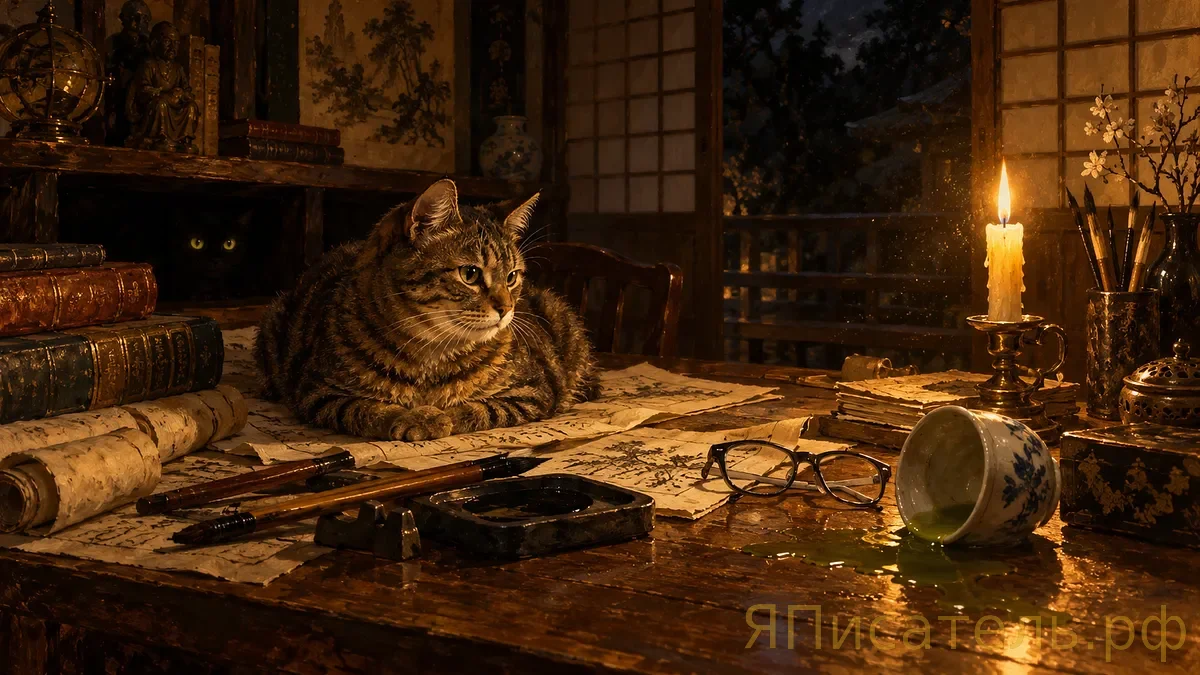
The Man Who Put His Face on Japan's Money — By Writing as a Cat
Imagine telling your boss to shove it, locking yourself in a room for two years, and emerging with a novel narrated by a cat that roasts all of human civilization. That's essentially what Natsume Soseki did — and Japan loved him so much they put his face on the thousand-yen note. For over a century, he stared back at you every time you bought a bowl of ramen. Not bad for a guy who nearly lost his mind in London.
Born on February 9, 1867, in Tokyo — back when it was still getting used to being called Tokyo — Natsume Kinnosuke (his real name, because of course "Soseki" was a pen name) entered the world as an unwanted child. His parents, already blessed with five sons, essentially sold him off to a childless couple as an adopted son. Then that couple divorced, and he bounced back to his biological family like a human ping-pong ball. If you're looking for the origin story of one of literature's great pessimists, well, there it is.
But here's where it gets interesting. The Japanese government, in its infinite wisdom, decided to send Soseki to London in 1900 to study English literature. He was supposed to come back and teach the Brits' literary tricks to Japanese students. Instead, London broke him. He spent two miserable years in cramped boarding houses, barely eating, rarely leaving his room, and slowly convincing himself that the entire Western intellectual tradition was a sham. His landlords thought he was insane. His fellow Japanese students reported back to Tokyo that Soseki had lost it. The government nearly recalled him. And yet — and this is the beautiful part — that descent into near-madness produced one of the sharpest literary minds of the twentieth century.
When he returned to Japan, Soseki took a teaching post at Tokyo Imperial University and was, by all accounts, a terrible fit for academic life. He was moody, brilliant, and had zero patience for institutional politics. So when a friend at the newspaper Asahi Shimbun basically dared him to write a novel, he did something extraordinary: he wrote "I Am a Cat" (1905), a satirical masterpiece narrated by an unnamed stray cat living with a bumbling intellectual. The cat observes human stupidity with the detached amusement of someone watching ants fight over a crumb. It was hilarious. It was vicious. And it was unlike anything Japanese literature had seen before. The serialized novel became a sensation, and Soseki quit his university job to write full-time for the newspaper. A tenured professor walking away from academia to become a newspaper novelist — in 1907, that was the equivalent of a Google engineer quitting to become a TikTok influencer.
But "I Am a Cat" was just the warm-up. Soseki's real knockout punch came with "Botchan" (1906), a semi-autobiographical novel about a hot-headed Tokyo kid who takes a teaching job in rural Japan and immediately starts feuding with every colleague in the building. It's laugh-out-loud funny, brutally honest about Japanese social hierarchies, and remains required reading in Japanese schools to this day. Think of it as Japan's "Catcher in the Rye," except Botchan actually does something about his frustrations instead of just whining about phonies.
Then came the dark turn. Soseki's later novels — "The Gate," "And Then," and especially "Kokoro" (1914) — are some of the most psychologically devastating works ever written. "Kokoro" in particular is a gut punch wrapped in silk. The novel follows a young man's relationship with an older figure he calls "Sensei," a man harboring a terrible secret about betrayal, guilt, and suicide. It's structured like a mystery, but the real mystery isn't what happened — it's why human beings are constitutionally incapable of connecting with each other. Soseki wrote isolation the way Dostoevsky wrote guilt: with surgical precision and no anesthetic.
What makes Soseki genuinely revolutionary — not just important, not just influential, but revolutionary — is that he essentially invented the modern Japanese novel. Before him, Japanese fiction was either classical courtly prose or imported Western imitations. Soseki figured out how to blend both traditions into something entirely new. He took the psychological depth of European realism, ran it through a distinctly Japanese sensibility, and created a literary voice that was simultaneously universal and unmistakably his own. Haruki Murakami, Kenzaburo Oe, Banana Yoshimoto — every major Japanese novelist since owes something to what Soseki built.
Here's the thing that kills me about Soseki, though: the man was perpetually miserable. He suffered from stomach ulcers that nearly killed him multiple times. He had what we'd now diagnose as severe depression and possibly paranoid episodes. His marriage was, by most accounts, a war zone — his wife later wrote a memoir essentially confirming that living with him was a nightmare. He died in 1916, at just 49, from a stomach hemorrhage, leaving his final novel "Light and Darkness" unfinished. Forty-nine years old. He'd been writing fiction for barely eleven of them. In that decade-plus, he produced a body of work that redefined an entire nation's literary identity.
The irony of Soseki's life is almost too perfect. He was sent to England to learn how to be more Western. He came back more Japanese than ever. He was trained as an academic. He became literature's greatest dropout. He wrote a comic novel about a cat and followed it with one of the most devastating explorations of loneliness ever committed to paper. The man contained multitudes, and most of those multitudes were arguing with each other.
So here we are, 159 years after his birth, and Soseki's work hits different now. "Kokoro" reads like it was written yesterday — its themes of isolation, the impossibility of true communication, the weight of secrets — they're not Meiji-era problems. They're Tuesday. His cat narrator's contempt for human self-importance feels more relevant in the age of social media than it did in 1905. And "Botchan" remains the eternal anthem for anyone who's ever walked into a workplace and thought, "Every single one of you is full of it."
They took his face off the thousand-yen note in 2007, replacing him with the bacteriologist Noguchi Hideyo. A scientist replaced a novelist — there's a metaphor Soseki himself would have appreciated, probably with a bitter laugh and another stomach ulcer. But here's what the Bank of Japan can't erase: open any serious discussion about world literature, about the novel as an art form, about what fiction can do to the inside of a human skull, and Natsume Soseki is still right there, staring back at you with those dark, knowing eyes. One hundred and fifty-nine years old, and the cat is still watching.
将此代码粘贴到您网站的HTML中以嵌入此内容。