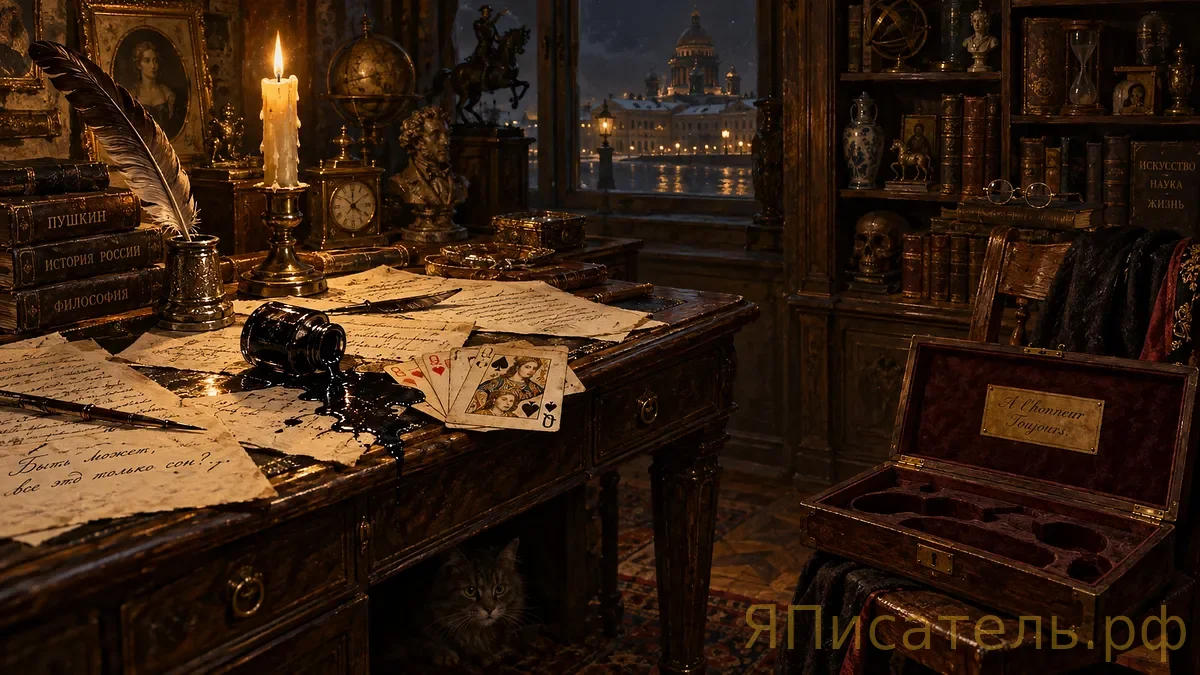
The Dead Russian Who Still Runs Your Love Life: Why Pushkin Refuses to Stay in His Grave
On February 10, 1837, Alexander Pushkin died from a gunshot wound sustained in a duel over his wife's honor. He was 37 years old, dramatically handsome in that disheveled Romantic way, and absolutely furious about dying. One hundred eighty-nine years later, we're still picking up the pieces of his literary explosion—and whether you know it or not, that dead Russian is probably the reason you swooned over your last toxic relationship.
Let me explain. Pushkin didn't just write poetry and prose—he essentially invented the blueprint for the brooding, emotionally unavailable love interest that has haunted Western storytelling ever since. Eugene Onegin, his verse novel masterpiece, gave us a protagonist who rejects genuine love because he's too sophisticated and bored to recognize it. Sound familiar? Every Mr. Darcy, every Heathcliff, every Edward Cullen (yes, even the sparkly vampire) owes a debt to this Russian template. Pushkin looked at the human heart and said: "What if I made falling in love feel like a beautiful catastrophe?"
But here's the delicious irony nobody talks about. Pushkin wrote Eugene Onegin over seven years, from 1823 to 1830, pouring his soul into this tale of missed connections and romantic tragedy. Meanwhile, in his actual life, he was chasing skirts across St. Petersburg with the enthusiasm of a golden retriever at a tennis ball factory. The man who penned the most devastating rejection scene in literature—Tatiana's famous letter and Onegin's cold refusal—was himself constantly falling in and out of love, writing passionate verses to various women, and generally behaving exactly like the irresponsible Romantic poet central casting would have ordered.
Now let's talk about gambling, because Pushkin absolutely loved a good card game—and that obsession gave us The Queen of Spades. This novella is essentially a horror story wearing a tailcoat. Hermann, our protagonist, becomes so consumed with learning a secret three-card winning combination that he literally terrorizes an old countess to death and then goes mad when her ghost appears to give him the formula. Published in 1834, this story predicted our modern addiction culture with unsettling accuracy. Replace the cards with slot machines, cryptocurrency, or doom-scrolling social media, and Hermann's descent feels uncomfortably contemporary. Pushkin understood that humans will absolutely destroy themselves chasing systems and shortcuts, and he made it entertainingly gothic.
The Captain's Daughter, meanwhile, is Pushkin doing something sneaky. On the surface, it's a historical romance set during the Pugachev Rebellion of the 1770s—young officer falls for commander's daughter, war breaks out, adventures ensue. But underneath, Pushkin was doing something revolutionary for Russian literature: he was writing about ordinary people with dignity and complexity. The peasant rebel Pugachev isn't a monster; he's charismatic, merciful, and genuinely interesting. This was dangerous stuff in 1836 Russia, where discussing peasant uprisings could get you exiled (again—Pushkin had already been banished twice for his liberal poems). He wrapped his subversive ideas in adventure story packaging, and the censors let it through.
Here's what truly sets Pushkin apart from his contemporaries: the man could write. I mean really write. While other Romantic poets were drowning their verses in tortured metaphors and pretentious classical references, Pushkin achieved something that seems simple but is devastatingly difficult—clarity. His Russian flows like conversation. His verse sounds like someone thinking aloud, working through emotions in real time. Russians still quote him constantly in daily speech, often without realizing it. Imagine if Shakespeare's lines were so embedded in English that people used them at the grocery store without noticing. That's Pushkin's position in Russian culture.
The influence bleeds everywhere once you start looking. Tchaikovsky turned both Eugene Onegin and The Queen of Spades into operas that remain in active rotation worldwide. Dostoevsky practically built his career on the psychological intensity Pushkin pioneered—that obsessive, feverish quality of Hermann staring at cards is a direct ancestor of Raskolnikov with his axe. Tolstoy, who famously thought most writers were overrated, couldn't stop praising Pushkin's prose style. Even Soviet authorities, who were suspicious of pre-revolutionary culture, couldn't dismiss him—they simply repackaged Pushkin as a proto-revolutionary figure fighting against aristocratic corruption.
But perhaps the most relevant aspect of Pushkin's legacy is how he handled being a celebrity in an era of surveillance. Tsar Nicholas I personally appointed himself Pushkin's censor, which meant every word the poet published had to pass imperial review. Pushkin responded with masterful ambiguity—writing works that could be read as loyal while containing subversive undercurrents. He pioneered the art of saying the unsayable through literary misdirection. In our current age of algorithmic content moderation and social media pile-ons, Pushkin's strategic ambiguity feels like a survival guide.
The circumstances of his death deserve mention because they're so perfectly, tragically literary that you'd reject them as too on-the-nose if they appeared in fiction. Pushkin's wife Natalya was considered the most beautiful woman in St. Petersburg—so beautiful that Tsar Nicholas himself was rumored to have interests. A French military officer named Georges d'Anthès began publicly pursuing her, and anonymous letters mocking Pushkin as a cuckold circulated through society. Pushkin, who had survived exile and censorship, couldn't survive wounded pride. He challenged d'Anthès. D'Anthès shot first and better. Pushkin lingered for two days before dying, surrounded by friends and books, asking his wife to feed him cloudberries.
So here we are, 189 years later, still reading him. Still watching operas based on his work. Still unconsciously replicating his romantic archetypes in our streaming shows and bestselling novels. Still struggling with the gambling addictions and status anxieties he diagnosed. The poet who died defending his honor against a Frenchman now belongs to humanity—translated into every major language, analyzed in every literature department, echoing through every story about love gone wrong or obsession gone too far.
Raise a glass tonight. Not to mourn, but to acknowledge. Somewhere in your understanding of what love should feel like, what tragedy should sound like, what Russian literature means—there's a 37-year-old poet with curly hair and African heritage, laughing at the cosmic joke of immortality. He wanted to be remembered. He got something stranger: he became inescapable.
Pega este código en el HTML de tu sitio web para incrustar este contenido.