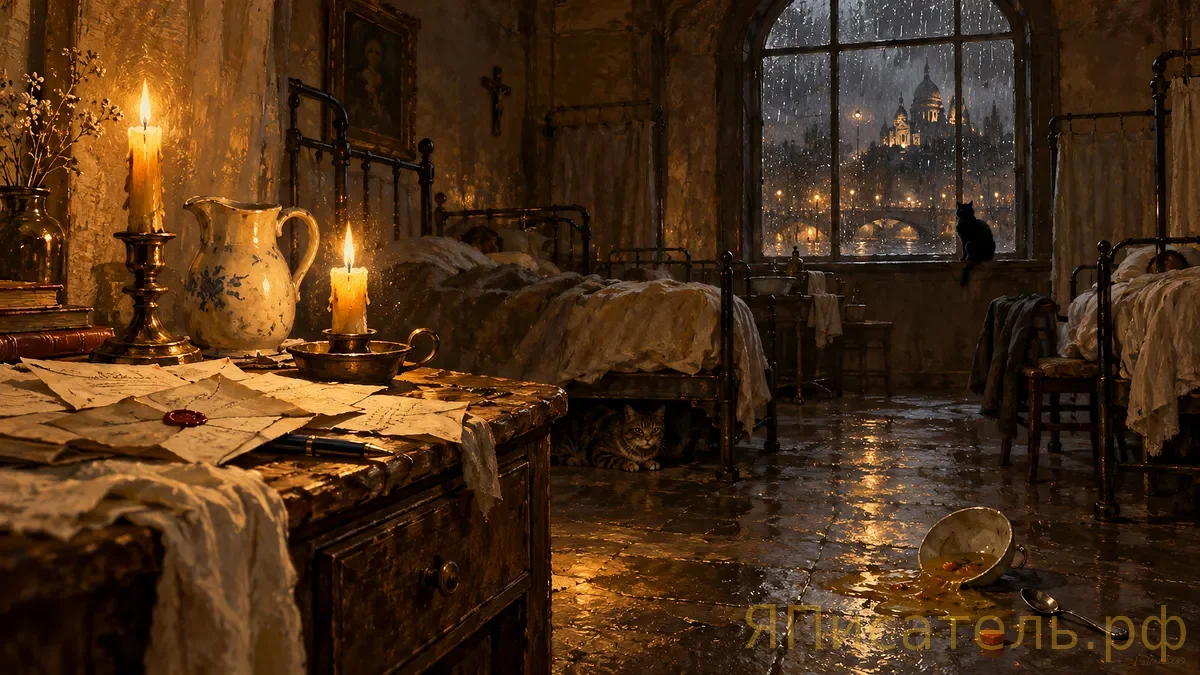
The Barricade's Ghost: A Lost Chapter of the Rue de l'Homme-Armé
Continuación creativa de un clásico
Esta es una fantasía artística inspirada en «Les Misérables» de Victor Hugo. ¿Cómo habría continuado la historia si el autor hubiera decidido extenderla?
Extracto original
He was dead. The night was starless and very dark. Without doubt, in the gloom some mighty angel was standing, with outstretched wings, awaiting the soul.
Continuación
Marius Pontmercy stood at the window of the house in the Rue des Filles-du-Calvaire, watching the rain fall upon Paris as it had fallen upon the barricade, and he thought of Jean Valjean. It was three months since the old man had died in their arms, three months since the candlesticks of the Bishop of Digne had cast their final silver light upon that transfigured face, and still Marius could not sleep without seeing those eyes — those eyes that had carried him through the sewer, through the darkness, through death itself.
Cosette did not speak of her father. This was the wound between them, the silence that lived in the house like a third presence, and Marius understood — with the terrible clarity that comes only to those who have wronged the dead — that his own cruelty had hastened that departure. He had banished Jean Valjean from their home. He had believed Thénardier. He had taken the word of a villain over the testimony of a saint, and the saint had accepted the exile without protest, as saints do, and had gone away to die.
This knowledge was a stone upon his chest.
* * *
One evening in the month of March, when the trees along the boulevards were still bare and the gas-lamps threw their trembling circles upon the wet pavement, Marius returned from the Luxembourg, where he had walked alone — for he walked there often now, as if proximity to the bench where he had first seen Cosette might restore something that had been lost — and found upon the table in the vestibule a letter.
It was addressed to him in an unfamiliar hand. The paper was coarse, the ink faded, and there was about it the unmistakable smell of poverty — that compound of damp walls, cold hearths, and unwashed linen which those who have known it never forget.
He broke the seal.
"Monsieur le Baron," the letter read, "I write to you from the Hôpital de la Pitié, where I am dying. I have something to tell you about the man you called Father Fauchelevent. I was at the barricade. I saw what he did. You do not know the half of it. Come, if you wish to know. If you do not come, it does not matter. I shall be dead by Sunday. — Gervais, formerly of the Faubourg Saint-Antoine."
Marius read the letter twice. Then he took his coat and went out into the rain.
* * *
The Hôpital de la Pitié was, in those years, a place where men went to die in the company of other dying men, which is to say, alone. The ward to which Marius was directed was long and low, with rows of iron beds upon which lay the harvest of Paris — the broken, the fevered, the abandoned. A nun in a white cornette led him to the far end, where a man lay propped upon pillows that had once been white.
He was old — older than Valjean had been — with a face that seemed to have been carved by suffering into something elemental, like a cliff face worn by the sea. His eyes, however, were sharp and bright, and they fixed upon Marius with an intensity that was almost accusatory.
"You are the Baron Pontmercy," said the man. It was not a question.
"I am."
"Sit down. I have not much breath, and what I have to say is long."
Marius sat upon the wooden stool beside the bed. The nun withdrew. From somewhere in the ward came the sound of a man coughing — that terrible, hollow cough that is the voice of consumption speaking its final sentence.
"You knew him as Fauchelevent," said Gervais. "The world knew him as other things. I knew him as the man who saved my life twice and asked nothing for it."
"Tell me," said Marius.
Gervais closed his eyes. When he opened them again, there was in them that distant look of a man gazing not at the present but at the past — that country from which no traveler departs willingly.
"The first time," he said, "was before the barricade. I was a boy — twelve years old, perhaps thirteen. I was a thief. Not a grand thief, you understand, not a Thénardier or a Patron-Minette. A small thief. A boy who stole bread because he was hungry and coins because he was cold. One night in the winter of 1823, I stole a forty-sou piece from a man on the road near Digne."
Marius started. Digne. The Bishop of Digne.
"The man chased me," Gervais continued. "He was large, strong, terrifying. I ran. He called after me — 'Little Gervais! Little Gervais!' — but I did not stop. I was too frightened. I ran until I could run no more, and then I hid in a ditch and wept, for I had lost my coin and gained nothing but fear."
Gervais paused. His breathing was labored, and Marius saw upon the pillow a faint stain of pink that spoke of blood.
"Years later," the old man resumed, "years and years — I was a man grown, a worker in the Faubourg, married, with a child — I saw him again. It was June 1832. The barricade in the Rue de la Chanvrerie. I was there because my child had died of hunger the week before, and when a child dies of hunger in Paris, the father goes to the barricade. It is the only logic that remains."
"I was there also," said Marius quietly.
"I know. I saw you fall. And I saw him — the old man who had chased me on the road near Digne, who had called my name into the darkness — I saw him lift you upon his back as if you weighed nothing, as if you were a child, and carry you into the sewer."
Marius said nothing. His hands trembled.
"But that is not what I wish to tell you," said Gervais. "What I wish to tell you is what happened before. Before he carried you. Before the barricade fell. There was a spy — you remember? An inspector of police."
"Javert," said Marius.
"Javert. He was discovered. Enjolras ordered him shot. And the old man — your Fauchelevent — he asked for the privilege of executing the spy himself. Enjolras agreed. The old man took the inspector into the alley. I followed. I do not know why. Perhaps because I had recognized him, and recognition is a kind of gravity that pulls us toward the past."
Gervais coughed. The nun appeared, offered water, was waved away.
"I stood in the shadows of the alley," he said, "and I watched. The old man raised the pistol. The inspector — Javert — stood straight, refused the blindfold, bared his chest. He was brave, I will say that for him. He was a dog, but he was a brave dog. The old man aimed. And then —"
Gervais looked at Marius with those bright, dying eyes.
"He fired into the air. He cut the ropes. He set the inspector free. He said to him — I heard every word — he said: 'You are free. If I leave here alive, you will find me at such-and-such an address.' And the inspector looked at him — and this is what I cannot forget, Monsieur le Baron — the inspector looked at him as a man looks at God. With terror. With incomprehension. With something that was almost hatred, because mercy, when it is absolute, is unbearable to those who have lived without it."
The ward was silent now, save for the rain upon the windows and the breathing of the dying.
"I have thought about that moment every day since," said Gervais. "Every day for nearly twenty years. A man who had every reason to kill — who had been hunted, imprisoned, persecuted by this inspector for decades — chose instead to give him his life. And the inspector could not bear it. I heard, afterward, that Javert drowned himself in the Seine that same night. Mercy killed him more surely than a bullet."
Marius felt the tears upon his face before he knew he was weeping.
"Why do you tell me this?" he asked.
"Because you did not know him," said Gervais. "Because you sent him away. Oh yes — I know that too. The dying know everything, Monsieur le Baron. The walls of Paris are thin, and gossip passes through them like water through sand. You learned he was a convict and you sent him away, and he went, because that was his nature — to accept suffering as others accept bread."
"I was wrong," said Marius.
"You were wrong. But that is not why I tell you. I tell you because there is a child."
Marius looked up sharply.
"A girl," said Gervais. "In the Faubourg. Seven years old. Her mother died last winter. She has no one. She sleeps in doorways and eats what she can steal. She is — she will become — what your wife's mother was before the old man found her. What I was, before that night on the road near Digne. Another Cosette. Another little Gervais. And I thought: if the old man were alive, he would find her. He would carry her, as he carried you, out of the darkness. But he is not alive. So I am telling you."
Gervais lay back upon his pillows. The effort of speech had exhausted him, and his face was the color of the linen beneath his head.
"Her name is Azelma," he whispered. "She has her mother's eyes. You will find her near the Éléphant de la Bastille — what remains of it. She is small. She is frightened. She is hungry. That is all I know."
Marius stood. He took the old man's hand.
"Thank you," he said.
"Do not thank me," said Gervais. "Thank him. Everything good that passes through this world passes through it because somewhere, once, a bishop gave his candlesticks to a thief, and the thief became a saint, and the saint taught us that even in the sewer — especially in the sewer — there is light."
* * *
Marius walked home through the rain. The streets of Paris lay before him like the pages of a book he was only now learning to read — each cobblestone a word, each lamppost a sentence, each darkened doorway a paragraph in the vast, unfinished story of human suffering and human grace.
When he arrived at the Rue des Filles-du-Calvaire, he found Cosette sitting by the fire, reading. She looked up, saw his face — saw the tears, the rain, the resolution — and set down her book.
"Marius," she said. "What has happened?"
He knelt beside her. He took her hands.
"There is a child," he said. "In the Faubourg. She is alone. She is hungry. She has no one."
Cosette looked at him. And in her eyes he saw — as he had always seen, though he had not always understood it — the reflection of Jean Valjean. That bottomless capacity for compassion that the old man had planted in her like a seed, watered with his suffering, and brought to flower with his love.
"Then we must go to her," said Cosette.
"Yes."
"Now?"
"Now."
She stood. She took her cloak from the hook by the door — the same gesture, Marius realized with a sudden, piercing clarity, that Jean Valjean must have made on that night in Montfermeil, when he went to fetch a small girl from a dark inn and carry her into the light.
They went out together into the rain.
And so it continues — the chain of mercy, forged by a bishop, carried by a convict, and passed now to those who remain. For this is the law of love, which is the only law that matters: that it does not end with the death of the one who bears it, but passes, like a flame from candle to candle, into the darkness, where it is needed most.
The night was vast. The rain was cold. And somewhere in the labyrinth of Paris, a child was waiting.
Pega este código en el HTML de tu sitio web para incrustar este contenido.