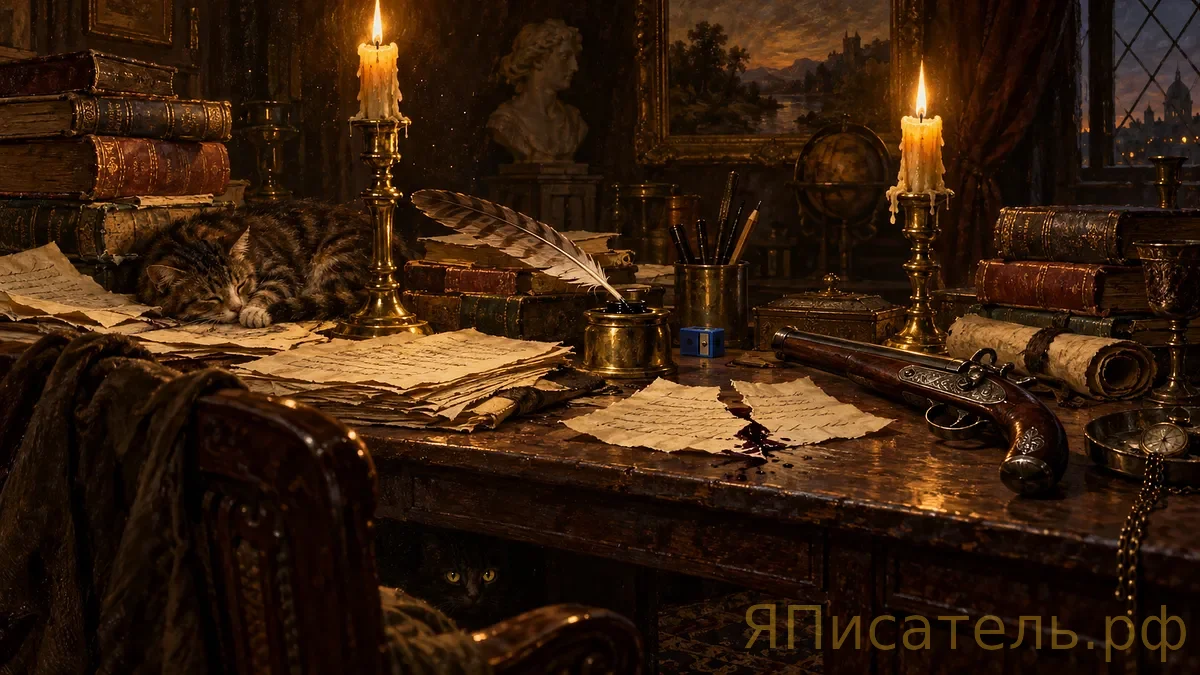
Pushkin Died in a Duel at 37 — And Still Writes Better Than You
On February 10, 1837, Alexander Pushkin bled out on a couch after getting shot in the gut by a French pretty-boy who was flirting with his wife. He was 37. That's younger than most people when they finally start their "I should write a novel" phase. And yet, nearly two centuries later, this man's fingerprints are all over modern literature, opera, film, and even the way Russians think about love, honor, and really bad decisions.
Here's the uncomfortable truth: Pushkin accomplished more in his truncated life than most writers could in three lifetimes with unlimited coffee and noise-canceling headphones. Today marks 189 years since that senseless duel with Georges d'Anthès, and instead of mourning, let's talk about why a guy from the 1820s still matters in 2026 — and why his three masterpieces hit harder now than they probably did back then.
Let's start with *Eugene Onegin*, the "novel in verse" that basically invented the modern Russian literary voice. Picture this: a bored, wealthy young man rejects the love of a sincere country girl named Tatiana, kills his best friend in a duel (Pushkin had a thing for duels, both on and off the page), and then years later realizes he's been an idiot all along. He crawls back to Tatiana, who's now married and powerful, and she essentially tells him to get lost. Sound familiar? It should. This is the blueprint for every romantic plot where the aloof guy realizes too late what he had. From Mr. Darcy to every rom-com where the commitment-phobe has a change of heart at the airport — they all owe Pushkin royalties.
But *Onegin* isn't just a love story. It's a devastating portrait of what happens when intelligence has no purpose. Onegin is smart, cultured, and completely useless. He drifts through life, destroying everything he touches — not out of malice, but out of sheer boredom. Tell me that doesn't describe half the people doom-scrolling through social media right now. Pushkin diagnosed an entire personality disorder two centuries before therapists had a name for it.
Then there's *The Captain's Daughter* — Pushkin's historical novel set during the Pugachev Rebellion of 1773. On the surface, it's an adventure story: young officer gets caught up in a peasant uprising, falls in love, faces execution, gets saved by the rebel leader himself. But underneath, it's a masterclass in moral ambiguity. Pugachev, the rebel, is simultaneously a bloodthirsty impostor and the most honorable character in the book. He spares the hero's life because of a kindness shown to him earlier — a fur coat given during a blizzard. One act of generosity, one coat, and it saves a man's life. Pushkin understood something that modern political discourse has completely forgotten: people are complicated, and your enemy today might be the only one willing to help you tomorrow.
Walter Scott was doing historical novels before Pushkin, sure. But Scott's characters are chess pieces. Pushkin's breathe. *The Captain's Daughter* influenced Tolstoy's approach to history in *War and Peace*, and you can trace a direct line from Pugachev's moral complexity to every antihero in modern television. Tony Soprano, Walter White — they all carry a little Pugachev DNA.
And then we arrive at *The Queen of Spades*, a short story so perfectly constructed it should be illegal. Hermann, a German officer in St. Petersburg, becomes obsessed with a gambling secret supposedly held by an old countess. He terrorizes her into revealing it, she dies of fright, her ghost visits him with the winning combination — three, seven, ace — and when he finally plays, the ace turns into the Queen of Spades, the dead countess's face staring back at him. He goes insane. The end. Forty pages. Absolute devastation.
This story is essentially the first psychological thriller. Dostoevsky read it and basically built his entire career on its foundation. *Crime and Punishment* is *The Queen of Spades* stretched to 500 pages — a man who thinks he can outsmart fate, who reduces other humans to instruments of his ambition, and who discovers that the universe has a wicked sense of humor. Tchaikovsky turned it into an opera. Hollywood has adapted the obsessive-gambler archetype approximately ten thousand times. Every time you watch a movie about someone who "just needs one more score," you're watching Pushkin's ghost deal the cards.
What makes Pushkin genuinely terrifying as a writer is his economy. Modern authors take 800 pages to say what he said in 80. *The Queen of Spades* contains more psychological insight per sentence than most entire novels. *Eugene Onegin* tells a complete life story in verse that reads like music. He didn't pad, didn't ramble, didn't show off — well, he showed off constantly, but he made it look effortless, which is the only kind of showing off that counts.
Here's what really gets me about his legacy, though: Pushkin essentially created the literary Russian language. Before him, serious Russian writing was either imitating French salon culture or drowning in Church Slavonic formality. Pushkin grabbed the living, spoken language of the streets and the salons and the countryside, threw it all in a blender, and produced something new. He did for Russian what Dante did for Italian and what Shakespeare did for English. Every Russian writer who came after — Gogol, Turgenev, Dostoevsky, Tolstoy, Chekhov, Bulgakov — is writing in the language Pushkin built.
And the man did all this while being exiled twice by the tsar, surveilled by secret police, drowning in gambling debts, fighting at least 29 duels (or nearly fighting them — many were called off), and managing a chaotic personal life that would make a reality TV producer weep with joy. He wrote some of the greatest literature in human history while essentially living in a pressure cooker. Most of us can't finish a blog post if the Wi-Fi is slow.
So, 189 years after a bullet fired by a man history barely remembers ended the life of a man history will never forget — what do we do with Pushkin? We read him. Not because he's a dusty monument on a school syllabus, but because he understood something fundamental about human nature: we are all, in our own ways, Onegin — too clever for our own good; Hermann — convinced we can game the system; and the young officer in *The Captain's Daughter* — hoping that one small act of decency will be enough to save us when the world falls apart.
Pushkin died at 37, in agony, on a couch, surrounded by friends who couldn't help him. D'Anthès, the man who killed him, lived to be 83 and died in comfortable obscurity. Life is not fair. But literature is a different kind of justice. And by that measure, Pushkin won the duel after all.
Pega este código en el HTML de tu sitio web para incrustar este contenido.