Pushkin Died 189 Years Ago and We Still Can't Get Over His Ex-Girlfriend Drama
Here's a thought experiment: imagine if the guy who basically invented modern Russian literature got himself killed in a duel over his wife's alleged affair with a French pretty boy. Now stop imagining, because that's exactly what happened on February 10, 1837, when Alexander Pushkin—Russia's Shakespeare, Byron, and Hemingway rolled into one gloriously mustachioed package—took a bullet to the gut and died two days later at age 37.
Today marks 189 years since that spectacularly stupid death, and somehow we're still talking about this man. Not because Russians are sentimental (though they absolutely are), but because Pushkin's work remains so devastatingly modern that reading him feels less like studying classics and more like scrolling through the most eloquent Twitter thread you've ever encountered.
Let's talk about "Eugene Onegin," shall we? This is a novel in verse—yes, an entire novel written in poetry, because apparently Pushkin found prose too easy—about a bored aristocrat who rejects the love of a naive country girl, only to fall desperately for her years later when she's married and successful. Sound familiar? It should. You've seen this plot in every romantic comedy since the invention of cinema. Pushkin didn't just write a love story; he wrote THE love story template that Hollywood has been shamelessly plagiarizing for nearly two centuries. Every "she was right there the whole time" movie owes this man royalties.
But here's what makes Onegin genuinely revolutionary: Pushkin made his hero an absolute tool and expected you to notice. Eugene isn't a misunderstood romantic—he's a privileged snob who destroys everything good in his life through sheer emotional constipation. The narrator constantly interrupts to mock him, to mock society, to mock the very conventions of literature itself. It's postmodern before postmodernism existed. Pushkin was doing meta-commentary in 1833 while everyone else was still figuring out how paragraphs worked.
Then there's "The Captain's Daughter" (Kapitanskaya Dochka), which reads like a historical thriller that someone accidentally wrote 150 years before the genre was invented. Set during the Pugachev Rebellion of the 1770s, it follows a young officer caught between duty and survival during a peasant uprising. Walter Scott was doing similar things in Britain, sure, but Pushkin's version cuts deeper because he refuses to let anyone—not the rebels, not the government, not even his protagonist—off the moral hook. The villain Pugachev is terrifying AND sympathetic. The hero is brave AND naive. Nobody gets to be purely good or purely evil, which was radical stuff in an era when literature still believed in clear-cut morality.
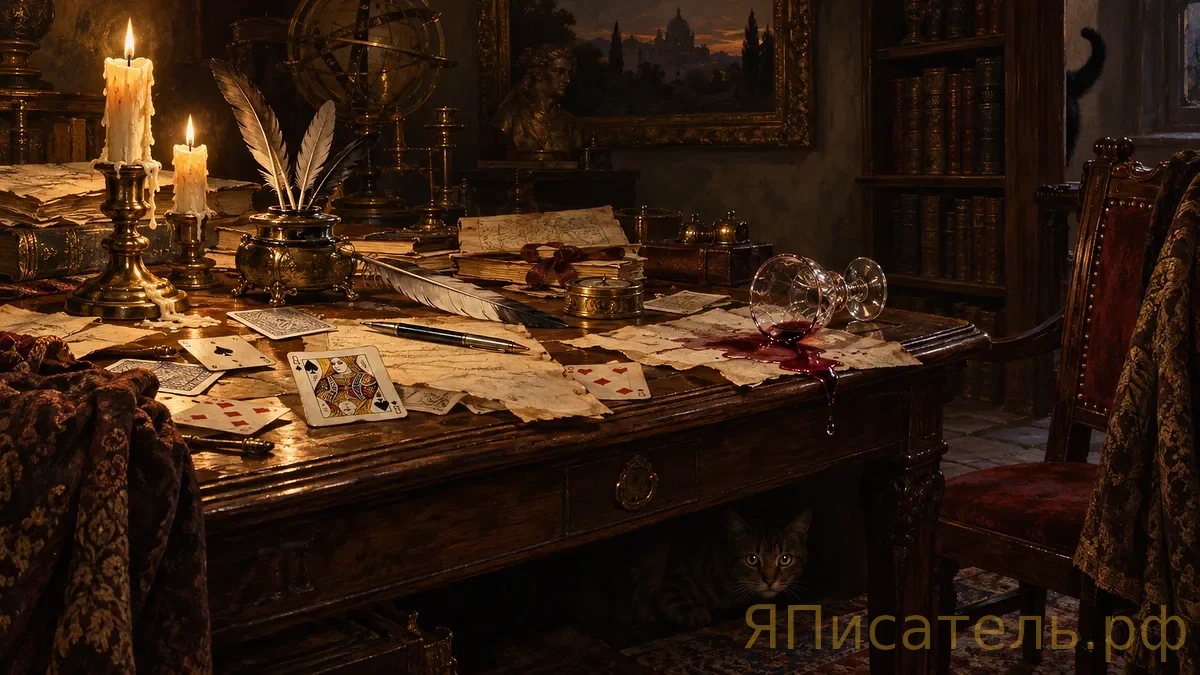
And then, oh then, there's "The Queen of Spades" (Pikovaya Dama). If you haven't read this short story, drop everything and find a copy immediately. It's about a German engineer named Hermann who becomes obsessed with learning the secret of three winning cards from an ancient countess. What follows is a psychological horror story so tight, so perfectly constructed, that Dostoevsky essentially built his entire career trying to replicate its effect. The story asks a simple question: what happens when rationality becomes obsession? The answer involves ghosts, madness, and one of the most chilling final lines in all of literature.
Here's what kills me about Pushkin's legacy: the man essentially created the Russian literary language. Before him, educated Russians wrote in French because Russian was considered too crude for sophisticated expression. Pushkin proved them catastrophically wrong. He took the language of peasants and servants and made it sing. Tolstoy, Dostoevsky, Chekhov, Bulgakov—every titan of Russian literature stands on Pushkin's shoulders, using the tools he forged.
The influence extends far beyond Russia, though. Tchaikovsky turned "Eugene Onegin" and "The Queen of Spades" into operas that remain in constant rotation at major houses worldwide. Mussorgsky set Pushkin's Boris Godunov to music. The Pushkin verse novel format influenced everything from Byron's later work to Vikram Seth's "The Golden Gate." When writers today play with unreliable narrators, fourth-wall breaks, and genre-mixing, they're walking paths Pushkin cleared with a quill pen and an attitude problem.
But let's get real about something uncomfortable: Pushkin was also deeply problematic by modern standards. He was a serial womanizer who treated women as conquests. He held views on race and class that we'd find repugnant today, despite (or perhaps because of) his own African ancestry through his great-grandfather Abram Gannibal. He fought approximately 29 duels, which suggests less romantic honor and more anger management issues. Celebrating Pushkin means grappling with the reality that genius and personal failure often share the same address.
And yet—and yet—his work transcends its creator. When Tatyana writes her letter to Onegin, confessing her love with a vulnerability that still makes readers wince in recognition, that moment belongs to everyone who's ever sent a message they immediately regretted. When Hermann stares at the Queen of Spades on his final card, watching everything crumble, we recognize our own obsessions reflected back. Literature at its best shows us ourselves, and Pushkin held up a mirror so clear that nearly two centuries of dust haven't dimmed it.
So here we are, 189 years after some French officer's bullet ended one of history's most productive literary careers. Pushkin never saw 40. He never got to grow old and boring and write his memoirs about the good old days. Instead, he left us with a body of work so vital, so alive, that students in Moscow and Manhattan alike still fall in love with his characters, still argue about whether Onegin deserved his fate, still shiver at the countess's ghost.
The real legacy isn't in the monuments or the museums or the annual commemorations. It's in every writer who dares to make their narrator unreliable, every novelist who blends poetry with prose, every storyteller who refuses to give audiences the comfortable morality they expect. Pushkin taught literature to be honest about human messiness. For that alone, we'll probably still be talking about him in another 189 years—assuming we haven't dueled ourselves into extinction by then.
Pega este código en el HTML de tu sitio web para incrustar este contenido.