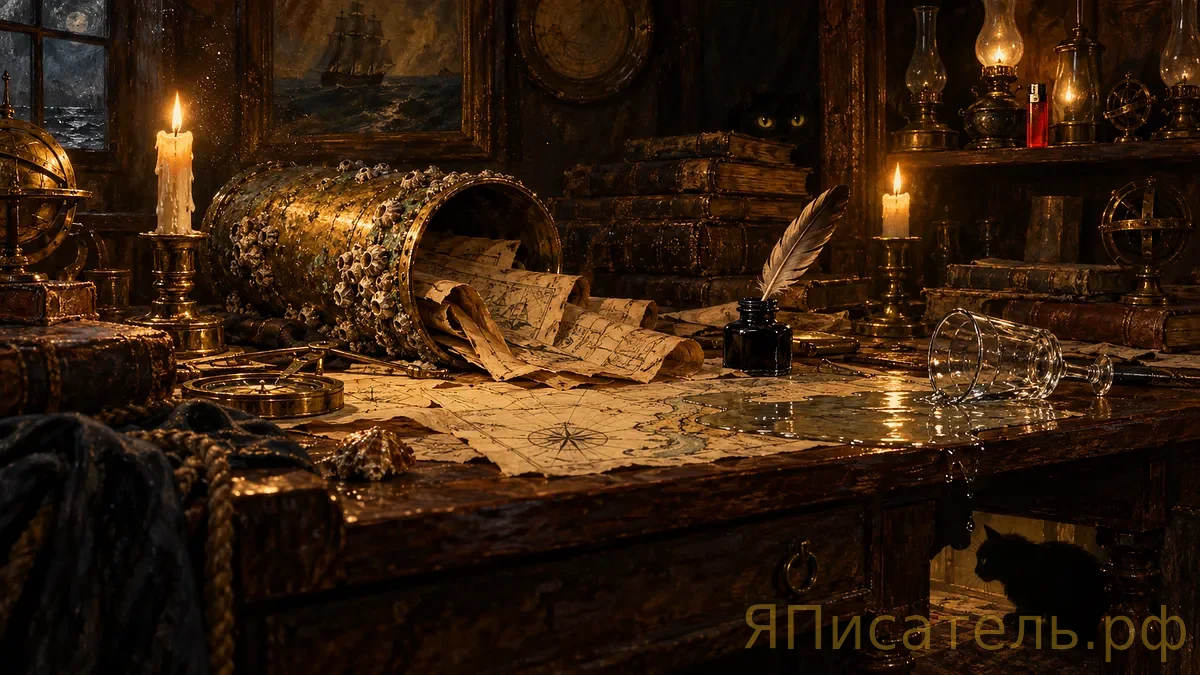
A Norwegian Fisherman's Net Pulled Up a Waterproof Case — Inside Was Knut Hamsun's Lost Novella
In what marine archaeologists are calling the most extraordinary literary find of the decade, a commercial fisherman working the deep waters of Hardangerfjord, Norway, hauled up a sealed brass case containing a complete handwritten novella by Nobel Prize-winning author Knut Hamsun.
The fisherman, 62-year-old Erik Nordahl, initially mistook the barnacle-encrusted cylinder for old naval ordnance and nearly tossed it back. "It was heavy, green with age, and I thought it might be a shell casing from the war," Nordahl told reporters in Bergen. "My grandson said we should open it. Thank God for curious children."
Inside the watertight case — which experts at the Norwegian Maritime Museum have dated to approximately 1905 — lay 187 pages of dense, meticulous handwriting, wrapped in oilcloth and remarkably well-preserved. The manuscript, titled *Havets Stemmer* ("Voices of the Sea"), appears to be a complete novella written during what Hamsun scholars have long referred to as his "silent year" — a twelve-month gap between 1904 and 1905 when the author vanished from public life and left no known correspondence.
Professor Ingrid Solheim of the University of Oslo, who has spent two weeks examining the manuscript under controlled conditions, describes the work as unlike anything in Hamsun's known catalog. "It reads almost like magical realism, sixty years before the term existed," she said. "The protagonist is a lighthouse keeper who begins hearing stories told by the sea itself — stories of drowned sailors, sunken ships, forgotten civilizations. It is lyrical, haunting, and completely at odds with the psychological realism Hamsun was known for at that time."
Handwriting analysis conducted by three independent graphologists has confirmed the manuscript as Hamsun's with a confidence level above 97 percent. Carbon dating of the paper is consistent with early twentieth-century Norwegian manufacture. But the central mystery remains: why did Hamsun seal this work in a brass case and apparently drop it into one of Norway's deepest fjords?
A note found tucked inside the case's lid offers one tantalizing clue. In Hamsun's hand, it reads: "Some stories belong to the water. I return this one."
Scholars are divided. Some believe Hamsun considered the novella too personal to publish, possibly drawing on a traumatic experience during his undocumented year. Others suggest he may have been experimenting with a style he feared would alienate the literary establishment that had embraced his earlier work, *Hunger* and *Mysteries*.
Gyldendal, Hamsun's original Norwegian publisher, has announced plans to release *Havets Stemmer* in a scholarly edition later this year, with translations into English, German, and French to follow. The brass case itself will be exhibited at the National Library of Norway in Oslo beginning in April.
For Erik Nordahl, the discovery has been life-changing in unexpected ways. "I've never read Hamsun," he admitted with a shrug. "But I've started *Hunger* now. I understand why people make a fuss."
The find has reignited interest in Hamsun's literary legacy, which remains complicated by his wartime sympathies. But Professor Solheim insists the novella should be judged on its own merits. "This is a work of extraordinary beauty," she said. "The sea kept it safe for over a century. Now it is time for readers to hear its voices."
Pega este código en el HTML de tu sitio web para incrustar este contenido.