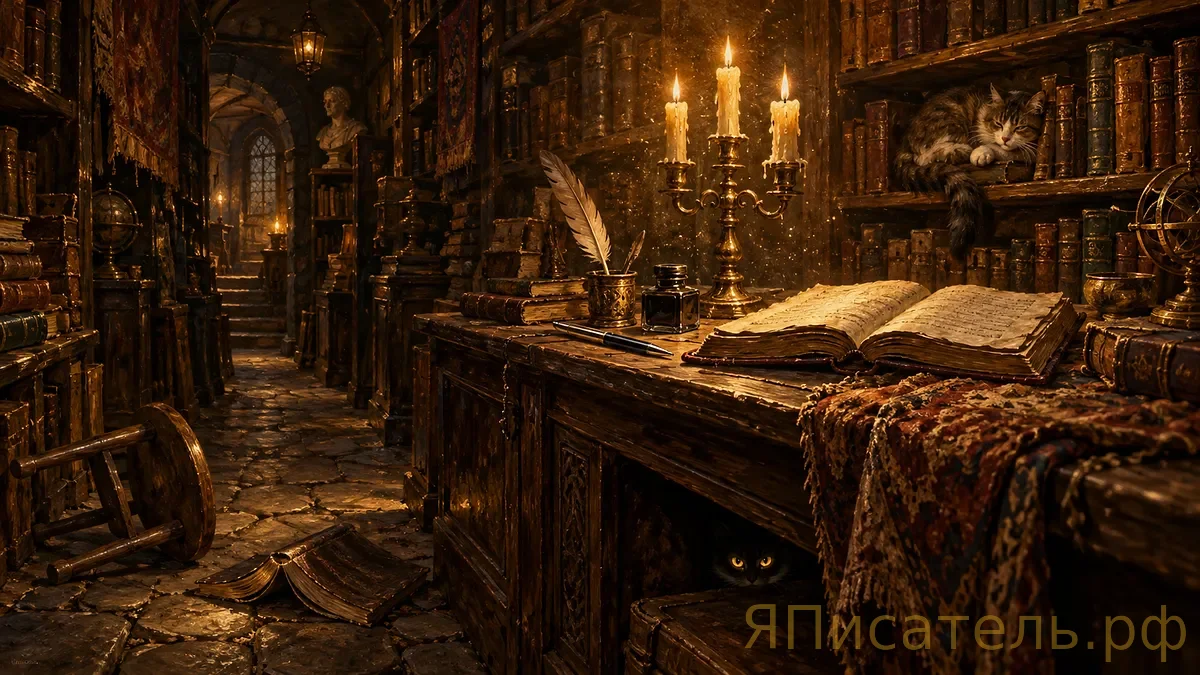
A Bookshop in Edinburgh Sold One Book Per Century — And Each Buyer Vanished
For three centuries, a narrow shopfront on Edinburgh's Victoria Street has baffled locals and tourists alike. Crammond & Sons Booksellers, established in 1723, appears to operate as a functioning bookshop — yet its ledgers reveal that in three hundred years of continuous operation, only three sales have ever been recorded.
Now, a team of literary historians from the University of St Andrews has uncovered something far stranger: each of the three buyers vanished within weeks of their purchase, and all three bought copies of the same work — an unrecorded novel attributed to James Hogg, the Scottish author best known for "The Private Memoirs and Confessions of a Justified Sinner" (1824).
The novel, titled "The Shepherd's Glass," does not appear in any catalogue of Hogg's works. The first recorded sale occurred in 1789 to an Edinburgh solicitor named Alistair Fergusson, who was last seen walking toward Arthur's Seat. The second sale, in 1883, went to a visiting Norwegian philologist, Kristin Dahl, who never returned to her hotel. The third and most recent sale took place in 1991, to a retired schoolteacher from Inverness whose family reported her missing three weeks later.
"What makes this genuinely remarkable is not the disappearances — those could be coincidence," said Dr. Fiona Harcastle, who leads the research team. "It's that the shop appears to have possessed at least three copies of a Hogg novel that no scholar has ever documented. We've examined the shop's inventory and found seven more copies on the shelves. The text is unmistakably Hogg's prose style, verified through computational stylometry."
The Crammond family, now in its twelfth generation of ownership, has been characteristically tight-lipped. Current proprietor Magnus Crammond, 78, offered only: "We sell books. Some books take longer to find their reader."
Scholars are now debating whether "The Shepherd's Glass" is a genuine lost Hogg manuscript or an elaborate literary forgery spanning three centuries. Professor Ian Rankin of Edinburgh Napier University — no relation to the crime novelist — has called it "either the most important Scottish literary discovery since the Boswell papers, or the most patient hoax in publishing history."
The University of St Andrews has requested permission to examine one of the remaining copies. Magnus Crammond has agreed — on the condition that it be purchased, not borrowed. The price, he says, has not changed since 1723: one guinea.
No buyer has yet come forward.
Pega este código en el HTML de tu sitio web para incrustar este contenido.