THE ROMANCE OF TRISTAN AND ISEULT
Vista Previa del Libro
Autor
Bédier, Joseph
Género
Portada del Libro
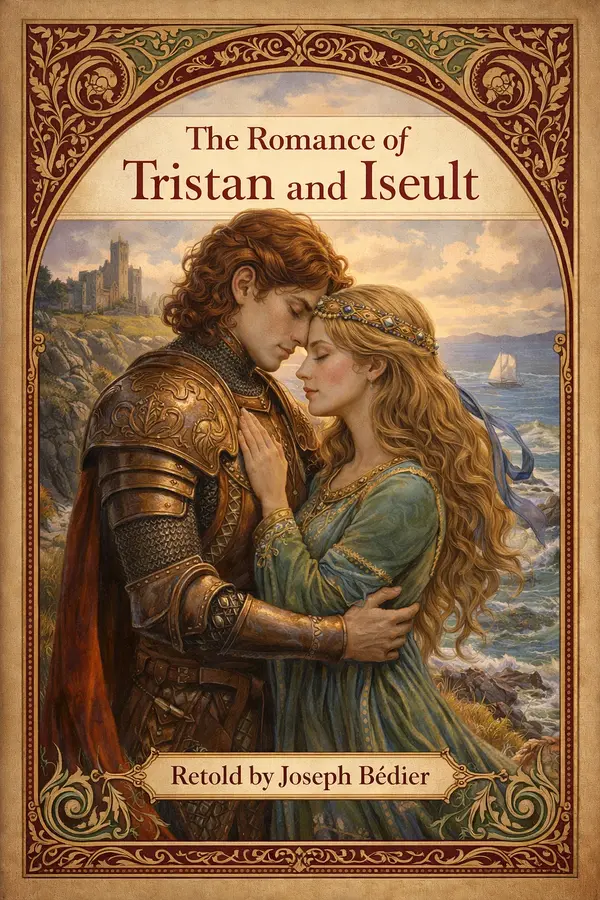
Resumen General del Libro
The Romance of Tristan and Iseult is a medieval tale of tragic love, retold by Joseph Bédier from the best French sources and rendered into English by Hilaire Belloc. The story follows Tristan, the orphaned son of King Rivalen and Blanchefleur (sister of King Mark of Cornwall), who is raised in secret by the loyal marshal Rohalt after his parents' deaths. Tristan grows into a accomplished knight, skilled in arms, music, and hunting. He arrives at his uncle King Mark's court in Cornwall, where he wins favor through his talents. When the Irish champion Morholt demands tribute of Cornish youths and maidens, Tristan defeats him in single combat but receives a poisoned wound. He travels to Ireland for healing, where he is cured by Queen Iseult and her daughter, Iseult the Fair. Later, Tristan returns to Ireland to win Iseult the Fair as a bride for King Mark. He slays a dragon terrorizing the land and claims the princess. On the voyage back to Cornwall, Tristan and Iseult accidentally drink a love potion intended for Iseult and Mark on their wedding night. This magical draught binds them in an irresistible, eternal love. Though Iseult marries King Mark, she and Tristan cannot resist their passion. Their secret affair is suspected by jealous barons who seek to expose them. The lovers flee to the forest of Morois, living as outlaws until King Mark discovers them sleeping with a sword between them and shows mercy. Iseult returns to Mark after proving her innocence through a cleverly worded oath and ordeal by hot iron. Tristan is exiled and eventually settles in Brittany, where he marries another woman named Iseult of the White Hands, though he never consummates the marriage due to his undying love for Iseult the Fair. When Tristan is mortally wounded by a poisoned spear, he sends for Iseult the Fair, instructing the messenger to raise a white sail if she comes, black if not. Iseult rushes to him, but his jealous wife lies about the sail's color. Tristan dies of grief, and when Iseult the Fair arrives and finds him dead, she lies beside him and dies of sorrow. King Mark buries them together, and a briar grows from Tristan's grave to root itself in Iseult's, symbolizing their love that transcends death.
Tabla de Contenidos
Este libro ha sido revisado
Lee la reseña profesional de este libro
Extracto del Libro
THE ROMANCE OF TRISTAN AND ISEULT
Retold by J. Bédier, rendered into English by H. Belloc
PART THE FIRST
THE CHILDHOOD OF TRISTAN
My lords, if you would hear a high tale of love and of death, here is that of Tristan and Queen Iseult; how to their full joy, but to their sorrow also, they loved each other, and how at last they died of that love together upon one day; she by him and he by her.
Long ago, when Mark was King over Cornwall, Rivalen, King of Lyonesse, heard that Mark’s enemies waged war on him; so he crossed the sea to bring him aid; and so faithfully did he serve him with counsel and sword that Mark gave him his sister Blanchefleur, whom King Rivalen loved most marvellously.
He wedded her in Tintagel Minster, but hardly was she wed when the news came to him that his old enemy Duke Morgan had fallen on Lyonesse and was wasting town and field. Then Rivalen manned his ships in haste, and took Blanchefleur with him to his far land; but she was with child. He landed below his castle of Kanoël and gave the Queen in ward to his Marshal Rohalt, and after that set off to wage his war.
Blanchefleur waited for him continually, but he did not come home, till she learnt upon a day that Duke Morgan had killed him in foul ambush. She did not weep: she made no cry or lamentation, but her limbs failed her and grew weak, and her soul was filled with a strong desire to be rid of the flesh, and though Rohalt tried to soothe her she would not hear. Three days she awaited re-union with her lord, and on the fourth she brought forth a son; and taking him in her arms she said:
“Little son, I have longed a while to see you, and now I see you the fairest thing ever a woman bore. In sadness came I hither, in sadness did I bring forth, and in sadness has your first feast day gone. And as by sadness you came into the world, your name shall be called Tristan; that is the child of sadness.”
After she had said these words she kissed him, and immediately when she had kissed him she died.
Rohalt, the keeper of faith, took the child, but already Duke Morgan’s men besieged the Castle of Kanoël all round about. There is a wise saying: “Fool-hardy was never hardy,” and he was compelled to yield to Duke Morgan at his mercy: but for fear that Morgan might slay Rivalen’s heir the Marshal hid him among his own sons.
When seven years were passed and the time had come to take the...
¿Listo para Leer Más?
Descubre la historia completa y todos los capítulos
Ya disponible en nuestra tienda