Tip Feb 6, 09:16 AM

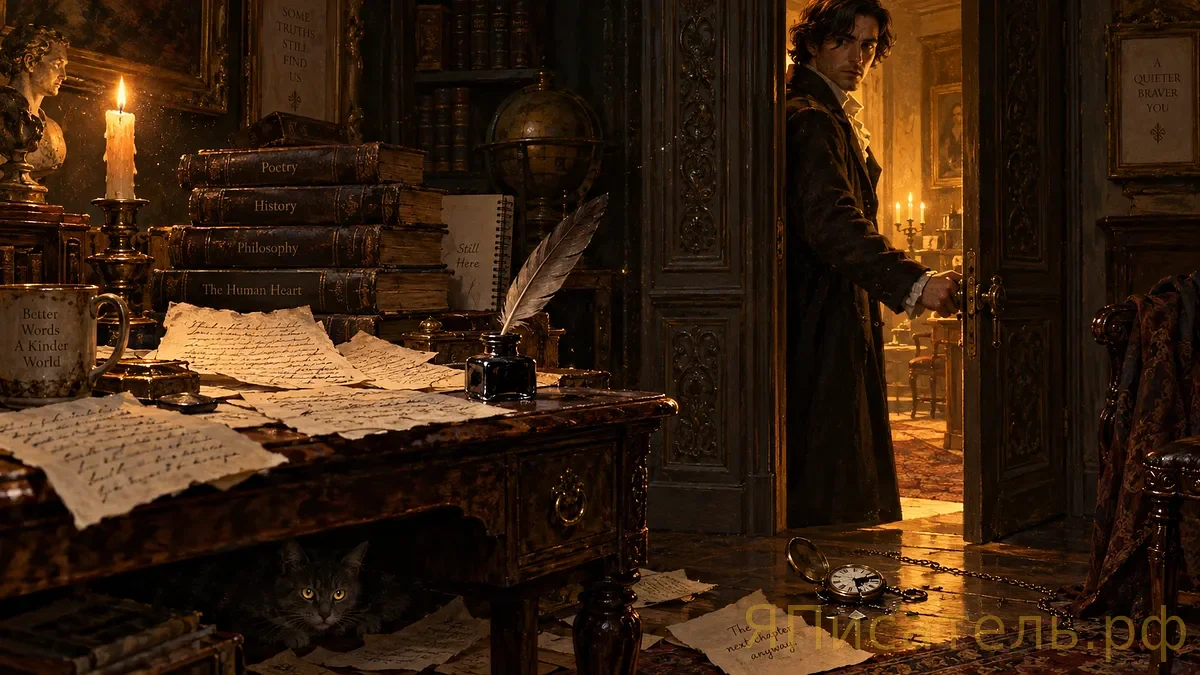
The Betraying Threshold: Use Doorways to Force Decisions

The threshold technique taps into something primal in human psychology. Anthropologists call it 'liminal space'—the in-between zone where transformation occurs. Wedding ceremonies, graduation stages, and courtroom entrances all use physical thresholds to mark the moment when someone becomes fundamentally different.

In your fiction, map your character's internal journey onto physical spaces. When they're about to confess love, betray a friend, or accept a dangerous mission, don't let them do it in the middle of a room. Move them to the edge. Make them cross something.

The technique is especially powerful for reluctant heroes. In John le Carré's 'The Spy Who Came in from the Cold,' Alec Leamas repeatedly crosses borders—each checkpoint representing a deeper moral compromise. The Berlin Wall isn't just setting; it's the physical manifestation of his impossible choice.

For maximum impact, have your character look back after crossing. What they see—or can no longer see—crystallizes what they've just sacrificed. The door closing behind them, the bridge disappearing in fog, the gate locking—these images haunt readers because they understand, viscerally, that some thresholds only allow one-way passage.

1x

Comments (0)

No comments yet

Sign up to leave comments

Read Also

The Weighted Silence: Make What Characters Don't Say Louder Than Dialogue
Tip
about 7 hours ago

The Weighted Silence: Make What Characters Don't Say Louder Than Dialogue

Master the art of meaningful omission. When characters deliberately avoid mentioning something obvious, that silence creates more tension than any spoken word. Have them talk around the issue while readers feel pressure building. When two estranged brothers meet after their father's funeral, don't have them argue about inheritance. Have them discuss weather, catering quality, parking spaces—anything except what matters. Each mundane exchange becomes charged with unspoken grief. Plant 'pressure leaks'—moments where the suppressed topic almost surfaces. A pause too long, a sentence trailing off, a sudden subject change. These micro-fractures signal something important beneath the surface.

0
0
The Contradictory Detail: Make Characters Want Two Things at Once
Tip
about 14 hours ago

The Contradictory Detail: Make Characters Want Two Things at Once

Give your characters simultaneous, incompatible desires within the same scene. A mother watching her child leave for danger feels proud and terrified, wanting to pull them back and push them forward in the same breath. The key is specificity: show it through action. The character reaches for the door handle, then adjusts the traveler's collar instead. They say 'be careful' when they mean 'don't go' and 'I believe in you' simultaneously. This transforms passive emotional scenes into dynamic ones. Avoid resolving the contradiction quickly. Let the reader feel the discomfort of wanting two impossible things. This mirrors real human experience far more accurately than clean, single-minded motivation.

0
0
The Interrupted Action: Break Scenes at Points of Maximum Tension
Tip
1 day ago

The Interrupted Action: Break Scenes at Points of Maximum Tension

Instead of resolving a tense moment completely before moving to the next scene, cut away precisely when tension peaks. Leave your reader mid-breath. Ernest Hemingway mastered this in 'The Sun Also Rises,' ending chapters on unfinished conversations. This technique works because the human brain craves closure. When denied it, readers mentally continue the scene themselves, becoming active participants. They'll turn pages faster and remember interrupted moments with unusual clarity. Practical application: Find your three most dramatic scenes. Mark where tension peaks. Move your scene break three to five sentences earlier, before resolution begins. If readers complain about the cutaway, you've found the right spot.

0
0
How to Write Sex Scenes Without Looking Like an Idiot: A Brutally Honest Guide
Article
33 minutes ago

How to Write Sex Scenes Without Looking Like an Idiot: A Brutally Honest Guide

Every year, the Literary Review hands out the Bad Sex in Fiction Award, and every year, established authors line up to collect their trophy of shame. Norman Mailer won it. John Updike got nominated. Even Sebastian Faulks took home the dubious honor. These aren't amateurs—they're literary giants who somehow forgot how to write the moment clothes started coming off. So what's the secret? How do you write about the most universal human experience without sounding like a Victorian medical textbook crossed with a teenager's diary?

0
0
Iris Murdoch Died 27 Years Ago, and We Still Haven't Figured Out What She Was Telling Us
Article
37 minutes ago

Iris Murdoch Died 27 Years Ago, and We Still Haven't Figured Out What She Was Telling Us

Here's a confession that might get me banned from literary circles: I didn't understand Iris Murdoch the first time I read her. Or the second. It took me three attempts at 'The Sea, the Sea' before I stopped throwing it across the room in frustration and started seeing what all the fuss was about. And that, my friends, is precisely the point. Twenty-seven years ago today, on February 8, 1999, one of the most brilliantly infuriating minds in twentieth-century literature went silent. Dame Iris Murdoch, philosopher-turned-novelist, left us with twenty-six novels, a handful of plays, and enough moral philosophy to give Immanuel Kant a migraine.

0
0
AI Wrote a Bestseller — What Have You Been Doing With Your Life?
Article
37 minutes ago

AI Wrote a Bestseller — What Have You Been Doing With Your Life?

In November 2023, a book called "Artificial Minds" hit Amazon's bestseller list. Nothing unusual, except the author didn't exist. The entire novel — 280 pages of surprisingly decent prose — was generated by GPT-4 in about six hours. Meanwhile, you've been staring at chapter one of your masterpiece for three years, rearranging the same sentence about autumn leaves. Let's be brutally honest here: the machines have arrived at the literary party, and they didn't even bother to knock.

0
0

"Writing is thinking. To write well is to think clearly." — Isaac Asimov