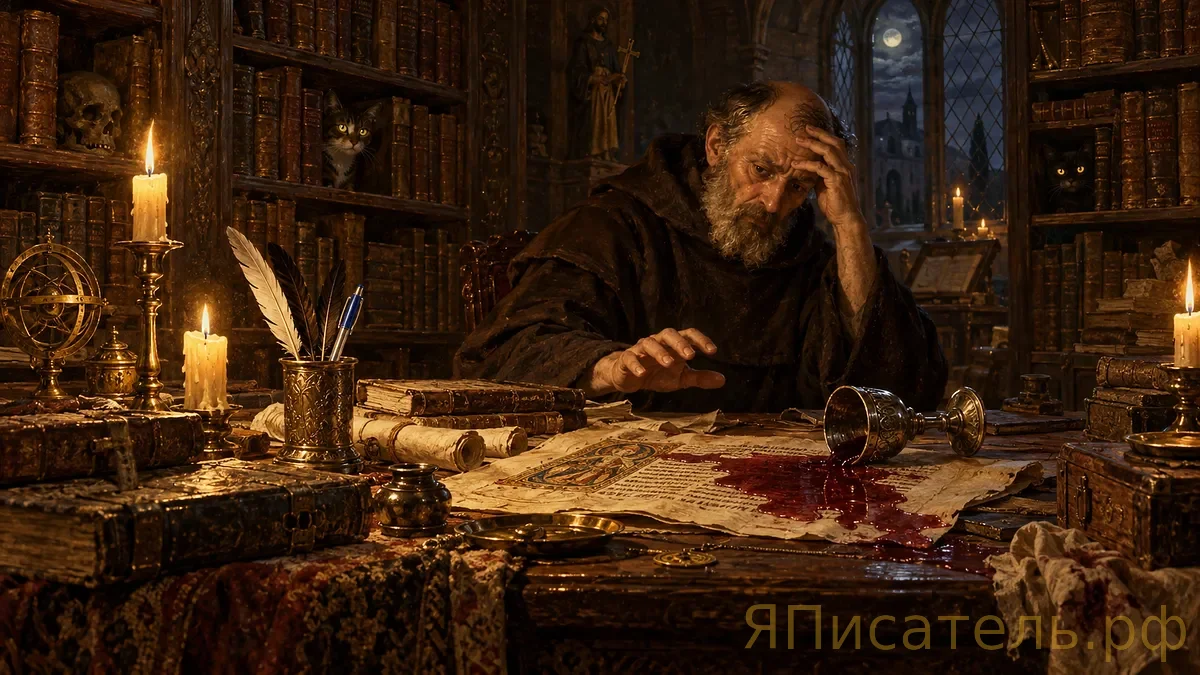
Umberto Eco Predicted TikTok Conspiracies — In 1988
Ten years ago today, on February 19, 2016, the world lost Umberto Eco — a man who wrote a medieval murder mystery so dense it required a dictionary and still sold fifty million copies. If that isn't the greatest intellectual prank of the twentieth century, I don't know what is.
But here's the thing about Eco that most obituaries got wrong: he wasn't primarily a novelist. He was a semiotician — a professional decoder of signs and symbols — who happened to write novels that read like the fever dreams of a librarian on absinthe. He published his first novel, The Name of the Rose, at the age of forty-eight. Before that, he'd spent decades writing about comic books, James Bond, and the structure of television — basically doing cultural criticism before it was a whole industry on YouTube.
Let's talk about The Name of the Rose for a moment, because its existence is borderline miraculous. Published in 1980, it's a murder mystery set in a fourteenth-century Benedictine monastery. The detective is a Franciscan friar named William of Baskerville — yes, that's a Sherlock Holmes reference, and no, Eco didn't care if you noticed. The book includes untranslated Latin passages, theological debates about whether Jesus laughed, and a labyrinthine library that functions as both a literal and metaphorical maze. It should have sold about three thousand copies to Italian medievalists. Instead, it sold over fifty million worldwide and got turned into a Sean Connery movie. Eco later said he wrote it because he "felt like poisoning a monk." That's the energy we've lost.
Then came Foucault's Pendulum in 1988, and this is where Eco becomes genuinely prophetic. The plot follows three bored editors at a vanity press who, as a joke, invent a grand conspiracy theory connecting the Knights Templar, the Rosicrucians, the Freemasons, and basically every secret society you've ever heard of. They feed random historical data into a computer and let it generate connections. The joke? People start believing it. The conspiracy takes on a life of its own and eventually devours its creators.
Read that paragraph again and tell me Eco didn't predict the internet. Specifically, he predicted QAnon, flat-earthers, and every rabbit hole algorithm that's ever sucked someone into believing the moon landing was filmed in Stanley Kubrick's garage. Foucault's Pendulum is essentially a novel about what happens when ironic people create content they don't believe in, and the content escapes into the wild. Sound familiar? Every satirical conspiracy meme that gets unironically shared on Facebook is living proof that Eco was right. He wrote the playbook for the post-truth era thirty years before anyone coined the term.
What made Eco different from your standard ivory-tower intellectual was his absolute refusal to be a snob. This was a man who collected sixty thousand books — his personal library was legendary — and simultaneously wrote serious academic essays about Superman. He analyzed the semiotics of blue jeans. He gave lectures on the philosophy of lists. He once wrote an essay arguing that the Mac was Catholic and the PC was Protestant, and honestly, he made it convincing. He believed that pop culture deserved the same analytical rigor as Dante, and he practiced what he preached.
His famous 2015 quote about social media — that it "gives legions of idiots the right to speak" — got him dragged online, which is exactly the kind of irony he would have appreciated. But people always cut the quote short. He wasn't saying people shouldn't speak. He was saying that before the internet, "the village idiot" spoke at the bar and was immediately corrected. Now, that corrective mechanism is gone. The village idiots found each other, formed communities, and started podcasts. Again: prophetic.
Eco's influence today isn't always visible on the surface, but it's everywhere underneath. Every novel that plays with layered narratives and unreliable narrators owes him a debt. Every TV show that trusts its audience to be smart — from True Detective's occult references to the labyrinthine plotting of Dark — is operating in territory Eco mapped. Dan Brown essentially built his entire career on a dumbed-down version of Foucault's Pendulum, something Eco handled with characteristic grace, saying he'd been told Brown was his reader. "My reader," Eco said, with the kind of pause that Italian professors have weaponized for centuries.
But maybe his most lasting contribution is as a model for what an intellectual can be. We live in an era that's deeply suspicious of experts, and for good reason — too many of them hide behind jargon and act as gatekeepers. Eco was the anti-gatekeeper. He wanted you to come inside the library. He just wanted you to understand that the library might be a labyrinth, and that the labyrinth might be on fire, and that the fire might be the point. He made difficulty seductive rather than exclusionary.
There's a scene near the end of The Name of the Rose where the great library burns. Everything — centuries of accumulated knowledge, irreplaceable manuscripts, the collected wisdom of the ancient world — goes up in flames because one fanatical monk decided that a single book by Aristotle on comedy was too dangerous for humanity to read. A book about laughter, destroyed by a man who couldn't tolerate laughter. If that's not the most Eco metaphor possible for every book ban, every censorship campaign, every attempt to control what people think by controlling what they can access, then I don't know what metaphor is.
Ten years after his death, Umberto Eco's central warning is more relevant than ever: beware of anyone who tells you there's a hidden pattern that explains everything. And simultaneously, beware of anyone who tells you that patterns don't exist at all. The truth, as William of Baskerville might say while adjusting his anachronistic reading glasses, is that the universe is full of patterns — it's just that most of the ones we see are ones we put there ourselves. That's not a comfortable thought. But comfort was never really Eco's department.
将此代码粘贴到您网站的HTML中以嵌入此内容。