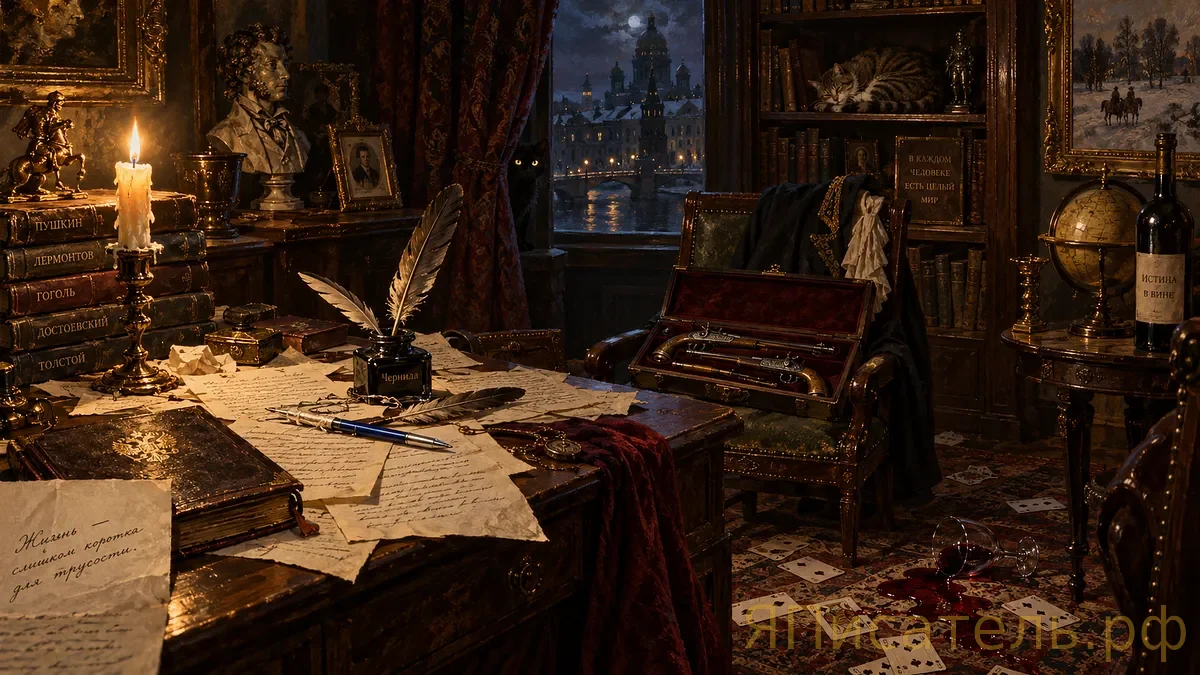
The Duel That Killed Russia's Greatest Poet But Couldn't Touch His Words: Why Pushkin Still Haunts Us 189 Years Later
On February 10th, 1837, a 37-year-old man with wild curly hair and African heritage lay dying from a gunshot wound to the abdomen. He had just lost a duel to a French military officer who was sleeping with his wife. That man was Alexander Pushkin, and Russia has never quite recovered from his death. Here we are, 189 years later, still obsessing over his verse like it's some kind of cultural religion—and honestly, maybe it is.
Let's get one thing straight: calling Pushkin "the Shakespeare of Russia" is both accurate and deeply insulting to the man. Shakespeare wrote in a language that already had Chaucer and Marlowe behind it. Pushkin essentially invented modern Russian literature from scratch, like some linguistic mad scientist who decided that Russian deserved to be beautiful. Before him, Russian literary language was this stiff, Church Slavonic-infected thing that nobody actually spoke. Pushkin grabbed it by the collar, dragged it into the 19th century, and made it dance.
Take 'Eugene Onegin'—a novel in verse that somehow manages to be a love story, a social satire, a philosophical meditation, and a comedy all at once. The plot sounds like something from a soap opera: bored aristocrat rejects innocent country girl, she grows up to become a sophisticated society woman, he falls desperately in love with her, she rejects him. Done. But the way Pushkin tells it—with that lilting, conversational tone, those devastating one-liners, those digressions about everything from ballet to champagne—transforms melodrama into something that feels uncomfortably true. Every Russian has met an Onegin: that guy who's too clever for his own good, too cynical to love, too proud to admit he's hollow inside. Hell, most of us have been Onegin at some point.
And here's the kicker: 'Eugene Onegin' basically invented the "superfluous man" archetype that would haunt Russian literature for the next two centuries. Lermontov's Pechorin, Turgenev's Rudin, Dostoevsky's underground man—they're all Onegin's bastard children. Even today, when we encounter someone who's intelligent, charming, and completely incapable of meaningful human connection, we're essentially describing Pushkin's creation. The man wrote a character so perfectly that he became a permanent fixture of the human psyche.
But if 'Onegin' is Pushkin at his most playful, 'The Captain's Daughter' shows him at his most deceptively simple. On the surface, it's a historical adventure novel about a young officer during the Pugachev Rebellion of the 1770s. Battles, romance, narrow escapes—standard stuff. But Pushkin does something sneaky: he makes Pugachev, the rebel leader who's technically the villain, into the most compelling character in the book. This illiterate Cossack pretending to be a dead tsar becomes a figure of terrifying charisma and strange honor. He's brutal, he's ridiculous, and yet there's something almost noble about him. Pushkin was essentially asking: what makes a legitimate ruler? Is it blood, power, or something else entirely? For a writer living under Tsar Nicholas I, this was playing with dynamite.
Then there's 'The Queen of Spades,' which might be the most influential short story in Russian literature. It's a ghost story about gambling, obsession, and whether the supernatural even matters when human greed is horrifying enough on its own. Hermann, the protagonist, is obsessed with discovering a secret formula for winning at cards. He manipulates, stalks, and ultimately terrorizes an old countess to death for this secret. When her ghost appears and gives him three winning cards, we're left wondering: is this supernatural revenge, or has Hermann simply gone mad from his own obsession? Dostoevsky would later take this theme and run with it all the way to 'Crime and Punishment.' Tchaikovsky turned it into an opera. Modern writers from Nabokov to Bulgakov have paid homage to it. The story is only about 30 pages long, and it's shaped an entire tradition.
What makes Pushkin still relevant isn't just his influence on other writers—it's that his observations about human nature remain devastatingly accurate. When Onegin dismisses Tatiana's love letter with a condescending lecture about how she'll get over it and find someone more suitable, haven't we all either delivered or received that speech? When Hermann convinces himself that the ends justify his increasingly horrible means, aren't we watching the birth of every tech bro and crypto fraudster who ever existed? When the narrator of 'The Queen of Spades' reports that Hermann went mad but "now sits at the Obukhov Hospital in Ward Number 17, never answering questions, but muttering with unusual rapidity: 'Three, seven, ace! Three, seven, queen!'"—that image of obsession crystallized into insanity feels more contemporary than most things written last week.
Pushkin also understood something that many writers still don't: brevity isn't just the soul of wit, it's the soul of art. His complete works fit into about ten volumes. Compare that to Tolstoy's doorstop-sized novels or Dostoevsky's psychological marathons. Pushkin could accomplish in a single stanza what others needed chapters to achieve. There's a famous anecdote about a reader who complained that 'Onegin' was too short. Pushkin's response: "The reader is always right, but not when he's wrong." That's the man in a nutshell—charming, arrogant, and absolutely correct.
The manner of his death only amplified his legend. Dying in a duel over his wife's honor at 37, just as his powers were reaching their peak—it's the kind of romantic tragedy that seems designed by a novelist. D'Anthès, the man who killed him, lived until 1895 and was universally despised. Pushkin's body was secretly transported to a monastery for burial to prevent demonstrations. The government was terrified of what his funeral might spark. They were right to worry: Pushkin's death became a rallying cry for literary freedom, a martyr's tale that energized generations of Russian writers.
So here's the uncomfortable truth: Pushkin matters because he's not dead. Not in any meaningful sense. His words are still being quoted at Russian weddings, his stories are still being adapted into films and operas, his innovations in language are still embedded in how Russians think and speak. Every time someone describes a cynical intellectual who can't commit, they're channeling Onegin. Every time someone writes a twist ending about gambling and madness, they're standing in Pushkin's shadow. Every time someone tries to write poetry that sounds like actual human speech rather than elevated rhetoric, they're following the path he blazed.
One hundred eighty-nine years after a bullet tore through his intestines on a frozen St. Petersburg afternoon, Alexander Pushkin remains inescapable. That's not just legacy—that's literary immortality. And if you've never read him, you're missing out on conversations that humanity has been having for two centuries. The duel may have killed the man, but it couldn't touch the words. D'Anthès might have won on that snowy field, but Pushkin won everywhere else, forever.
将此代码粘贴到您网站的HTML中以嵌入此内容。