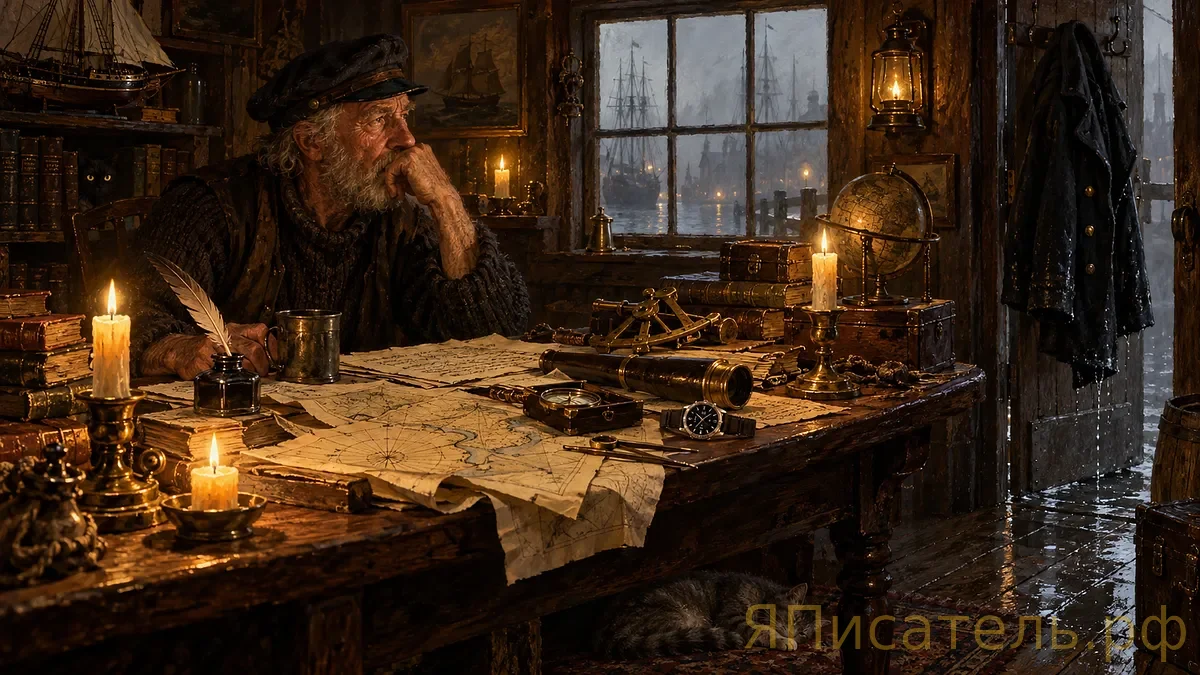
The Depths Speak Yet: An Epilogue to the Pequod's Voyage
经典作品的创意续写
这是受Herman Melville的《Moby Dick; or, The Whale》启发的艺术幻想。如果作者决定延续故事,情节会如何发展?
原文摘录
The drama's done. Why then here does any one step forth?—Because one did survive the wreck. It was the devious-cruising Rachel, that in her retracing search after her missing children, only found another orphan.
续写
The drama's done. Why then here does any one step forth?—Because one did survive the wreck. It was the devious-cruising Rachel, that in her retracing search after her missing children, only found another orphan. Thus was I drawn from the sea, clinging to that coffin life-buoy which had once been meant for Queequeg, my savage friend whose spirit perhaps guided it to bear me up when all else had gone down into the vortex.
For three days I lay in fever upon the Rachel's deck, and in my delirium I saw again the white phantom rising from the deep, saw Ahab's arm beckoning from the hemp entanglements, saw the Pequod spiral downward like a wounded gull. The sailors thought me mad, and perhaps I was—perhaps I am still. For what is madness but the mind's attempt to comprehend that which defies all mortal understanding?
Captain Gardiner himself attended to my recovery, though his own grief was such as might have excused any neglect. His lost son—that boy of twelve whom he had sought so desperately—was never found. The sea had claimed him as surely as it had claimed all my shipmates, and in Gardiner's hollow eyes I saw reflected my own survivor's guilt, that peculiar torment of those who live when others perish.
"You were of the Pequod," he said to me on the fourth morning, when the fever had broken and I could sit upright upon a coil of rope. It was not a question.
"I was," said I. "Ishmael, formerly of Manhattan, now of nowhere in particular."
"And Ahab?"
"Gone down with his vengeance. The whale took him at the last—or he took himself to the whale. In truth, I cannot say which pursued which into that final embrace."
Gardiner was silent for a long moment. The Rachel creaked and groaned around us, her timbers speaking that ancient language of ships which only sailors understand. Above, the canvas bellied with a following wind, carrying us eastward, homeward, toward that civilization which now seemed to me as foreign and fantastical as any cannibal isle.
"I met Ahab once," Gardiner said at length. "Years ago, in Nantucket, before his first encounter with the white whale. He was different then—still proud, still driven, but there was warmth in him yet. He spoke of his young wife with such tenderness as I have rarely witnessed in any man."
"I saw that wife," I replied, "or rather, I saw her shadow pass across his face in rare unguarded moments. She haunted him even as the whale did, though in a gentler fashion. Two ghosts competing for possession of one tormented soul."
The Rachel bore me homeward across leagues of that same ocean which had swallowed my companions. Each night I stood at the taffrail and gazed into the phosphorescent wake, half-expecting to see Queequeg's tattooed face rise from the depths, or Starbuck's steady eyes, or even Ahab himself, still lashed to the whale's flank, still shaking his fist at an indifferent heaven. But the sea kept its secrets, as it always does, and showed me only the cold glitter of stars reflected in black water.
It was during these night watches that I began to write—first in my mind, where the words arranged themselves into something like prayer or confession, and later upon paper which the Rachel's mate kindly provided. I wrote of Ahab and his monomania, of Queequeg's noble savagery, of Starbuck's doomed conscience, of Stubb's gallows humor and Flask's simple courage. I wrote of the whale itself, that "grand hooded phantom," as I came to call it, swimming through my dreams and my waking hours alike.
But what was the whale? This question tormented me more than any other. Was it merely a brute beast, an "unexampled, intelligent malignity," as Ahab believed? Or was it something else entirely—a symbol, perhaps, of that ultimate blankness which terrifies us most? The whale was white, colorless, void of all chromatic character, and yet in that very absence of color lay its deepest horror. For what is whiteness but the visible absence of all things? What is the whale but nature itself, stripped of all the comfortable illusions by which we render it comprehensible?
I posed these questions to Gardiner one evening as we sat in his cabin, sharing a bottle of Madeira which he had been saving for his son's homecoming. The wine tasted of grief, but we drank it nonetheless.
"You think too much, young man," Gardiner said, not unkindly. "The whale is a whale. It killed your captain and your shipmates because that is what whales do when men pursue them with harpoons. There is no mystery in it, no cosmic meaning. Only the brute facts of the hunt."
"Perhaps you are right," I allowed. "And yet I cannot help but feel that in witnessing Ahab's destruction, I witnessed something larger—some eternal conflict between the human will and the forces arrayed against it. Ahab sought to strike through the mask, to pierce the visible world and reach whatever lies beyond. He failed, of course. But was his failure not more magnificent than most men's successes?"
Gardiner shook his head. "Magnificent? He led thirty men to their deaths in pursuit of a private grievance. He abandoned my son—my only son—to the sea rather than pause in his chase. Where is the magnificence in that?"
I had no answer. The truth was that I both admired and despised Ahab—admired his iron will, his refusal to yield before an uncaring universe, and yet despised the cruelty which that same will engendered. He was a great man and a terrible one, and in the end, I could not separate these qualities. Perhaps they were, in Ahab at least, the same quality viewed from different angles.
We made port in New Bedford on a gray November morning, the town shrouded in that peculiar New England mist which seems to emanate from the very stones. I had no money, no possessions save the clothes upon my back and the sheaf of papers upon which I had been writing. Gardiner pressed a few coins into my hand and wished me well, and I saw in his eyes that he was already preparing to face his wife with the news of their son's loss.
"What will you do now?" he asked.
"I shall write," I said. "I shall set down everything I saw and heard and felt aboard the Pequod, and perhaps in the writing I shall come to understand it. Or perhaps not. Perhaps understanding is not the point."
"What is the point, then?"
I considered the question as the mist swirled around us and the gulls cried their desolate cries overhead. "Witness," I said at last. "Someone must witness. Someone must remember. That is my task now—to remember the Pequod and all who sailed in her, to give their deaths whatever meaning words can provide."
I walked into New Bedford alone, a ghost among the living. The townspeople hurried past me on their quotidian errands, buying and selling, talking and laughing, utterly ignorant of the drama which had played out upon the waters they could see from their doorsteps. How strange, I thought, that such tremendous events should occur so near to ordinary life and yet remain so utterly separate from it. The whale might rise from the deep this very moment, might surface in New Bedford harbor itself, and these good citizens would scatter in confusion, unable to comprehend what they were seeing.
But the whale did not rise. The whale, I slowly came to understand, had no need to rise. It was already present—in the fog, in the cold, in the indifferent faces of strangers, in the silence between heartbeats. The whale was everywhere and nowhere, as all true terrors are.
I found lodgings in a cheap boarding house and began to write in earnest. The words poured from me like blood from a wound, unstoppable, uncontainable. I wrote of the Spouter-Inn and my first meeting with Queequeg. I wrote of Father Mapple's sermon and the Pequod's departure. I wrote of the masthead and the quarter-deck, of Fedallah's prophecies and Pip's madness, of the chase itself in all its terrible glory. And as I wrote, I felt the ghosts crowding around me—not threatening, not malevolent, but simply present, simply waiting to be acknowledged.
"We are here," they seemed to say. "We are still here. The sea could not silence us entirely."
And so I wrote on, through the long New England winter, through spring and into summer. I wrote until my fingers cramped and my eyes burned, until the candles guttered and the dawn light crept beneath my door. I wrote because I had to, because the dead demanded it, because in writing I kept them alive.
The book, when at last I finished it, was vast and strange and ungainly—a leviathan in its own right, full of digressions and meditations and passages of pure terror. I did not know if anyone would read it. I did not know if anyone could read it, so thoroughly had I saturated its pages with the salt and spray of my own obsession.
But I had borne witness. I had remembered. And in remembering, I had performed the only act of defiance available to those who survive—I had refused to let the dead be forgotten.
The whale still swims, somewhere in the deeps. Perhaps it will swim forever, or until the seas themselves run dry. But now there is a record of its passage, a chart of the damage it has done. Let those who come after me read these words and tremble. Let them understand that the hunt goes on, that it never truly ends, that each generation must face the white whale in its own way.
And let them remember the Pequod.
Call me Ishmael. I am the one who lived to tell the tale.
将此代码粘贴到您网站的HTML中以嵌入此内容。