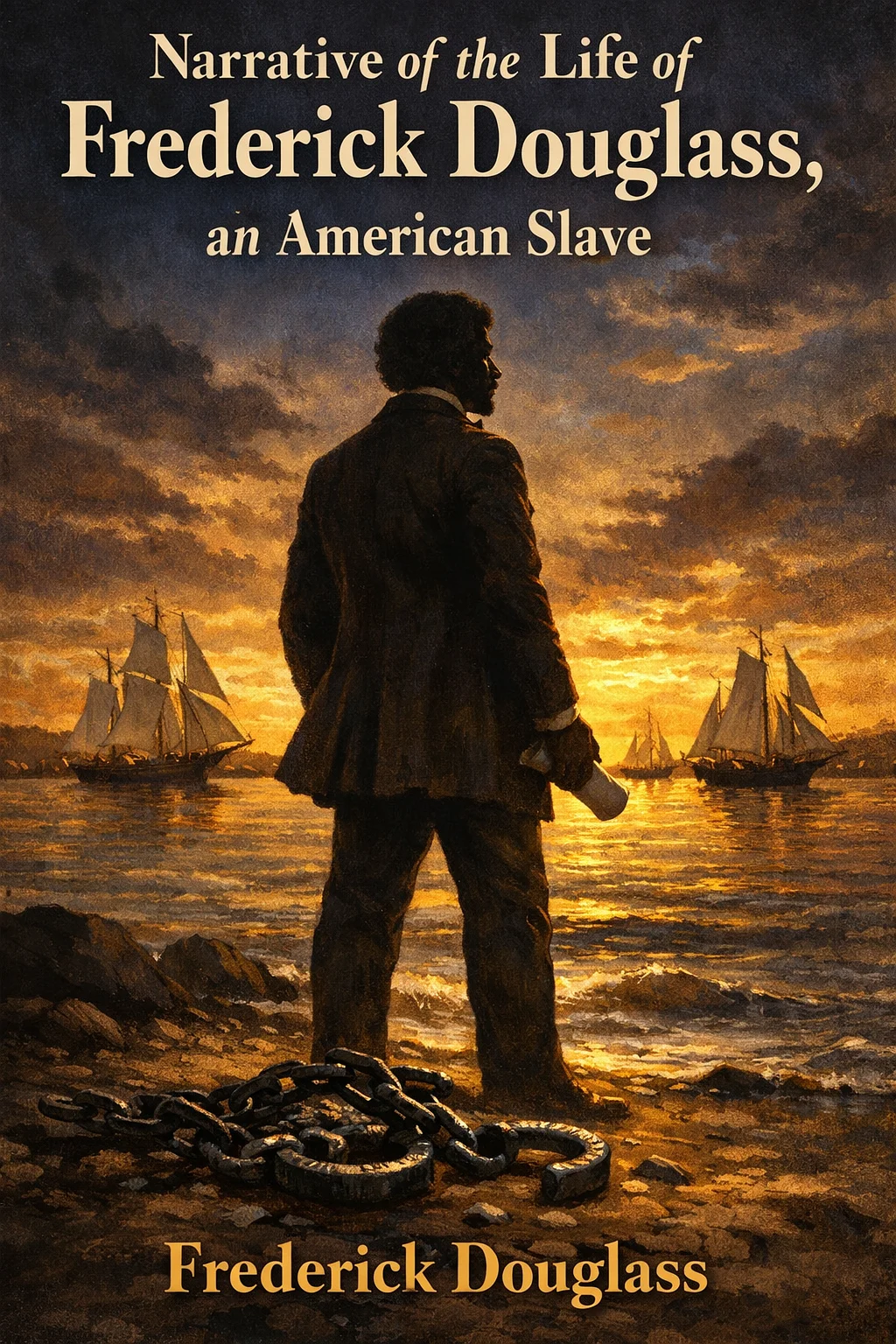
New Book: Narrative of the Life of Frederick Douglass, an American Slave by Сергей Черняков
Frederick Douglass
作者
Narrative of the Life of Frederick Douglass, an American Slave is one of the most powerful autobiographies in American literature — a first-person account of a man born into bondage who, through intellectual determination and an inextinguishable hunger for freedom, transformed himself into one of the nineteenth century's most formidable voices against slavery.
Frederick Douglass was born around 1818 on the Eastern Shore of Maryland, the son of an enslaved woman and an unknown white father rumored to be his master. From birth, slavery conspired to strip him of every human connection: he was separated from his mother in infancy, denied knowledge of his own age, and taught from his earliest years to regard himself as property. The Narrative opens not with his voice alone, but with a preface by William Lloyd Garrison, who witnessed Douglass speak at an abolitionist convention in Nantucket and recognized immediately that this fugitive slave possessed an eloquence surpassing even the greatest orators of the age. Here stands a man the law calls a chattel, yet whose mind and soul proclaim him the equal of any free citizen.
The body of Douglass's narrative traces his journey from the plantation of Colonel Edward Lloyd — a vast, wealthy estate where cruelty was as systematic as the seasons — through a series of masters and overseers whose brutality he documents with unflinching precision. As a child he witnessed his Aunt Hester savagely whipped by Captain Anthony, his first owner; that scene of blood and screaming would scar his memory forever and serves as the Narrative's searing emotional core. He observed the murder of slaves committed with perfect legal impunity. He endured cold, hunger, and degradation designed to extinguish the human spirit.
Yet the turning point of the Narrative is intellectual, not merely physical. When sent to Baltimore to live with Hugh and Sophia Auld, young Frederick encountered something that would change everything: the alphabet. Sophia Auld began teaching him to read until her husband furiously forbade it, declaring that literacy would make a slave unfit for slavery. That prohibition ignited in Douglass an obsessive, secret pursuit of learning. He bribed poor white boys with bread for reading lessons, studied discarded newspapers, and pored over every scrap of text he could find. Literacy became his path to understanding his own condition — and his weapon against it.
Returned to the Eastern Shore and placed under the control of the notorious slave-breaker Edward Covey, Douglass was subjected to months of brutal physical labor and regular whippings intended to crush his will entirely. He reached the lowest point of his existence, considering himself spiritually broken. But one day, he fought back — a prolonged, desperate physical confrontation that Covey ultimately could not win. That moment of resistance was the turning point of his life as a slave: "however long I might remain a slave in form, the day had passed forever when I could be a slave in fact."
From that moment, freedom ceased to be a distant dream and became a practical goal. Standing on the banks of the Chesapeake Bay, watching white-sailed ships move freely across the water, Douglass composed an anguished and magnificent soliloquy — one of the most celebrated passages in American letters — apostrophizing those vessels as symbols of a liberty denied to him by nothing but the crime of his birth. He made one failed attempt at escape, then in 1838 succeeded in fleeing north, disguised and armed with borrowed sailor's papers. He arrived in New York, then settled in New Bedford, Massachusetts, where he took the surname Douglass and began building a free life.
The Narrative closes with Douglass's emergence as a public speaker and his decision — despite fear of re-capture — to dedicate his life to the destruction of slavery. Framed by letters from Garrison and Wendell Phillips attesting to its truth and power, the book served simultaneously as personal testimony, political argument, and living proof that the enslaved were not the intellectually inferior beings that slaveholders claimed. It remains an unassailable monument to human dignity and the written evidence that no system of oppression, however total, can permanently extinguish the longing for freedom.
相关书籍
Narrative of the Life of Frederick Douglass, an American Slave
Frederick Douglass
关于这本书
Born into the darkness of slavery in Talbot County, Maryland, Frederick Douglass never knew his exact birth date — a deliberate cruelty of a system designed to strip its victims of identity, history, and humanity. His father was almost certainly a white man, likely his own master; his mother, Harriet Bailey, was taken from him in infancy, dying before he was old enough to know her. This is where the Narrative of the Life of Frederick Douglass begins: not with a name, but with an absence.
As a child, Douglass witnessed the brutal whipping of his Aunt Hester by Captain Aaron Anthony — his first searing encounter with the raw violence that undergirded plantation life. He was later sent to Baltimore to live with Hugh and Sophia Auld, a transfer that would change his life forever. Sophia Auld, kind at first, began to teach him the alphabet — until her husband forbade it, declaring that literacy would make a slave unfit for his chains. That prohibition became Douglass's greatest motivation. Through cunning, persistence, and the help of poor white boys he befriended on the streets of Baltimore, he secretly taught himself to read and write, understanding at last that knowledge was the pathway to freedom.
After the death of Captain Anthony, Douglass was returned to the plantation and eventually placed under the control of Thomas Auld, a cruel and hypocritically religious master. Thomas hired him out to Edward Covey, a notorious 'slave-breaker' — a man whose profession was to crush the spirit of resistant slaves through relentless labor and savage beatings. For months, Covey succeeded. Douglass was broken in body and nearly in soul. But one August day, when Covey attacked him again, Douglass fought back — a two-hour struggle that ended in a draw but ignited something permanent in him. He resolved: he would never be whipped again. The man had been reborn.
He attempted an escape with a small group of fellow slaves while working on William Freeland's farm, but the plan was betrayed and the conspirators were jailed. Douglass was returned to Baltimore, where he was hired out to work in the shipyards. In September 1838, disguising himself as a free Black sailor and borrowing identification papers, he boarded a train and fled North — reaching New York, then settling in New Bedford, Massachusetts with his new wife, Anna Murray, a free Black woman who had helped fund his escape.
In New Bedford, Douglass encountered William Lloyd Garrison and the abolitionist movement. At an anti-slavery convention on Nantucket in 1841, he rose to speak — hesitantly at first — and electrified the crowd with his testimony. His eloquence, bearing, and intellectual power shattered every prejudice in the room. He became a lecturer for the Massachusetts Anti-Slavery Society, traveling the North to bear witness against the institution that had owned him.
The Narrative itself was published in 1845 as both a testimony and a dare — naming names, places, and dates so that his former masters could not dismiss it as fiction. It is a landmark of American autobiography, a document of resistance, and a masterwork of moral argument. Its central themes — the connection between literacy and liberation, the corruption of slaveholders by absolute power, the resilience of the human spirit, and the fundamental hypocrisy of a Christian nation built on bondage — remain as urgent today as when Douglass first set them down. The book does not merely recount suffering; it transforms suffering into an indictment, and an indictment into a call to action.
将此代码粘贴到您网站的HTML中以嵌入此内容。