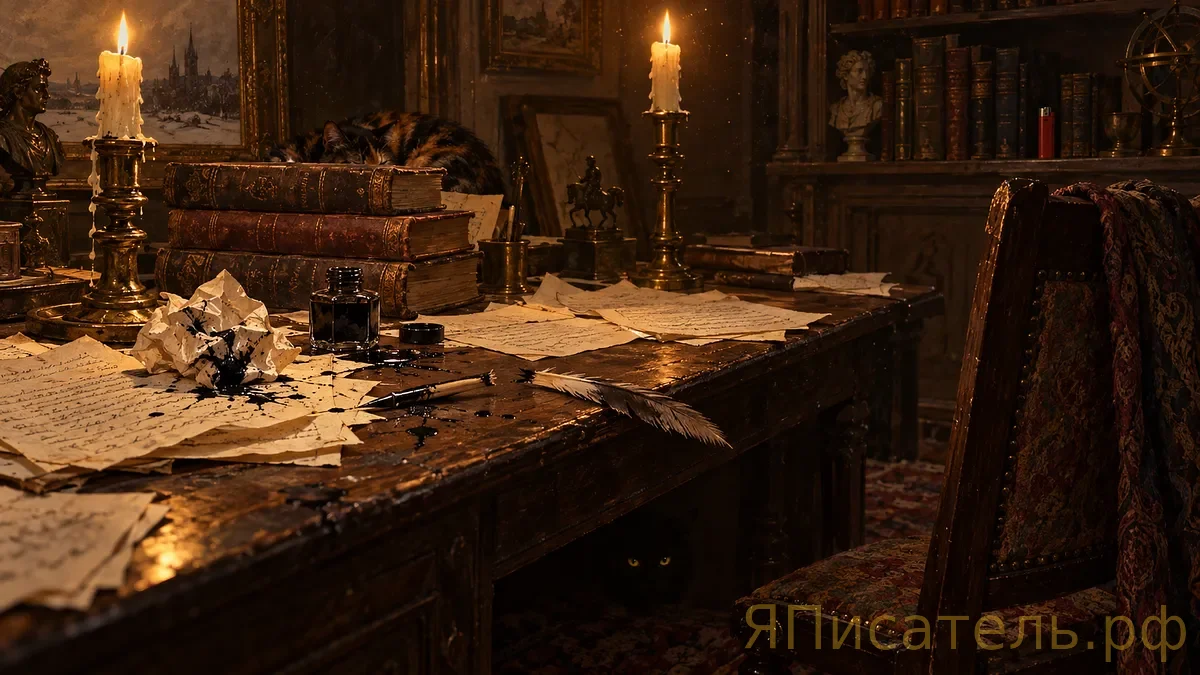
Dostoevsky Diagnosed Your Mental Illness 150 Years Before Your Therapist
On February 9, 1881, Fyodor Dostoevsky died in St. Petersburg, leaving behind a body of work so disturbingly accurate about the human psyche that modern psychiatrists still use his characters as case studies. One hundred and forty-five years later, we're all living in a Dostoevsky novel — we just haven't noticed yet. The man who suffered from epilepsy, survived a mock execution, and spent four years in a Siberian labor camp didn't just write books. He performed an autopsy on the human soul and published the results.
Let's start with the elephant in the room: Raskolnikov. The protagonist of *Crime and Punishment* is a broke, hungry student in a cramped apartment who convinces himself he's a Napoleon-level genius entitled to break moral law. Sound familiar? Scroll through any social media platform for five minutes and you'll find thousands of Raskolnikovs — people who've constructed elaborate intellectual justifications for why the rules don't apply to them. The only difference is that Raskolnikov actually had the nerve to act on his delusion, while most modern versions just post manifestos on Reddit. Dostoevsky didn't just create a murderer. He created the blueprint for every armchair philosopher who ever confused arrogance with enlightenment.
But here's the thing that separates Dostoevsky from every other 19th-century novelist: he didn't judge Raskolnikov. He didn't stand above his character wagging a literary finger. He crawled inside Raskolnikov's fevered brain and let you feel every twisted rationalization from the inside. You finish *Crime and Punishment* not thinking "what a monster" but thinking "oh God, I understand him." That's not comfortable. That's not supposed to be comfortable. And that's exactly why the book still sells millions of copies in a world where people have the attention span of a caffeinated goldfish.
Then there's Prince Myshkin from *The Idiot* — a genuinely good man thrown into a society that has absolutely no idea what to do with genuine goodness. Dostoevsky essentially asked: what would happen if Christ returned to 19th-century Russia? The answer, predictably, is that everyone would call him an idiot, exploit his kindness, and watch him have a nervous breakdown. Written in 1869, this remains the most savage critique of how society treats sincerity. We worship cynicism. We reward manipulation. And anyone naive enough to lead with pure honesty gets eaten alive. Myshkin isn't just a character — he's a prophecy about every decent person who's ever been destroyed by a system designed to reward the ruthless.
And we haven't even gotten to the big one. *The Brothers Karamazov* is Dostoevsky's final novel, his magnum opus, and arguably the greatest novel ever written — a claim I'll make at any bar, to anyone, at any volume. Published in 1880, just months before his death, it's a murder mystery wrapped in a philosophical debate wrapped in a family drama wrapped in a theological crisis. The question at its core is devastatingly simple: if God doesn't exist, is everything permitted? Ivan Karamazov's "Grand Inquisitor" chapter alone contains more intellectual firepower than most entire philosophical traditions. Nietzsche read it and basically said, "Yeah, this guy gets it." Freud called Dostoevsky one of the greatest psychologists who ever lived. Einstein kept *The Brothers Karamazov* on his desk. When the holy trinity of modern thought — philosophy, psychology, and physics — all point at the same Russian novelist and say "this man understood something fundamental," maybe we should pay attention.
What makes Dostoevsky's influence so persistent is that he wasn't writing about 19th-century Russia. He was writing about the permanent architecture of human consciousness. His characters don't feel historical. Dmitri Karamazov's impulsive, passion-driven chaos is every person who's ever made a catastrophic decision because they felt too much. Ivan's cold intellectualism is every person who's ever thought too much and felt too little. Alyosha's quiet faith is every person trying to hold onto something good in a world that seems determined to prove that goodness is naive. These aren't archetypes — they're diagnoses.
Consider the practical legacy. Without Dostoevsky, there's no existentialism as we know it. Sartre, Camus, Kafka — they all acknowledged the debt. The entire noir genre, from Raymond Chandler to David Fincher's films, operates in a moral landscape that Dostoevsky mapped first. TV antiheroes like Walter White and Tony Soprano? They're Raskolnikov's grandchildren, ordinary people constructing philosophical permission slips for their worst impulses. Every prestige drama that asks you to sympathize with a terrible person is running Dostoevsky's playbook.
Here's a fact that still blows my mind: in 1849, Dostoevsky was led before a firing squad for his involvement with a group of intellectuals who discussed banned books. He stood there, blindfolded, waiting for the bullets. At the last second, a messenger arrived with a commutation from the Tsar. The whole execution had been staged as psychological torture. He was 28 years old. Everything he wrote after that — every word about suffering, about the razor-thin line between sanity and madness, about the desperate human need to find meaning in a universe that offers no guarantees — came from a man who had literally stared into the void and lived to describe what he saw.
The four years in a Siberian prison camp that followed gave him something no writing workshop ever could: intimate knowledge of murderers, thieves, and the genuinely broken. He didn't study criminals from a safe academic distance. He slept next to them, ate with them, and discovered that the line between a "good person" and a "bad person" was far thinner and more arbitrary than polite society wanted to admit. This is why his villains are never cartoons and his heroes are never saints.
Today, 145 years after his death, Dostoevsky is more relevant than ever — and that's not a compliment to our era. We live in a time of radical isolation, ideological extremism, and people desperately searching for meaning while simultaneously dismissing every institution that used to provide it. Raskolnikov's alienation is our alienation. Ivan Karamazov's rage against a God who permits child suffering is our rage against systemic injustice. The Underground Man's spiteful rejection of rational self-interest is playing out in real time across the political spectrum of every Western democracy.
So here's my unsolicited advice on this grim anniversary: read Dostoevsky. Not because it's good for you, not because he's a "classic," and definitely not because some literature professor told you to. Read him because he's the only writer who will make you feel genuinely seen — and genuinely terrified by what he sees. Read him because in 2026, a man who died in 1881 still understands you better than your therapist, your algorithm, and your horoscope combined. That's not literary greatness. That's sorcery.
将此代码粘贴到您网站的HTML中以嵌入此内容。