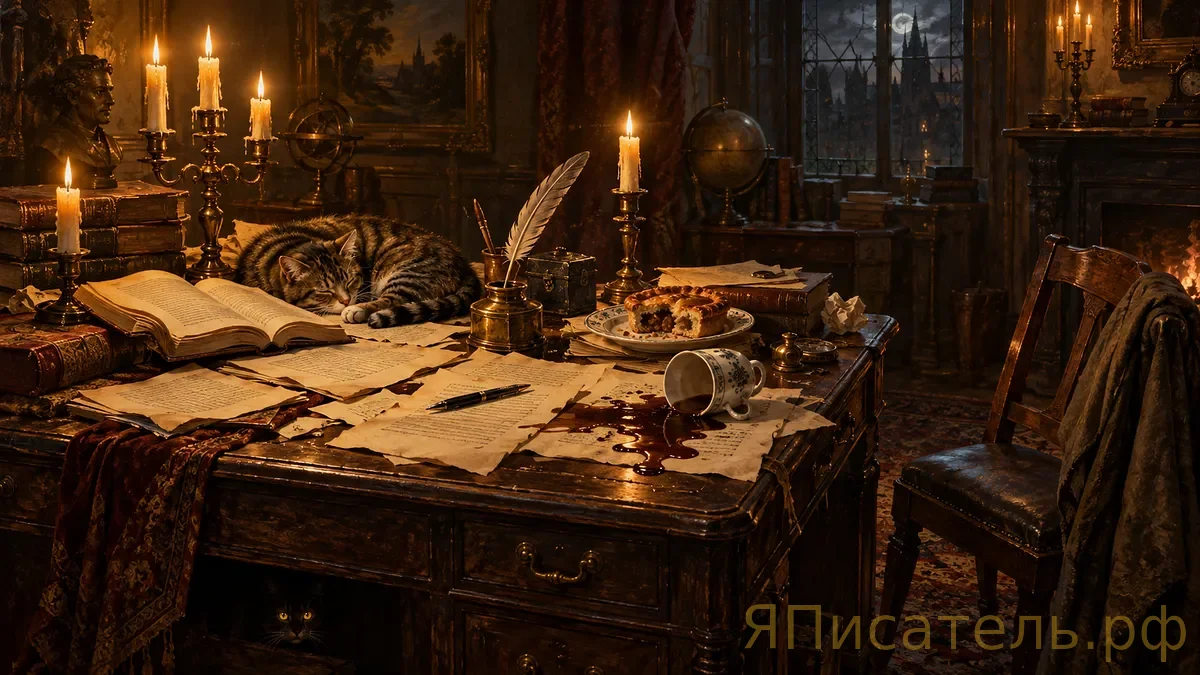
Charles Dickens Worked Children to Death — Then Got Rich Writing About It
Charles Dickens is the most beloved hypocrite in literary history. The man who made Victorian England weep over the fate of orphans and child laborers was himself a ruthless workaholic who drove his children into careers they hated, dumped his wife after twenty-two years of marriage, and possibly worked himself into an early grave at fifty-eight. Born on February 7, 1812, in a cramped house in Portsmouth, Dickens transformed his childhood trauma into a literary empire — and today, 214 years later, we're still buying what he sold.
But here's the thing: the contradictions are precisely what made Dickens great. A writer without wounds is a writer without words, and Dickens had wounds deep enough to fill thirty novels.
Let's start with the origin story, because it's straight out of one of his own books. When Charles was twelve, his father John Dickens — a man who spent money like water and understood debt like a goldfish understands quantum physics — was thrown into Marshalsea debtors' prison. Little Charles was pulled out of school and sent to work at Warren's Blacking Factory, pasting labels on bottles of shoe polish. Ten hours a day. Six days a week. A middle-class kid suddenly rubbing shoulders with street urchins, rats, and despair. The humiliation scarred him so deeply that he never spoke of it publicly during his lifetime. But it leaked out everywhere in his fiction. Every time you read about Oliver Twist asking for more gruel, or David Copperfield laboring at Murdstone and Grinby's warehouse — that's Dickens replaying his own nightmare, trying to make sense of it through ink and paper.
His father eventually got out of prison (an inheritance bailed the family out, which is the most Dickensian plot twist possible), and Charles went back to school. But the factory never left him. It turned a sensitive boy into a man obsessed with social justice — and also obsessed with money, fame, and control. Both things can be true. Both things were.
Dickens didn't just write novels. He detonated them. "The Pickwick Papers" in 1836 made him famous overnight at the age of twenty-four. He published in serial form — monthly installments that had all of England gripped like a Netflix binge, except instead of clicking "next episode," people queued at bookstalls. When readers in New York couldn't wait for the ship carrying the latest installment of "The Old Curiosity Shop," they reportedly shouted from the docks: "Is Little Nell dead?" Whether that story is apocryphal or not, it tells you something real about Dickens's grip on the public imagination.
Then came the heavy hitters. "Oliver Twist" (1838) exposed workhouse cruelty with such precision that it helped change actual laws. "David Copperfield" (1850) — his most autobiographical novel — gave us the template for the modern coming-of-age story. And "Great Expectations" (1861) delivered something even more sophisticated: a novel about how the desire to be a gentleman can rot your soul from the inside. Pip's journey from the marshes to London high society is one of the great cautionary tales about class, ambition, and the lies we tell ourselves. Dickens wrote it in his late forties, and you can feel the wisdom of a man who'd achieved everything he ever wanted and discovered it wasn't enough.
What made Dickens revolutionary wasn't just his plots or his social conscience. It was his characters. Nobody before or since has created such a gallery of grotesques, eccentrics, and unforgettable weirdos. Uriah Heep with his clammy handshake and oozing humility. Miss Havisham rotting in her wedding dress beside a cake covered in cobwebs. Mr. Micawber eternally waiting for something to turn up. Ebenezer Scrooge — a character so iconic that his name became an actual word in the English language. Dickens didn't create characters; he created species.
And here's where the hypocrisy gets juicy. While Dickens was championing the poor and the downtrodden in print, his private life was a mess worthy of a tabloid. In 1858, after twenty-two years of marriage and ten children, he left his wife Catherine for a young actress named Ellen Ternan. He was forty-five. She was eighteen. He didn't just leave Catherine — he publicly humiliated her, publishing a statement in his own magazine essentially blaming her for the separation. He tried to have her committed to an asylum. He cut off friends who sided with her. The champion of compassion could be spectacularly cruel when his own desires were at stake.
His relationship with his children was hardly better. He named them extravagantly — one son was called Alfred D'Orsay Tennyson Dickens, which is less a name than a literary monument — but he was a demanding, often distant father who shipped several sons off to the colonies when they didn't meet his standards. He once described his son Walter as having "a strange lassitude and want of purpose." The kid was fifteen.
But none of this diminishes the work. If anything, it enriches it. Dickens understood human cruelty because he was capable of it himself. He understood selfishness because he practiced it. He understood the gap between who we pretend to be and who we actually are — and that gap is the engine of every great Dickens novel.
His influence on literature is almost impossible to overstate. He essentially invented the Christmas story as we know it — "A Christmas Carol" single-handedly transformed Christmas from a minor religious holiday into the commercial and sentimental juggernaut it is today. He pioneered serial fiction, proving that novels could be popular entertainment, not just elite art. He showed that social criticism could be embedded in gripping storytelling rather than dry polemic. Every writer who's ever tried to make you laugh and cry on the same page is operating in Dickens's shadow.
He also literally killed himself for his art. In his final years, Dickens embarked on grueling public reading tours — performing dramatic readings of his works to packed theaters across Britain and America. His doctors begged him to stop. He refused. On June 8, 1870, he collapsed at dinner after a day of writing "The Mystery of Edwin Drood," a novel he would never finish. He died the next day at fifty-eight. The half-finished manuscript sits in literary history like a sentence that stops mid-
Two hundred and fourteen years after his birth, Dickens remains stubbornly, irritatingly alive. His novels are still adapted into films, TV series, and musicals. His characters still populate our cultural vocabulary. And his central question — can a society that allows children to suffer ever call itself civilized? — still doesn't have a good answer. Dickens was a flawed man who wrote perfect sentences about imperfect people. He was a monster who taught us empathy. And if that contradiction bothers you, well — he'd probably say you haven't been paying attention to your own life.
将此代码粘贴到您网站的HTML中以嵌入此内容。