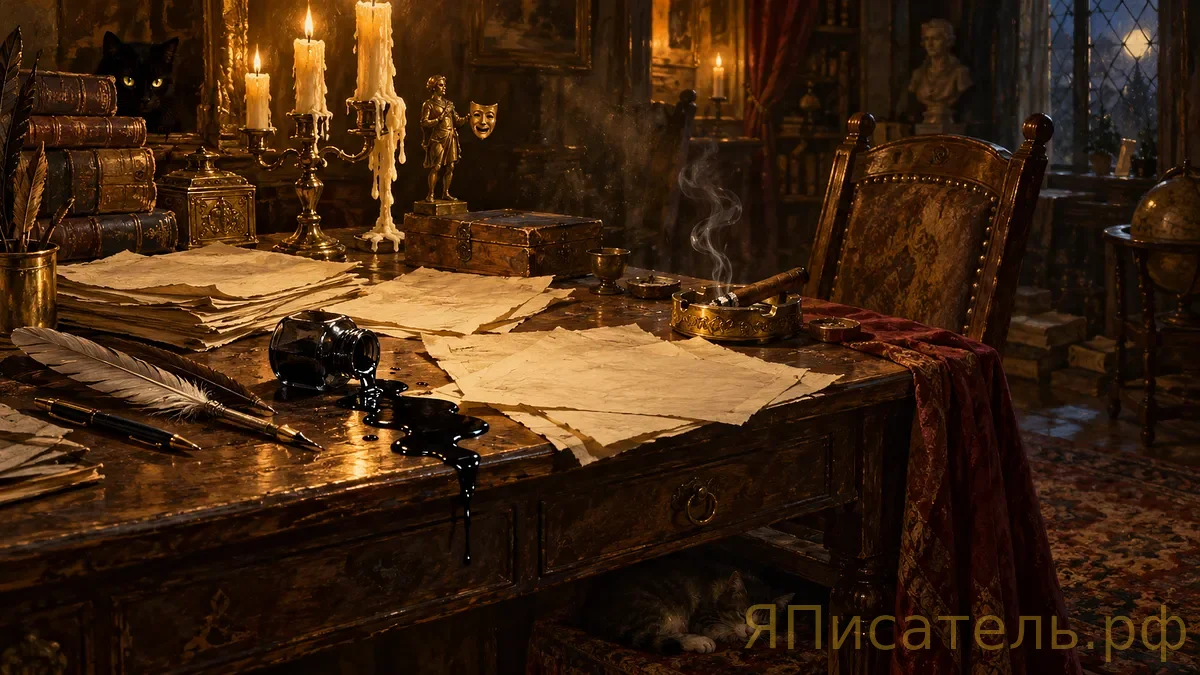
Bertolt Brecht: The Man Who Broke Theatre and Never Bothered to Fix It
Imagine telling an entire industry it's been doing everything wrong for three centuries — and then proving it. That's essentially what Bertolt Brecht did. Born 128 years ago today, on February 10, 1898, in Augsburg, Germany, this chain-smoking, leather-jacket-wearing provocateur didn't just write plays. He detonated the very idea of what theatre was supposed to be.
While everyone else was trying to make audiences cry, Brecht wanted them to think. And for that sin, he was exiled, investigated by the FBI, and eventually became the most influential dramatist of the twentieth century. Not bad for a guy who once described himself as someone who simply "makes suggestions."
Let's start with the audacity. Brecht's concept of "epic theatre" was, at its core, a middle finger to Aristotle. For over two thousand years, the consensus was clear: drama should create catharsis. The audience should lose themselves in the story, feel what the characters feel, and walk out emotionally purged. Brecht looked at this tradition and said — no. He introduced the Verfremdungseffekt, or "alienation effect," which is a fancy German way of saying: "Stop getting comfortable. I'm about to remind you this is a play, and you should be questioning everything." Actors would break the fourth wall. Songs would interrupt the action. Placards would announce what was about to happen, killing any suspense. It was theatre designed to irritate — and it was genius.
The Threepenny Opera, which premiered in 1928, is probably the best example of Brecht at his most deliciously subversive. Written with composer Kurt Weill, it took John Gay's 18th-century Beggar's Opera and turned it into a savage satire of capitalism. The plot follows Macheath — "Mack the Knife" — a charming criminal who robs, murders, and womanizes his way through London. The twist? He's no worse than the bankers and police chiefs around him. The show's most famous song, "Mack the Knife," became a jazz standard later crooned by Bobby Darin and Frank Sinatra, which is deeply ironic considering it's literally about a serial killer. Brecht would have loved that irony — or maybe he would have hated it. With Brecht, you never quite know.
Then came Mother Courage and Her Children in 1939, written as Europe was sleepwalking into another catastrophe. The play follows Anna Fierling, a canteen woman who drags her wagon through the Thirty Years' War, trying to profit from the conflict while losing her children to it, one by one. It's not a tragedy in the traditional sense — Brecht would never allow that. Mother Courage doesn't learn. She doesn't grow. At the end of the play, she hitches herself back to her wagon and keeps going, having learned absolutely nothing. That's the point. Brecht wasn't interested in redemption arcs. He wanted audiences to sit there and think: "Why doesn't she change?" And then, ideally, to ask the same question about themselves and their own complicity in the systems that grind people up.
Life of Galileo, written in multiple versions between 1938 and 1955, might be Brecht's most personal work. On the surface, it's about the astronomer who proved the Earth revolves around the Sun. But Brecht kept rewriting it because history kept changing around him. The first version, written in exile in Denmark, presented Galileo as a cunning hero who recants under pressure but secretly smuggles out his discoveries. Then the atomic bomb fell on Hiroshima. Suddenly, a scientist's responsibility to society looked very different. Brecht rewrote the play to make Galileo a coward — a man who betrayed science and humanity by caving to the Inquisition. The play asks an uncomfortable question that's only gotten more relevant: What do scientists owe the world? When does knowledge become dangerous?
Brecht's personal life was, to put it diplomatically, complicated. He was a committed Marxist who lived quite comfortably. He preached collective creation while making sure his name was on everything. He had a wife, Helene Weigel, who was one of the greatest actresses of the century, and a string of collaborators — Elisabeth Hauptmann, Margarete Steffin, Ruth Berlau — who contributed significantly to his work and received far less credit than they deserved. The question of who actually wrote what in the Brecht canon remains a live grenade in academic circles. Some scholars argue that Hauptmann essentially co-wrote The Threepenny Opera. Brecht's genius was real, but it was also, shall we say, a group project.
His political journey reads like a Cold War thriller. He fled Nazi Germany in 1933, bouncing through Denmark, Sweden, Finland, and eventually landing in Hollywood, where he wrote screenplays that mostly went nowhere. In 1947, he was hauled before the House Un-American Activities Committee, where he performed brilliantly — smoking his trademark cigar, playing dumb through a translator, and technically not lying while revealing absolutely nothing. The committee actually thanked him for being a cooperative witness. He left for Europe the next day.
He settled in East Berlin, where the German Democratic Republic gave him his own theatre company — the Berliner Ensemble — and the resources to stage his plays exactly as he wanted. It was a Faustian bargain, and Brecht knew it. He lived in a socialist state that suppressed dissent while writing plays about the importance of questioning authority. When workers rose up during the 1953 East German uprising and the government crushed the revolt, Brecht wrote a poem suggesting that if the government had lost confidence in the people, perhaps it should "dissolve the people and elect another." It's one of the most devastating political one-liners ever written, and it perfectly captures the contradiction that was Brecht: a revolutionary who lived under the protection of the very power structures he critiqued.
Brecht died in 1956 at the age of 58 — heart failure, officially. He left behind a body of work that changed not just theatre but how we think about storytelling itself. Every time a film breaks the fourth wall, every time a narrator tells you how the story ends before it begins, every time a musical number interrupts a TV show for satirical effect — that's Brecht's ghost, still chain-smoking in the wings.
His influence extends far beyond the stage. Filmmakers like Jean-Luc Godard and Lars von Trier owe him a debt. So does every playwright from Tony Kushner to Caryl Churchill. Hip-hop, with its sampling, its direct address, its refusal of comfortable narrative — that's Brechtian too, whether anyone in the booth knows it or not.
So here's to Bertolt Brecht, 128 years after his birth. A man who proved that the most radical thing art can do is not make you feel something — it's make you think something. And then, maybe, do something about it. He'd probably hate a birthday tribute. He'd say it was sentimental. But then again, he also said that art is not a mirror held up to reality, but a hammer with which to shape it. One hundred and twenty-eight years later, that hammer still swings.
将此代码粘贴到您网站的HTML中以嵌入此内容。