The Picture of Dorian Gray
图书预览
作者
Oscar Wilde
类型
书籍封面
图书总体内容
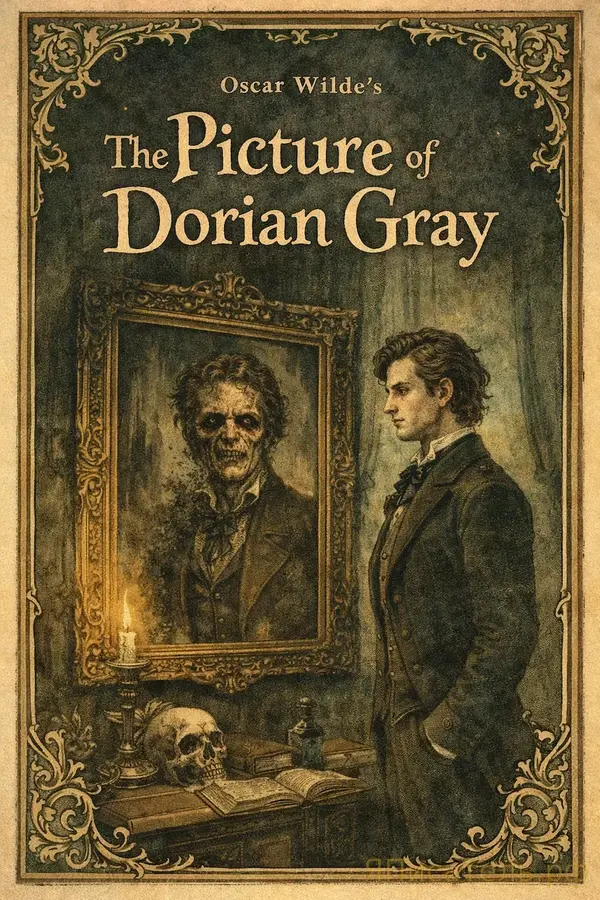
"The Picture of Dorian Gray" is Oscar Wilde's only novel, a profound exploration of aestheticism, moral corruption, and the dark consequences of pursuing eternal youth and beauty at any cost. The story begins in the London studio of Basil Hallward, a talented painter who has just completed a stunning portrait of Dorian Gray, a remarkably beautiful young man. During this sitting, Dorian meets Lord Henry Wotton, a witty aristocrat who espouses a philosophy of New Hedonism—the pursuit of pleasure and beauty above all else. Lord Henry's seductive words about the fleeting nature of youth deeply unsettle Dorian, who gazes upon his finished portrait and makes a fateful wish: that the painting would age instead of him, allowing him to remain forever young and beautiful. This wish mysteriously comes true. As Dorian embarks on a life of sensual indulgence and moral transgression, his face remains untouched by time or sin, while the portrait—hidden away in his attic—gradually transforms to reflect every corrupt deed and passing year. The first change occurs after Dorian cruelly breaks the heart of Sibyl Vane, a young actress he had briefly loved. When she takes her own life following his rejection, Dorian notices a subtle cruelty appearing in the painted lips of his portrait. Over the following eighteen years, Dorian descends deeper into depravity, ruining reputations, corrupting innocence, and pursuing every forbidden pleasure. His eternal youth becomes a source of dark rumor throughout London society. When Basil Hallward confronts Dorian about the scandalous stories surrounding him, Dorian reveals the hideous, aged portrait—and then murders Basil in a fit of rage. He blackmails a former friend, Alan Campbell, into disposing of the body, driving Campbell to eventual suicide. The past returns to haunt Dorian when James Vane, Sibyl's brother who had sworn vengeance years earlier, tracks him down. Though James dies accidentally before he can exact his revenge, Dorian is shaken. Attempting to reform, he finds that even his supposed good deeds are tainted by vanity and self-interest—the portrait now shows hypocrisy added to its catalog of sins. In a final desperate act, Dorian stabs the portrait with the same knife he used to kill Basil. Servants discover his body—withered, aged, and unrecognizable—lying before a portrait restored to its original beauty. The supernatural pact is broken only through Dorian's destruction, suggesting that one cannot escape the moral consequences of one's actions.
目录
书籍摘录
THE PREFACE
The artist is the creator of beautiful things. To reveal art and conceal the artist is art’s aim. The critic is he who can translate into another manner or a new material his impression of beautiful things.
The highest as the lowest form of criticism is a mode of autobiography. Those who find ugly meanings in beautiful things are corrupt without being charming. This is a fault.
Those who find beautiful meanings in beautiful things are the cultivated. For these there is hope. They are the elect to whom beautiful things mean only beauty.
There is no such thing as a moral or an immoral book. Books are well written, or badly written. That is all.
The nineteenth century dislike of realism is the rage of Caliban seeing his own face in a glass.
The nineteenth century dislike of romanticism is the rage of Caliban not seeing his own face in a glass. The moral life of man forms part of the subject-matter of the artist, but the morality of art consists in the perfect use of an imperfect medium. No artist desires to prove anything. Even things that are true can be proved. No artist has ethical sympathies. An ethical sympathy in an artist is an unpardonable mannerism of style. No artist is ever morbid. The artist can express everything. Thought and language are to the artist instruments of an art. Vice and virtue are to the artist materials for an art. From the point of view of form, the type of all the arts is the art of the musician. From the point of view of feeling, the actor’s craft is the type. All art is at once surface and symbol. Those who go beneath the surface do so at their peril. Those who read the symbol do so at their peril. It is the spectator, and not life, that art really mirrors. Diversity of opinion about a work of art shows that the work is new, complex, and vital. When critics disagree, the artist is in accord with himself. We can forgive a man for making a useful thing as long as he does not admire it. The only excuse for making a useless thing is that one admires it intensely.
All art is quite useless.
OSCAR WILDE
CHAPTER I.
The studio was filled with the rich odour of roses, and when the light summer wind stirred amidst the trees of the garden, there came through the open door the heavy scent of the lilac, or the more delicate perfume of the pink-flowering thorn.
From the corner of the divan of Persian saddle-bags on which...