Human, All Too Human: A Book for Free Spirits
图书预览
作者
Nietzsche, Friedrich Wilhelm
类型
书籍封面
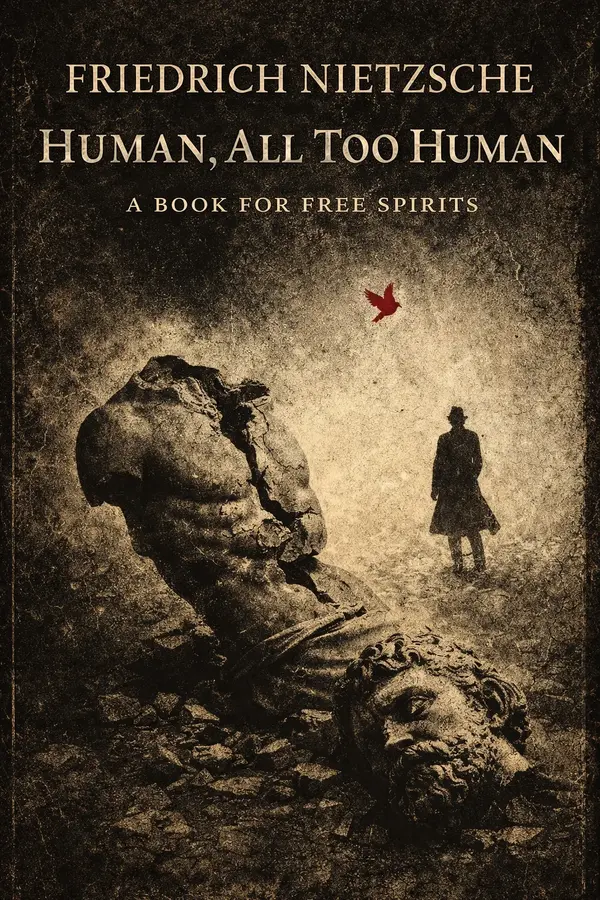
图书总体内容
"Human, All Too Human: A Book for Free Spirits" is a philosophical work by Friedrich Nietzsche, first published in 1878, representing a decisive break from his earlier romantic philosophy influenced by Schopenhauer and Wagner. The book is dedicated to "free spirits" - individuals who have undergone a profound intellectual and spiritual emancipation from traditional beliefs, customs, and moral conventions. The work is structured as a collection of aphorisms and short essays exploring fundamental questions about human nature, morality, religion, and knowledge. Nietzsche systematically deconstructs metaphysical thinking, arguing that what humans have traditionally considered absolute truths are merely human constructions - "all too human" perspectives shaped by psychological needs, historical circumstances, and evolutionary pressures. In the opening sections, Nietzsche describes the psychological journey of becoming a "free spirit" - the painful process of breaking free from inherited beliefs, the subsequent period of intellectual wandering and questioning, and the eventual arrival at a new form of wisdom that embraces uncertainty. He critiques the very foundations of Western thought, including language, logic, and the distinction between appearance and reality. The book systematically examines morality, tracing the historical origins of concepts like good and evil, justice, and responsibility. Nietzsche argues that moral feelings evolved from social utility rather than transcendent principles, and controversially suggests that humans bear no ultimate responsibility for their actions since character and will are products of necessity. Nietzsche offers a penetrating critique of Christianity, viewing it as a "barbarous" and "un-Greek" religion that degrades humanity through doctrines of sin and guilt while promising impossible salvation. He contrasts this with what he sees as the healthier religious attitudes of ancient Greeks. Throughout, Nietzsche champions science and rational inquiry over metaphysical speculation and religious faith, while acknowledging that even scientific knowledge is provisional and that the illogical remains necessary for human flourishing. The work represents Nietzsche's turn toward a more skeptical, scientific, and psychologically penetrating philosophy.
目录
此书已被评审
阅读此书的专业评审
书籍摘录
Distributed Proofreading Team at https://www.pgdp.net (This book was produced from scanned images of public domain material from the Google Print project.)
HUMAN, ALL TOO HUMAN
A BOOK FOR FREE SPIRITS
BY FRIEDRICH NIETZSCHE
TRANSLATED BY ALEXANDER HARVEY
CHICAGO CHARLES H. KERR & COMPANY 1908
Copyright 1908 By Charles H. Kerr & Company
CONTENTS
AUTHOR'S PREFACE
OF THE FIRST AND LAST THINGS
HISTORY OF THE MORAL FEELINGS
THE RELIGIOUS LIFE
PREFACE.
1
It is often enough, and always with great surprise, intimated to me that there is something both ordinary and unusual in all my writings, from the "Birth of Tragedy" to the recently published "Prelude to a Philosophy of the Future": they all contain, I have been told, snares and nets for short sighted birds, and something that is almost a constant, subtle, incitement to an overturning of habitual opinions and of approved customs. What!? Everything is merely--human--all too human? With this exclamation my writings are gone through, not without a certain dread and mistrust of ethic itself and not without a disposition to ask the exponent of evil things if those things be not simply misrepresented. My writings have been termed a school of distrust, still more of disdain: also, and more happily, of courage, audacity even. And in fact, I myself do not believe that anybody ever looked into the world with a distrust as deep as mine, seeming, as I do, not simply the timely advocate of the devil, but, to employ theological terms, an enemy and challenger of God; and whosoever has experienced any of the consequences of such deep distrust, anything of the chills and the agonies of isolation to which such an unqualified difference of standpoint condemns him endowed with it, will also understand how often I must have sought relief and self-forgetfulness from any source--through any object of veneration or enmity, of scientific seriousness or wanton lightness; also why I, when I could not find what I was in need of, had to fashion it for myself, counterfeiting it or imagining it (and what poet or writer has ever done anything else, and what other purpose can all the art in the world possibly have?) That which I always stood most in need of in order to effect my cure and self-recovery was faith, faith enough not to be thus isolated, not to look at life from so singular a point of view--a magic...