Crime and Punishment
图书预览
作者
ФЕДОР ДОСТОЕВСКИЙ
出版日期
2026年01月09日 15:41
类型
书籍封面
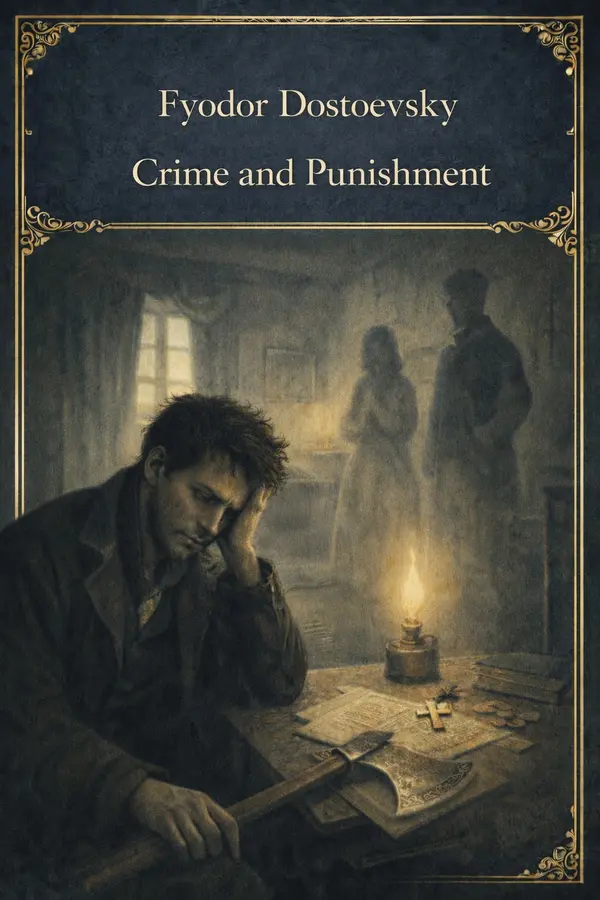
图书总体内容
"Crime and Punishment" is a psychological novel by Fyodor Dostoevsky that tells the story of a former student, Rodion Raskolnikov, living in extreme poverty in Petersburg. Tormented by destitution and loneliness, he develops a theory about "extraordinary people" who are permitted to transgress moral laws for the sake of great purposes. The protagonist commits the murder of an old pawnbroker, Alyona Ivanovna, justifying himself with the belief that she is a useless, evil person, and that her money could help many. However, he accidentally also kills her stepsister Lizaveta—a meek, defenseless woman who becomes an innocent victim. In parallel unfolds the story of the Marmeladov family: a drunken civil servant, Semyon Marmeladov, tells Raskolnikov about his fate, about his ailing wife Katerina Ivanovna and his daughter Sonya, forced into prostitution to feed the family. Sonya's story—that of "eternal Sonechka"—becomes for Raskolnikov a mirror of his own reflections on sacrifice and sin. An important role is played by Raskolnikov's own family: his mother Pulkheria Alexandrovna and his sister Dunya. From his mother's letter, the protagonist learns that Dunya is preparing to marry a calculating businessman, Luzhin, sacrificing herself for her brother's sake. This news intensifies Raskolnikov's internal conflict and pushes him toward action. The novel also features the enigmatic figure of Svidrigailov—a landowner who pursued Dunya, a man with a dark past and complex nature. The central themes of the work are the moral boundaries of what is permissible, the psychology of crime, the torments of conscience, redemption through suffering, and the opposition between pride and humility. Dostoevsky masterfully conveys the hero's spiritual anguish, the atmosphere of stifling summer Petersburg, and the social depths of the great city.
目录
此书已被评审
阅读此书的专业评审
书籍摘录
I
In early July, during an extremely hot spell, toward evening, a young man left his garret, which he rented from tenants in S—y Lane, and walked slowly, as if in indecision, toward K—n Bridge.
He had successfully avoided meeting his landlady on the stairs. His garret was under the very roof of a tall five-story house and resembled a cupboard more than a room. As for his landlady, from whom he rented this garret with dinner and service, she lived one flight below, in a separate apartment, and every time he went out into the street, he inevitably had to pass by his landlady's kitchen, which was almost always wide open onto the staircase. And every time the young man passed by, he felt a sort of sickly and cowardly sensation, which made him ashamed and from which he winced. He was deeply in debt to his landlady and was afraid of meeting her.
Not that he was so cowardly and downtrodden, quite the contrary; but for some time he had been in an irritable and tense state, resembling hypochondria. He had become so absorbed in himself and isolated from everyone that he feared even any encounter, not only an encounter with his landlady. He was crushed by poverty; but even his straitened circumstances had lately ceased to burden him. He had completely stopped attending to his immediate affairs and did not want to attend to them. He was not really afraid of any landlady, whatever she might be plotting against him. But to stop on the stairs, to listen to all sorts of nonsense about all this everyday rubbish, which was none of his business, all these pestering about payment, threats, complaints, and at the same time to dodge, apologize, lie himself—no, it was better to slip down the stairs somehow like a cat and sneak away so that no one would see.
However, this time the fear of meeting his creditor struck even him as he came out into the street.
"What sort of business am I attempting, and yet what trifles I'm afraid of!" he thought with a strange smile. "Hm... yes... everything is in man's hands, and he lets it all slip past his nose, simply from cowardice alone... that's already an axiom... I wonder what people are most afraid of? A new step, a new word of their own—that's what they're most afraid of... But I talk too much. That's why I do nothing, because I talk. Though perhaps it's also this way: I talk because I do nothing. I've learned to chatter this last...