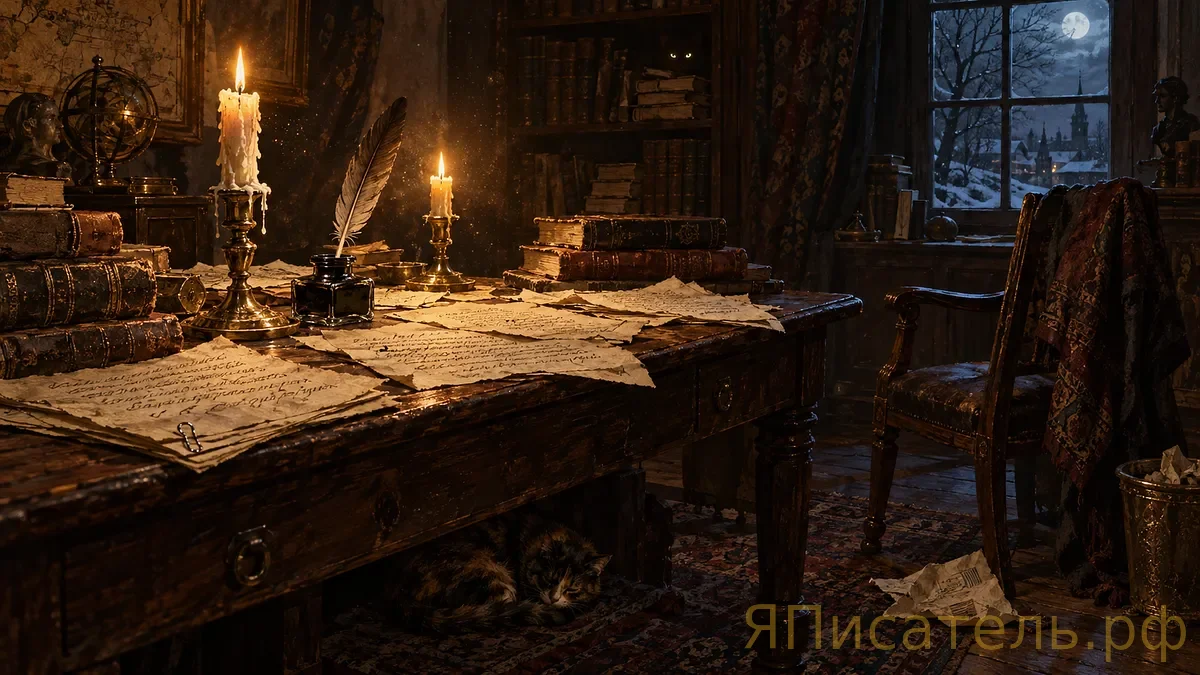
The Nobel Prize That Nearly Killed Boris Pasternak
Imagine winning the most prestigious literary award on the planet — and being forced to reject it under threat of exile. That's not a dystopian novel plot. That's Tuesday for Boris Pasternak, born 136 years ago today, the man who wrote Doctor Zhivago and paid for it with everything except his life. Most writers dream of the Nobel. Pasternak's Nobel was a loaded gun pointed at his temple by his own government.
Boris Leonidovich Pasternak came into this world on February 10, 1890, in Moscow, into what you might call a creatively loaded household. His father, Leonid Pasternak, was a prominent Post-Impressionist painter who counted Leo Tolstoy among his friends. His mother, Rosa Kaufman, was a concert pianist who had performed across Europe. So young Boris grew up in a house where Tolstoy literally dropped by for tea, Rachmaninoff played the piano in the living room, and Rilke — yes, the Rilke — was a family friend. If you think your parents' dinner parties were impressive, sit down.
Naturally, with that kind of upbringing, Pasternak first wanted to be a musician. He studied composition under Alexander Scriabin, no less. But here's the twist — he quit music because he didn't have perfect pitch. Let that sink in. The man had such impossibly high standards that lacking one specific auditory gift made him abandon an entire art form. He then pivoted to philosophy, studying at the University of Marburg in Germany. And then he quit that too. Because apparently, Boris Pasternak collected abandoned careers the way some people collect stamps.
Poetry is where he finally stuck. And thank whatever muse watches over Russian literature, because Pasternak became one of the most extraordinary poets of the twentieth century. His early collections — "My Sister, Life" (1917) and "Themes and Variations" (1923) — were revolutionary. He didn't just write poems; he detonated them. His imagery was so dense, so electrically alive, that reading him felt like sticking your tongue on a frozen lamppost — shocking, immediate, impossible to forget. Osip Mandelstam, no slouch himself, called Pasternak's poetry "the rain itself." When another great poet calls your work a weather event, you've arrived.
But here's where the story gets dark, because this is Russia, and stories about Russian writers always get dark. Stalin's regime turned Soviet literature into a propaganda factory. Writers were expected to produce "socialist realism" — essentially cheerful fiction about happy workers building a glorious future. Pasternak couldn't do it. He wasn't built for lies. Instead, he retreated into translation work, producing legendary Russian versions of Shakespeare, Goethe, and Shelley. His translations of Hamlet and King Lear are still considered definitive. He survived the purges partly because Stalin, in one of history's more bizarre phone calls, personally rang Pasternak in 1934 to ask about Mandelstam's arrest. Pasternak tried to discuss poetry with the dictator. Stalin hung up. Somehow, Pasternak lived.
Then came Doctor Zhivago. He worked on it for over a decade, from 1945 to 1955, pouring everything into this sprawling, lyrical novel about a poet-physician navigating the Russian Revolution and its aftermath. It was deeply personal, openly spiritual, and completely incompatible with Soviet ideology. The manuscript was rejected by every Soviet publisher. The official verdict was devastating: the novel suggested that the October Revolution had been a mistake. In the USSR, that wasn't literary criticism — that was a death sentence.
What happened next reads like a spy thriller. An Italian publisher, Giangiacomo Feltrinelli, got hold of the manuscript through a chain of intermediaries. The KGB tried everything to stop publication — diplomatic pressure, threats, even sending agents to retrieve the manuscript. Feltrinelli published it anyway in 1957. The novel exploded across the world. It was translated into eighteen languages within a year. The CIA — and this is declassified fact, not conspiracy theory — secretly helped distribute Russian-language copies to Soviet citizens at the 1958 Brussels World's Fair. Doctor Zhivago became a weapon in the Cold War, and Pasternak was caught in the crossfire.
In October 1958, the Swedish Academy awarded Pasternak the Nobel Prize in Literature. His initial response, in a telegram, was pure joy: "Immensely thankful, touched, proud, astonished, abashed." That joy lasted about forty-eight hours. The Soviet literary establishment erupted in orchestrated fury. The Union of Soviet Writers expelled him. Newspapers ran coordinated attacks. One factory worker who admitted he hadn't read the book declared Pasternak "a pig who fouled the spot where he ate." The pressure was suffocating and relentless.
Four days after the announcement, Pasternak sent a second telegram to Stockholm: "Considering the meaning this award has been given in the society to which I belong, I must reject this undeserved prize which has been presented to me. Please do not receive my voluntary rejection with displeasure." Read that again. "Voluntary." The most heartbreaking word in the history of the Nobel Prize. He rejected humanity's highest literary honor not because he wanted to, but because accepting it meant permanent exile from Russia — from his language, his landscape, the birch trees and snowfields that fed every line he ever wrote.
The aftermath was brutal. Pasternak was systematically humiliated, isolated from friends, and watched as his lover, Olga Ivinskaya — the real-life inspiration for Lara in Doctor Zhivago — was threatened with imprisonment. He wrote a letter to Khrushchev begging not to be deported: "Leaving the motherland will equal death for me." They let him stay. But the damage was done. His health deteriorated rapidly. On May 30, 1960, Boris Pasternak died of lung cancer at his dacha in Peredelkino, just outside Moscow. He was seventy years old.
Here's what stays with me. Doctor Zhivago is not actually about revolution or politics, despite what both the CIA and the KGB thought. It's about the stubborn, irrational persistence of the individual soul against the machinery of history. Yuri Zhivago is a terrible revolutionary and a mediocre husband, but he's an extraordinary observer of snowfall, of candlelight through a frozen window, of the way a woman's voice sounds in an empty room. The novel argues — quietly, lyrically, without raising its voice — that these small, private moments of beauty are worth more than any ideology.
David Lean's 1965 film adaptation, starring Omar Sharif and Julie Christie, turned the story into a global cultural phenomenon. The balalaika theme became one of the most recognizable melodies in cinema history. But the film, gorgeous as it is, smoothed out Pasternak's rough edges. The novel is stranger, more difficult, more poetic than any movie could capture. Its power isn't in plot — it's in sentences that make you stop reading and stare at the wall.
Today, 136 years after his birth, Pasternak's legacy is complicated in the best possible way. In Russia, he's been rehabilitated — the Nobel rejection was posthumously reversed in 1989 when his son accepted the medal. Doctor Zhivago is taught in schools. But his poetry, which he considered his true life's work, remains underappreciated outside the Russian-speaking world, partly because translating Pasternak is like trying to bottle lightning.
So here's to Boris Pasternak — the man who quit music, quit philosophy, survived Stalin, wrote a masterpiece, won the Nobel, lost the Nobel, and died heartbroken in a country that didn't deserve him. He proved something that every writer secretly knows and fears: that the most dangerous thing you can do with a pen is tell the truth.
Pega este código en el HTML de tu sitio web para incrustar este contenido.