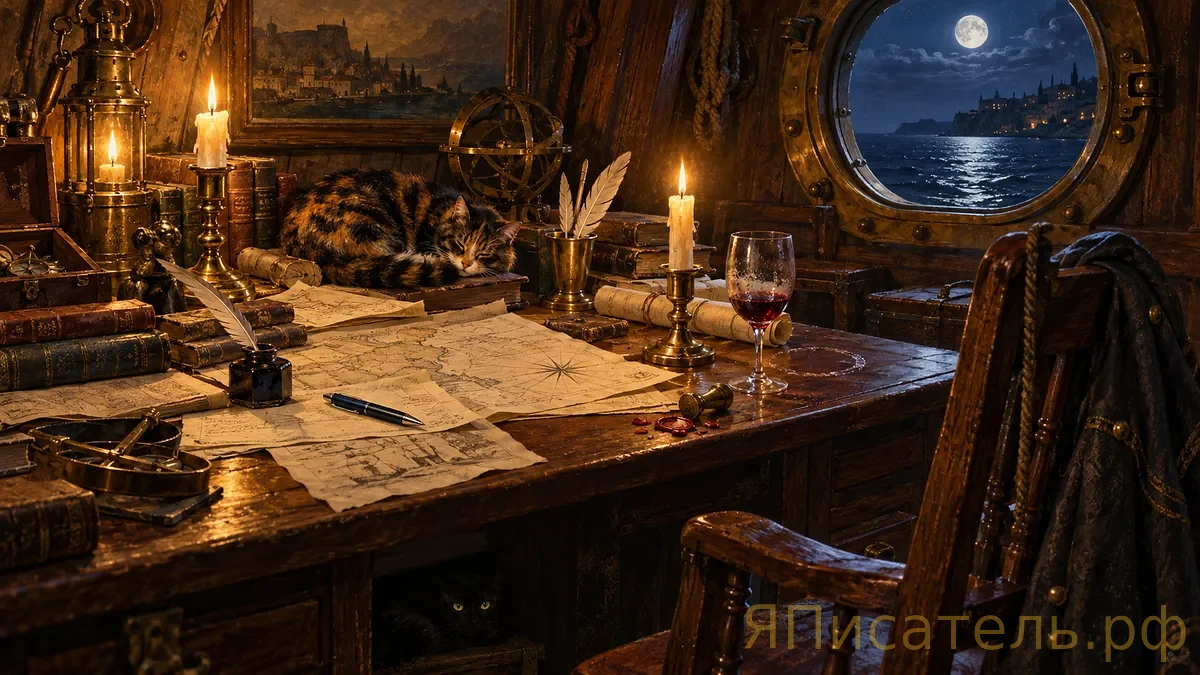
The Horizon Beyond Marseilles: A Lost Chapter of The Count of Monte Cristo
Continuación creativa de un clásico
Esta es una fantasía artística inspirada en «The Count of Monte Cristo» de Alexandre Dumas. ¿Cómo habría continuado la historia si el autor hubiera decidido extenderla?
Extracto original
"'... there is neither happiness nor misery in the world; there is only the comparison of one state with another, nothing more. He who has felt the deepest grief is best able to experience supreme happiness. We must have felt what it is to die, Morrel, that we may appreciate the enjoyments of living. Live, then, and be happy, beloved children of my heart, and never forget that until the day when God shall deign to reveal the future to man, all human wisdom is contained in these two words,—Wait and hope. Your friend, Edmond Dantès, Count of Monte Cristo.' ... On the dark blue line separating on the horizon the sky from the Mediterranean Sea, they perceived a large white sail."
Continuación
The Jacopo stood at the helm, steering the small vessel toward the open sea, and Edmond Dantès — no longer the Count of Monte Cristo, no longer the agent of Providence, but simply a man who had loved and suffered and at last understood — watched the coast of France recede into a pale thread of gold upon the horizon. Beside him, Haydée pressed her hand against his arm, and her warmth was the only anchor he required.
"You are thinking of them," she said. It was not a question. She had learned to read the particular stillness that overtook him when memory pulled at his heart — that gravity which no fortune, no title, no vengeance could ever fully dissolve.
"I am thinking," he replied, "of Maximilian and Valentine. Of the letter I left them. I wonder if they understand what I meant — that all human wisdom is contained in those two words: wait and hope."
Haydée lifted her dark eyes to his face. The Mediterranean wind stirred the silk of her hair, and in that moment she seemed to him not merely beautiful but eternal, as though she belonged to the sea itself, to the sky, to the deep currents that carried them forward into the unknown.
"You gave them everything," she said. "The island, the fortune, the future. What have you kept for yourself?"
Dantès was silent for a long while. The waves broke softly against the hull, and the sails filled with the warm southern wind that had carried him, so many years ago, as a young sailor aboard the Pharaon — that ship which no longer existed, just as the young man who had captained it no longer existed.
"I have kept," he said at last, "the knowledge that I was wrong."
Haydée did not flinch. She had known suffering of her own — the fall of her father, the slave markets of Constantinople, the long years of captivity before Dantès had found her and given her a life that was, if not freedom in its purest form, at least the semblance of dignity and love. She understood that confession was not weakness but the hardest species of courage.
"Tell me," she said.
And so, as the coast of France disappeared entirely and there was nothing before them but the vast, indifferent expanse of the sea, Edmond Dantès spoke.
"When I escaped the Château d'If, I believed myself chosen. The treasure of Spada was my confirmation — God had placed it there for me, had preserved me through fourteen years of darkness so that I might emerge as His instrument. Every step I took afterward — every disguise, every manipulation, every ruin I brought upon those who had destroyed me — I justified as divine will. I was not Edmond Dantès; I was Providence itself."
He paused. A gull cried overhead, wheeling against the cloudless sky.
"But Providence does not weep over the bodies of the innocent. Providence does not stand in a darkened room and watch a child die because the poison meant for another found the wrong glass. I did that. Not God. Not fate. I, Edmond Dantès, who had suffered and therefore believed he had earned the right to make others suffer."
Haydée's grip on his arm tightened, but she did not speak. She knew that this confession had been building within him for months — perhaps years — and that to interrupt it would be to dam a river that needed, desperately, to reach the sea.
"Villefort is mad," Dantès continued. "His reason broke under the weight of what I revealed to him — what I forced him to confront. And I told myself it was justice. But is it justice to destroy a man's mind? Is it justice to leave his children orphaned, not by death but by something worse — by the knowledge that their father was a monster? I did not create Villefort's sins, but I arranged their revelation with the precision of a surgeon who cares nothing for the patient's survival, only for the elegance of the incision."
The sun was descending now, painting the water in shades of amber and rose. Jacopo, at the helm, hummed a Genoese sailor's song, oblivious to the weight of the words being spoken behind him — or perhaps, in his simple wisdom, choosing to grant his master the privacy of apparent inattention.
"And Fernand," Dantès said, his voice dropping lower. "Fernand Mondego, who betrayed me — who stole Mercédès — who built his fortune on the blood of Ali Pasha. Yes, he was guilty. But when I exposed him, when I stripped away every layer of the life he had constructed, I did not think of Mercédès. I did not think of Albert. I thought only of the boy in the dungeon, the boy who had scratched the days into the stone walls of his cell until the numbers lost all meaning. I was still that boy, Haydée. After all those years, after all that wealth and power and knowledge, I was still scratching at the walls."
Haydée released his arm and took his hand instead, intertwining her fingers with his.
"You are not that boy now," she said.
"No," Dantès agreed. "But I became something worse before I became something better. I became a man who believed that suffering had made him wise, when in truth it had only made him dangerous."
They stood together in silence as the last light faded from the sky and the first stars appeared — tentative, as though unsure of their welcome. The sea darkened from gold to violet to the deep, impenetrable black that Dantès remembered from his nights in the Château d'If, when the only light was the distant, impossible gleam of the stars through the narrow window of his cell.
But this darkness was different. This darkness was chosen. This darkness held no walls, no chains, no slowly calcifying despair. This darkness was simply the night, and it would pass, as all nights pass, into morning.
"Where shall we go?" Haydée asked.
It was the question he had been expecting, and yet he found that he had no answer prepared. For twenty years, every action he had taken had been in service of a plan — the meticulous, all-consuming architecture of revenge. He had known, at every moment, precisely where he was going and why. Now, for the first time since his youth, since those golden days when he had sailed the Pharaon under the Mediterranean sun with no thought beyond the next port, the next cargo, the next letter from Mercédès — now, he was free.
The freedom terrified him.
"I do not know," he said.
Haydée smiled. It was a smile he had seen before, but never directed at him with quite this quality of understanding — as though she saw not the Count of Monte Cristo, not the Lord of the treasure, not the dark avenger who had shaken the foundations of Parisian society, but simply a man standing at the prow of a ship, lost and frightened and trying, with whatever remained of his battered heart, to find his way.
"Then we shall go nowhere," she said. "We shall go everywhere. We shall let the wind decide."
Dantès looked at her, and something shifted within him — some final stone in the great fortress he had built around his soul, loosening, falling, letting in a shaft of light that was painful in its intensity.
"You are not afraid?" he asked.
"I was a slave," Haydée said simply. "I was sold in the marketplace like a bolt of silk. I watched my father die and my mother die of grief. I have lived in palaces and in chains. What should I fear from the open sea?"
Dantès raised her hand to his lips and kissed it — not with the theatrical gallantry of the Count, but with the simple tenderness of the sailor he had once been.
"Jacopo," he called.
The helmsman turned. "Master?"
"Set no course. Follow the wind."
Jacopo grinned — the broad, uncomplicated grin of a man who had spent his life at sea and understood, better than any philosopher, that the finest voyages are those undertaken without destination.
"As you say, Master. The wind blows south tonight. Toward Africa."
"Then south we go."
Haydée leaned against him, and he felt the steady rhythm of her breathing, and for a moment — just a moment — Edmond Dantès allowed himself to believe that the words he had written to Maximilian were not merely advice but prophecy: that to wait and to hope was not resignation but the deepest form of faith; that a man who had descended into hell might yet, if he was brave enough and humble enough and willing to release the burning coal of his grievance, find his way to something that resembled, however imperfectly, grace.
The ship sailed on. The stars multiplied above them, filling the sky with their ancient, indifferent light. And the sea — the great, dark, patient sea that had swallowed his youth and returned to him, after fourteen years, a man he could no longer recognize — the sea received them, and carried them forward, into the vast and luminous unknown.
Somewhere behind them, in a house in Paris, Maximilian Morrel unfolded a letter and read its final line to Valentine, who wept — not from sadness but from the strange, piercing joy that comes when one understands, at last, that love is not possession but release.
And somewhere beneath them, in the dark waters off the coast of the Château d'If, the bones of the Abbé Faria lay undisturbed in their canvas shroud, weighted with stones, resting on the ocean floor where the currents moved like slow, invisible hands, rearranging the sand, grain by grain, in patterns that no living eye would ever see — patterns that were, perhaps, the only true language of eternity.
Dantès did not look back. He had spent twenty years looking back. Now, with the wind in his hair and Haydée's hand in his, he looked forward — not with certainty, not with the terrible, consuming confidence that had driven him to become the Count of Monte Cristo, but with something quieter and more durable: the simple, stubborn willingness to begin again.
The night deepened. The ship sailed on. And the morning, when it came, was unlike any morning Edmond Dantès had ever known — not because the sun rose differently, or the sea changed its color, or the world rearranged itself to accommodate his redemption, but because he saw it, for the first time in twenty years, with the eyes of a man who expected nothing and was therefore capable of receiving everything.
Wait and hope.
The words echoed in his mind like the tolling of a distant bell — not a funeral bell, not the terrible iron bell of the Château d'If that had marked the hours of his captivity, but something softer, something that might have been the sound of a new world being born, or an old world being forgiven, or simply the sound of the wind in the rigging as the ship carried him south, toward a horizon that held no promises and no threats, only the immense, terrifying, beautiful possibility of what might come next.
Pega este código en el HTML de tu sitio web para incrustar este contenido.