Noticias 6 feb, 07:19

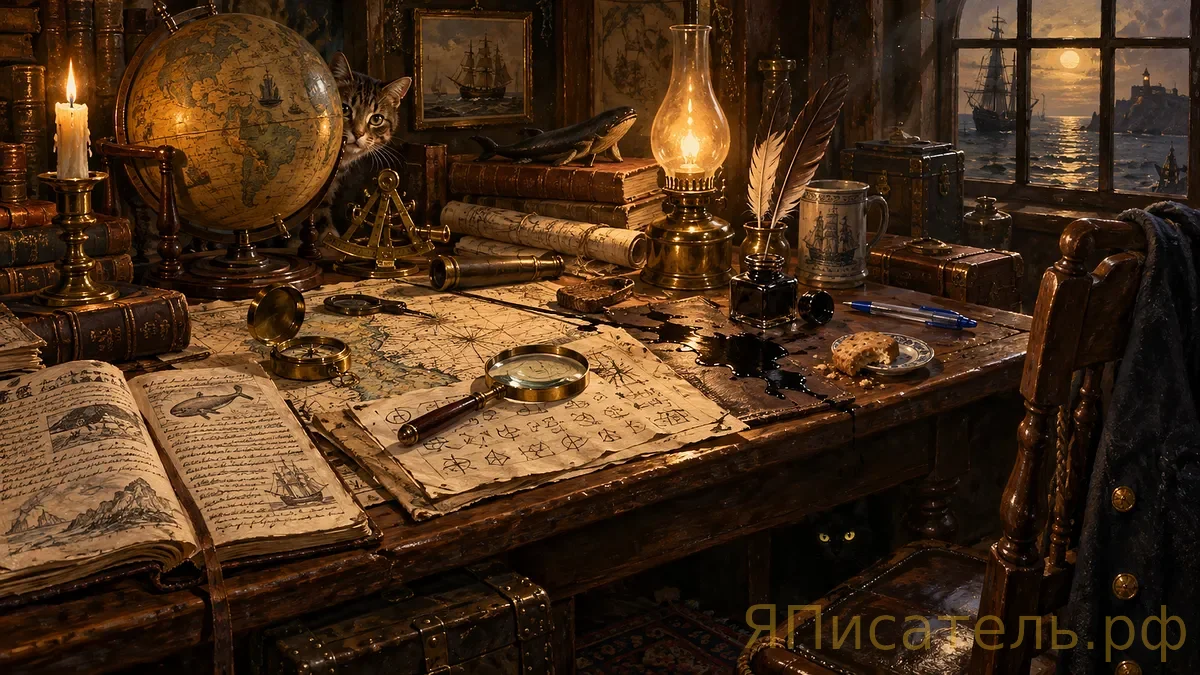
Mysterious Cipher in Herman Melville's Margin Notes May Reveal Hidden Chapter of Moby-Dick

In a discovery that has sent ripples through the academic world, a team of cryptographers and literary scholars at Yale University have cracked a sophisticated cipher embedded in the margin notes of Herman Melville's personal copy of Moby-Dick, revealing what appears to be detailed instructions for locating an unpublished final chapter.

The leather-bound volume, long held in Yale's Beinecke Rare Book and Manuscript Library, was known to contain Melville's handwritten annotations. However, researchers had always dismissed certain repetitive markings as mere doodles or signs of the author's restless mind during his troubled later years.

Dr. Helena Marchetti, who led the investigation, explained that the breakthrough came when a graduate student noticed the markings formed a pattern consistent with 19th-century maritime signal codes. "Once we applied the proper cipher key—which Melville had cleverly hidden within a seemingly innocuous letter to Nathaniel Hawthorne—the margins began to speak," Dr. Marchetti said.

The decoded message references a manuscript deposited with a whaling captain in New Bedford, Massachusetts, in 1852, one year after Moby-Dick's original publication. According to the cipher, this lost chapter presents an alternative conclusion in which Captain Ahab survives his encounter with the white whale, living out his days as a changed man on a remote Pacific island.

Historians are now racing to trace the lineage of the mysterious captain's descendants, hoping the manuscript may have been preserved as a family heirloom. The New Bedford Whaling Museum has already received dozens of inquiries from families claiming ancestral connections.

"If authentic, this would fundamentally alter our understanding of Melville's artistic vision," noted Professor James Whitmore of Harvard's English Department. "The published ending, with its themes of obsession and destruction, defined American literature. An alternative ending suggests Melville himself may have wrestled with whether redemption was possible for Ahab."

The discovery has reignited interest in Melville's work, with bookstores reporting a significant uptick in Moby-Dick sales. The full findings will be published in next month's issue of American Literary History.

1x

Comentarios (0)

Sin comentarios todavía

Registrate para dejar comentarios

Lee También

The Betraying Threshold: Use Doorways to Force Decisions
Consejo
2 minutes hace

The Betraying Threshold: Use Doorways to Force Decisions

Place your characters at literal thresholds—doorways, gates, bridges—when they must make irreversible choices. The physical act of crossing creates a visceral moment of commitment that readers feel in their bodies. Before the threshold, your character can still retreat. After, they cannot. This technique works because architecture becomes psychology. In Bram Stoker's 'Dracula,' Jonathan Harker notices that Count Dracula never invites him to cross a threshold—he must choose to enter himself. Each doorway Harker walks through deepens his entrapment. The castle's many doors become symbols of choices he cannot unmake. When writing threshold scenes, slow the pacing dramatically. Describe the door itself, the character's hand on the handle, the sounds from the other side. Let them pause. Let them almost turn back. Then have them step through—and immediately show how the world on the other side is subtly different from what they expected.

0
0
The Man Who Broke the Novel and Taught Us to Read Backwards: 42 Years Without Julio Cortázar
Artículo
13 minutes hace

The Man Who Broke the Novel and Taught Us to Read Backwards: 42 Years Without Julio Cortázar

Forty-two years ago today, the literary world lost its greatest prankster. Julio Cortázar died in Paris on February 12, 1984, leaving behind a body of work that still makes contemporary novelists look like they're writing grocery lists. If you've never read Hopscotch, congratulations—you've been missing out on the single most revolutionary reading experience of the twentieth century.

0
0
The Depths Speak Yet: An Epilogue to the Pequod's Voyage
Continuación Clásica
about 1 hour hace

The Depths Speak Yet: An Epilogue to the Pequod's Voyage

The drama's done. Why then here does any one step forth?—Because one did survive the wreck. It was the devious-cruising Rachel, that in her retracing search after her missing children, only found another orphan. Thus was I drawn from the sea, clinging to that coffin life-buoy which had once been meant for Queequeg, my savage friend whose spirit perhaps guided it to bear me up when all else had gone down into the vortex. For three days I lay in fever upon the Rachel's deck, and in my delirium I saw again the white phantom rising from the deep, saw Ahab's arm beckoning from the hemp entanglements.

0
0

"Una palabra tras una palabra tras una palabra es poder." — Margaret Atwood