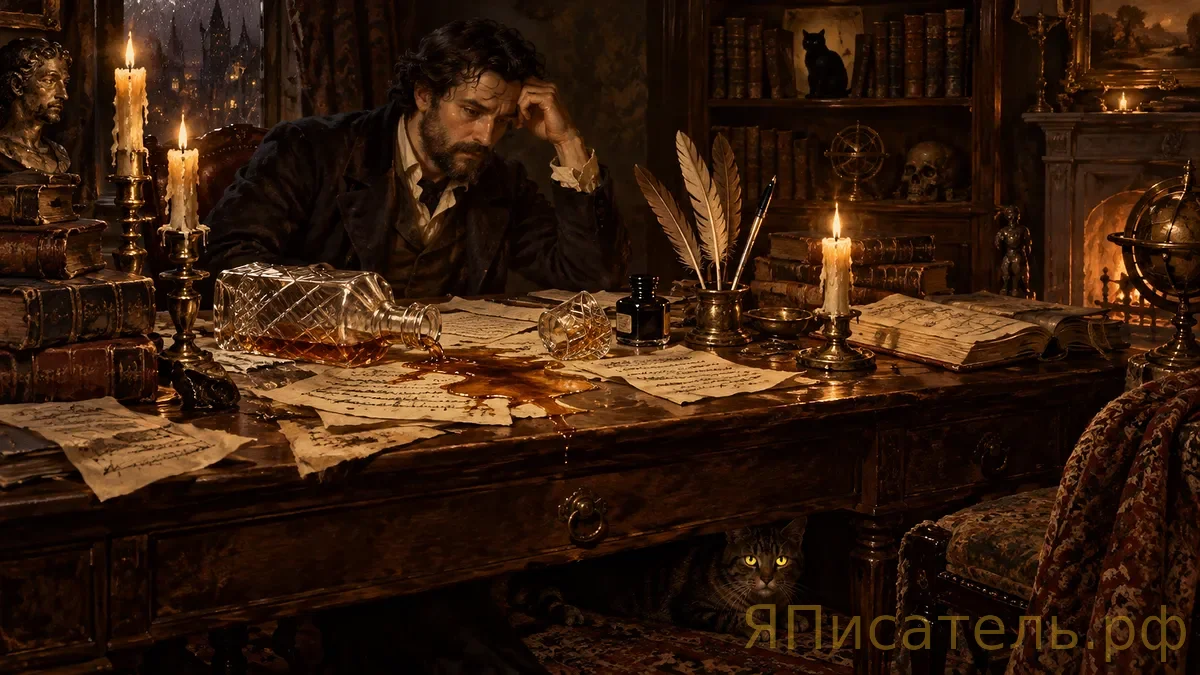
Hemingway Never Said It — But Did Booze Really Write the Great American Novel?
Here's an uncomfortable truth that will ruin your favorite inspirational poster: Ernest Hemingway never said "Write drunk, edit sober." Not once. Not in any letter, interview, or memoir. The quote was invented by a novelist named Peter De Vries in 1964 — and it was a joke. Yet millions of aspiring writers have pinned this fabricated wisdom to their walls, using it as a permission slip to crack open a bottle before cracking open a laptop. The real question isn't whether Hemingway said it. The real question is whether it actually works.
Let's get the irony out of the way first. Hemingway — the man most associated with literary alcoholism — was adamant about never writing while drunk. In a 1935 article for Esquire, he was blunt: "Have you ever heard of anyone who drank while he worked? You're thinking of Faulkner." And even that was a dig, not an endorsement. Hemingway woke up at dawn, wrote standing at his desk in his Havana home, drank nothing stronger than coffee, and didn't touch alcohol until his daily word count was finished. The man who gave us "The Old Man and the Sea" treated mornings like a cathedral — quiet, sober, and sacred.
But here's where it gets interesting, because Faulkner — the one Hemingway was mocking — actually did drink while writing. William Faulkner reportedly kept a bottle of whiskey on his desk while composing "As I Lay Dying," a novel he claimed to have written in six weeks while working the night shift at a power plant. Whether the whiskey helped or not, that book became one of the most experimental and celebrated novels of the twentieth century. So does that prove the myth? Not so fast.
Faulkner also produced plenty of garbage while drunk. His later novels declined in quality precisely as his drinking escalated. By the 1950s, his alcoholism required hospitalizations, and his output suffered dramatically. The same man who wrote "The Sound and the Fury" in a blaze of intoxicated genius couldn't finish a coherent paragraph during his worst benders. Alcohol didn't give Faulkner talent. It just happened to be in the room when talent showed up — and it stuck around long after talent had left.
The list of alcoholic literary legends is so long it's almost a cliche. F. Scott Fitzgerald, Dorothy Parker, Raymond Carver, Jack Kerouac, Edgar Allan Poe, Dylan Thomas, Charles Bukowski, Truman Capote — pick a name from the twentieth-century canon and there's a decent chance they had a complicated relationship with a bottle. Five of the seven American Nobel Prize winners in literature were alcoholics. That's not a coincidence, but it's also not causation. It's a tragedy dressed up as a tradition.
Here's what actually happens in your brain when you drink and try to write. Alcohol suppresses the prefrontal cortex — the part responsible for judgment, self-censorship, and executive function. This is why your drunk texts feel so eloquent at 2 a.m. and so catastrophic at 7 a.m. In small doses, this suppression can feel liberating. The inner critic shuts up. The words flow more freely. A 2012 study from the University of Illinois found that mildly intoxicated participants solved creative word-association problems faster and more accurately than sober ones. The researchers called it the "creative sweet spot" — just buzzed enough to lower inhibitions, not drunk enough to lose coherence.
But — and this is the "but" that ruins the party — the same study found that drunk participants were terrible at analytical tasks, editing, and revision. In other words, alcohol might help you generate raw material, but it actively sabotages your ability to shape that material into anything worth reading. The "write drunk" part has a sliver of scientific backing. The "edit sober" part isn't just good advice — it's neurological necessity.
The problem is that most people who romanticize drinking and writing skip right past the editing part. They remember Kerouac typing "On the Road" on a continuous scroll of paper in a three-week amphetamine frenzy, and they think that's how great literature happens. What they forget is that Kerouac spent years revising that manuscript before it was published in 1957, and his editor Malcolm Cowley cut and restructured it substantially. The scroll was a first draft. The book was the product of sober, painstaking work.
Raymond Carver is perhaps the most instructive case. During his drinking years, Carver produced some stories, but he was barely functional — missing deadlines, destroying relationships, getting fired from jobs. It wasn't until he got sober in 1977 that he wrote the stories that made him famous. "Cathedral," "What We Talk About When We Talk About Love," "A Small, Good Thing" — all written stone-cold sober. Carver himself said that getting sober was the best thing that ever happened to his writing. Not because sobriety gave him ideas, but because it gave him the discipline to actually finish them.
Stephen King tells a similar story. During the 1980s, King was writing bestsellers while consuming a case of beer a day and mountains of cocaine. He doesn't remember writing "Cujo" at all. Let that sink in — one of the most successful novelists alive has zero memory of creating an entire book. When he got sober in 1988, his writing didn't get worse. It got better. "Misery," "The Green Mile," "11/22/63" — all products of a clear mind. King has said bluntly that the idea of the alcoholic genius writer is "the biggest myth going."
So what's really happening when we celebrate the drunk writer? We're confusing correlation with causation, and more dangerously, we're romanticizing self-destruction. Writing is hard. It requires sitting alone with your thoughts and making something from nothing. That's terrifying. Alcohol makes terrifying things feel manageable. It's not that booze makes you a better writer — it's that writing makes you want to drink. The bottle isn't a tool. It's a coping mechanism that literary culture has rebranded as a method.
There's also a survivorship bias at work. We remember the alcoholic writers who produced masterpieces. We don't talk about the thousands of equally talented writers whose drinking killed them before they finished anything. Brendan Behan died at 41. Dylan Thomas at 39. Jack London at 40. Malcolm Lowry at 47. For every Faulkner who stumbled through genius, there are a hundred writers who just stumbled.
The truth is unglamorous but useful: the best writing comes from a mind that can access both chaos and control. You need the wildness to generate ideas and the discipline to execute them. Some writers achieve that wildness through alcohol. Others through meditation, long walks, insomnia, heartbreak, or simply staring at a wall until something clicks. The method doesn't matter. What matters is showing up to the page with enough clarity to actually do the work.
So the next time you see that fake Hemingway quote on a coffee mug, remember this: the man it's attributed to never said it, the writers who actually drank mostly wished they hadn't, and the science says your best creative work happens at about one beer — not one bottle. Write curious. Write scared. Write angry. Write obsessed. And yes, edit sober. But maybe skip the drunk part entirely. Your liver — and your second draft — will thank you.
Pega este código en el HTML de tu sitio web para incrustar este contenido.