The Works of Edgar Allan Poe — Volume 4
Vista Previa del Libro
Autor
Edgar Allan Poe
Fecha de Publicación
27 de febrero de 2026, 19:01
Género
Portada del Libro
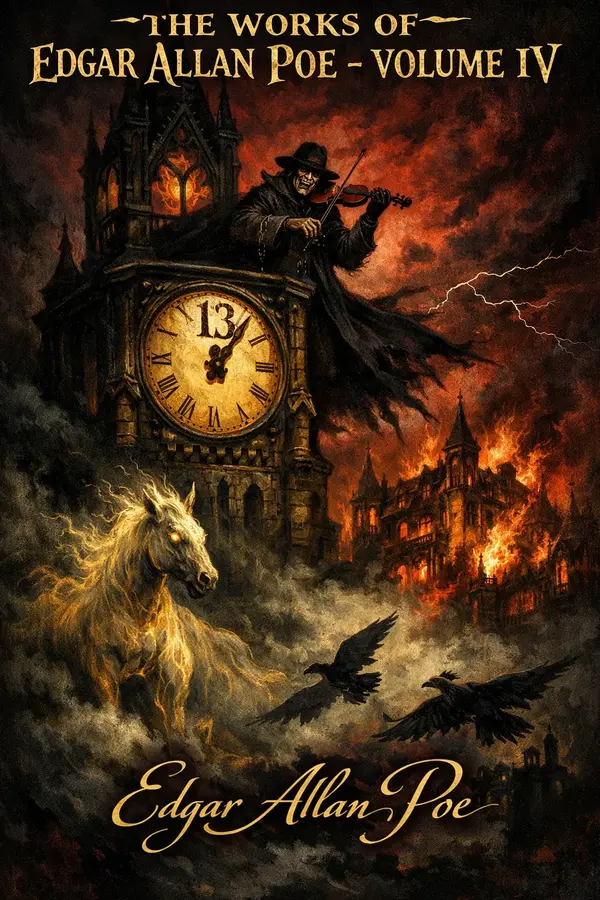
Resumen General del Libro
The Works of Edgar Allan Poe — Volume 4 is a richly varied collection that reveals the full breadth of one of American literature's most singular minds. While Poe is celebrated as a master of Gothic terror, this volume showcases an equally formidable gift for dark satire, grotesque comedy, philosophical fantasy, and social burlesque — dimensions of his genius that remain as electrifying as his tales of dread. The collection opens with 'The Devil in the Belfry,' a satirical fable about the impossibly ordered Dutch borough of Vondervotteimittiss, where life revolves entirely around clocks and cabbages, and where no one has ever ventured beyond the surrounding hills. Into this hermetic paradise arrives a sinister, fiddle-wielding stranger who ascends the belfry, beats the belfry-man senseless, and strikes the great bell thirteen at noon — shattering the orderly world irreparably. The tale is a comic parable about conformity, insularity, and the chaos that lurks beyond any self-imposed perfection. The Gothic register arrives fully realized in 'Metzengerstein,' an early and atmospheric tale of ancestral hatred between two Hungarian noble houses. Young Baron Frederick Metzengerstein, dissolute and malevolent, becomes supernaturally bound to a mysterious horse — a creature many believe carries the transmigrated soul of his dead enemy, old Count Berlifitzing. The story builds to a fiery, apocalyptic conclusion, as horse and rider vanish into the burning ruins of the château, leaving only a ghostly column of smoke in the shape of a horse against the night sky. 'The System of Doctor Tarr and Professor Fether' is perhaps the collection's most wickedly comic masterpiece. A young traveler visits a remote French asylum, is entertained lavishly by the suave Monsieur Maillard, and gradually realizes — too late — that the lunatics have long since overpowered their keepers, confined them in underground cells, and are themselves running the institution. The story's twist is both hilarious and unsettling, a perfect inversion of reason and madness. 'X-ing a Paragrab' lampoons journalistic rivalry with typographical absurdity: the obstinate editor Bullet-head, challenged to write without the letter O, produces a paragraph so saturated with the vowel that when his rival steals every O from his print shop, it is published with X substituted throughout — a hieroglyphic scandal that baffles an entire town. 'The Literary Life of Thingum Bob, Esq.' offers a sharp and sustained parody of literary ambition, editorial back-scratching, and the hollow mutual praise of the nineteenth-century press. The companion pieces 'How to Write a Blackwood Article' and 'A Predicament' construct the gloriously absurd Signora Psyche Zenobia, who follows Mr. Blackwood's instructions for sensation-writing so faithfully that she ends up trapped in a clock tower, decapitated by the great minute-hand — and narrates her own grotesque end with perverse philosophical composure. 'Mystification' introduces the unforgettable Baron Ritzner von Jung, a Hungarian aristocrat whose impassive, gravity-laden face conceals a genius for elaborate deception. He engineers the most outrageous pranks while appearing, to all observers, to be their most earnest opponent — a portrait of controlled, brilliant mischief. Beyond these major pieces, the volume contains metaphysical dialogues exploring the soul and cosmic catastrophe ('The Power of Words,' 'The Colloquy of Monos and Una,' 'The Conversation of Eiros and Charmion'), the dreamlike 'Shadow — A Parable,' and further tales of the absurd and the arabesque. Together, they confirm Poe as an author of staggering versatility — equally capable of constructing existential dread, exposing human folly with surgical wit, and conjuring visions of cosmic grandeur from the depths of a singular imagination.
Tabla de Contenidos
Extracto del Libro
THE DEVIL IN THE BELFRY
What o’clock is it?—_Old Saying_.
Everybody knows, in a general way, that the finest place in the
world is—or, alas, _was_—the Dutch borough of
Vondervotteimittiss. Yet as it lies some distance from any of the
main roads, being in a somewhat out-of-the-way situation, there
are perhaps very few of my readers who have ever paid it a visit.
For the benefit of those who have not, therefore, it will be only
proper that I should enter into some account of it. And this is
indeed the more necessary, as with the hope of enlisting public
sympathy in behalf of the inhabitants, I design here to give a
history of the calamitous events which have so lately occurred
within its limits. No one who knows me will doubt that the duty
thus self-imposed will be executed to the best of my ability,
with all that rigid impartiality, all that cautious examination
into facts, and diligent collation of authorities, which should
ever distinguish him who aspires to the title of historian.
By the united aid of medals, manuscripts, and inscriptions, I am
enabled to say, positively, that the borough of
Vondervotteimittiss has existed, from its origin, in precisely
the same condition which it at present preserves. Of the date of
this origin, however, I grieve that I can only speak with that
species of indefinite definiteness which mathematicians are, at
times, forced to put up with in certain algebraic formulae. The
date, I may thus say, in regard to the remoteness of its
antiquity, cannot be less than any assignable quantity
whatsoever.
Touching the derivation of the name Vondervotteimittiss, I
confess myself, with sorrow, equally at fault. Among a multitude
of opinions upon this delicate point—some acute, some learned,
some sufficiently the reverse—I am able to select nothing which
ought to be considered satisfactory. Perhaps the idea of
Grogswigg—nearly coincident with that of Kroutaplenttey—is to be
cautiously preferred.—It runs:—“Vondervotteimittis—Vonder, lege
Donder—Votteimittis, quasi und Bleitziz—Bleitziz obsol:—pro
Blitzen.” This derivative, to say the truth, is still
countenanced by some traces of the electric fluid evident on the
summit of the steeple of the House of the Town-Council. I do not
choose, however, to commit myself on a theme of such importance,
and must refer the reader desirous of information to...
¿Listo para Leer Más?
Descubre la historia completa y todos los capítulos
Ya disponible en nuestra tienda