Leviathan
Vista Previa del Libro
Autor
Thomas Hobbes
Fecha de Publicación
20 de febrero de 2026, 11:42
Género
Portada del Libro
Resumen General del Libro
Leviathan, written by Thomas Hobbes and published in 1651, is one of the most influential works of political philosophy in Western intellectual history. The treatise systematically constructs a comprehensive theory of human nature, society, and government, arguing for the necessity of a strong, centralized sovereign authority to prevent the chaos of the natural human condition. The work is divided into four parts. Part I, 'Of Man,' lays the philosophical groundwork by examining human cognition, beginning with sense perception and imagination, progressing through the nature of speech, reason, and science. Hobbes develops a materialist and mechanistic account of human psychology, arguing that all thought originates in sensory experience and that reason itself is essentially a form of computation—the adding and subtracting of concepts. He provides detailed analyses of the passions—desire, aversion, hope, fear, love, hatred, and ambition—showing how these interior motions drive all voluntary human action. Crucially, Hobbes argues that human beings are driven by 'a perpetuall and restlesse desire of Power after power, that ceaseth onely in Death.' This analysis culminates in his famous depiction of the 'state of nature'—the condition of mankind without government—as a war of 'every man against every man,' where life is 'solitary, poore, nasty, brutish, and short.' From this bleak premise, Hobbes derives the natural laws that compel rational individuals to seek peace and, through mutual covenant, establish a sovereign authority—the Leviathan, an 'Artificiall Man' of immense power created to maintain order and security. Part II, 'Of Common-wealth,' elaborates the rights and duties of sovereigns and subjects, the nature of civil law, crime, punishment, and the causes of a commonwealth's dissolution. Part III addresses the relationship between civil and ecclesiastical power within a Christian commonwealth, while Part IV critiques what Hobbes calls the 'Kingdom of Darkness'—the spiritual errors and philosophical confusions perpetuated by the Roman Church and scholastic philosophy. Hobbes draws extensively on Scripture, classical philosophy, and history to support his arguments. His work challenged both royalist divine-right theory and parliamentary claims, offering instead a rational, secular foundation for political authority rooted in consent and self-preservation. Leviathan remains essential reading for understanding modern concepts of sovereignty, social contract theory, individual rights, and the relationship between religion and the state.
Tabla de Contenidos
Extracto del Libro
THE INTRODUCTION
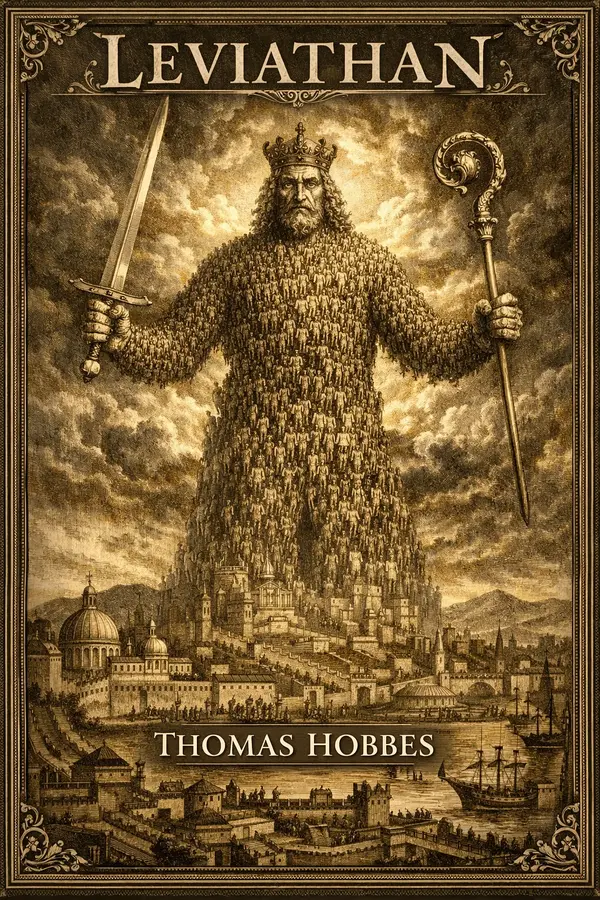
Nature (the art whereby God hath made and governes the world) is by the art of man, as in many other things, so in this also imitated, that it can make an Artificial Animal. For seeing life is but a motion of Limbs, the begining whereof is in some principall part within; why may we not say, that all Automata (Engines that move themselves by springs and wheeles as doth a watch) have an artificiall life? For what is the Heart, but a Spring; and the Nerves, but so many Strings; and the Joynts, but so many Wheeles, giving motion to the whole Body, such as was intended by the Artificer? Art goes yet further, imitating that Rationall and most excellent worke of Nature, Man. For by Art is created that great LEVIATHAN called a COMMON-WEALTH, or STATE, (in latine CIVITAS) which is but an Artificiall Man; though of greater stature and strength than the Naturall, for whose protection and defence it was intended; and in which, the Soveraignty is an Artificiall Soul, as giving life and motion to the whole body; The Magistrates, and other Officers of Judicature and Execution, artificiall Joynts; Reward and Punishment (by which fastned to the seat of the Soveraignty, every joynt and member is moved to performe his duty) are the Nerves, that do the same in the Body Naturall; The Wealth and Riches of all the particular members, are the Strength; Salus Populi (the Peoples Safety) its Businesse; Counsellors, by whom all things needfull for it to know, are suggested unto it, are the Memory; Equity and Lawes, an artificiall Reason and Will; Concord, Health; Sedition, Sicknesse; and Civill War, Death. Lastly, the Pacts and Covenants, by which the parts of this Body Politique were at first made, set together, and united, resemble that Fiat, or the Let Us Make Man, pronounced by God in the Creation.
To describe the Nature of this Artificiall man, I will consider
First the Matter thereof, and the Artificer; both which is Man.
Secondly, How, and by what Covenants it is made; what are the Rights and just Power or Authority of a Soveraigne; and what it is that Preserveth and Dissolveth it.
Thirdly, what is a Christian Common-Wealth.
Lastly, what is the Kingdome of Darkness.
Concerning the first, there is a saying much usurped of late, That Wisedome is acquired, not by reading of Books, but of Men. Consequently whereunto, those persons, that for the most part...
¿Listo para Leer Más?
Descubre la historia completa y todos los capítulos
Ya disponible en nuestra tienda