Frankenstein; Or, The Modern Prometheus
Vista Previa del Libro
Autor
Mary Wollstonecraft Shelley
Fecha de Publicación
20 de febrero de 2026, 11:42
Género
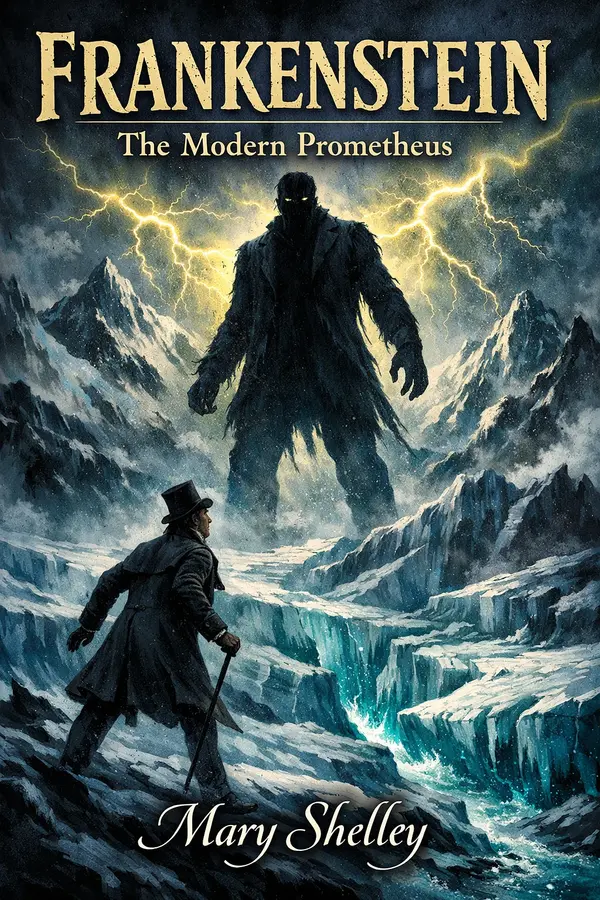
Portada del Libro
Resumen General del Libro
Frankenstein; or, The Modern Prometheus is a Gothic novel framed through nested narratives. The outermost story belongs to Robert Walton, an ambitious Arctic explorer who rescues a mysterious stranger from the ice. That stranger is Victor Frankenstein, a Genevan scientist who relates the harrowing tale of his life. Victor grows up in a loving household alongside his adopted cousin Elizabeth Lavenza and devoted friend Henry Clerval. Consumed by a passion for natural philosophy, he attends the University of Ingolstadt, where he plunges into chemistry and anatomy with obsessive zeal. After years of feverish study, Victor discovers the secret of animating lifeless matter and creates a living being from scavenged body parts. The result is catastrophic. The eight-foot-tall creature fills Victor with immediate horror, and he flees. The abandoned creature wanders into a hostile world. Tragedy strikes when Victor's young brother William is murdered and the servant Justine Moritz is falsely convicted and executed. Victor alone knows the true killer—his creation. Tormented by guilt, Victor retreats to the Alps, where the creature confronts him. In an eloquent narrative, the creature recounts his painful awakening, his secret observation of the De Lacey family, his self-education through their conversations and books including Paradise Lost, and his devastating rejection by humanity. Driven to despair, the creature demands Victor create a female companion. Victor begins the work but destroys the half-finished female, fearing the consequences. The creature's vengeance is swift: Clerval is murdered, Elizabeth is killed on her wedding night, and Victor's father dies of grief. Now utterly alone, Victor pursues the creature across Europe into the frozen Arctic, where Walton finds him. The novel explores scientific hubris, parental responsibility, social rejection, and the dangerous consequences of unchecked ambition. Both creator and creature are tragic figures—Victor destroyed by his refusal to take responsibility, the creature corrupted by a world that offered only cruelty. Shelley's masterwork remains a timeless meditation on what it means to be human and what happens when humanity plays God.
Tabla de Contenidos
Extracto del Libro
[Transcriber’s Note: This text was produced from a photo-reprint of the 1818 edition.]
FRANKENSTEIN;
OR,
THE MODERN PROMETHEUS.
IN THREE VOLUMES. VOL. I.
London:
_PRINTED FOR_ LACKINGTON, HUGHES, HARDING, MAVOR, & JONES, FINSBURY SQUARE.
1818.
* * * * *
Did I request thee, Maker, from my clay To mould me man? Did I solicit thee From darkness to promote me?——
Paradise Lost.
* * * * *
_TO_ WILLIAM GODWIN, _AUTHOR OF POLITICAL JUSTICE, CALEB WILLIAMS, &c._ THESE VOLUMES _Are respectfully inscribed_ BY THE AUTHOR.
PREFACE.
The event on which this fiction is founded has been supposed, by Dr. Darwin, and some of the physiological writers of Germany, as not of impossible occurrence. I shall not be supposed as according the remotest degree of serious faith to such an imagination; yet, in assuming it as the basis of a work of fancy, I have not considered myself as merely weaving a series of supernatural terrors. The event on which the interest of the story depends is exempt from the disadvantages of a mere tale of spectres or enchantment. It was recommended by the novelty of the situations which it developes; and, however impossible as a physical fact, affords a point of view to the imagination for the delineating of human passions more comprehensive and commanding than any which the ordinary relations of existing events can yield.
I have thus endeavoured to preserve the truth of the elementary principles of human nature, while I have not scrupled to innovate upon their combinations. The _Iliad_, the tragic poetry of Greece,—Shakespeare, in the _Tempest_ and _Midsummer Night’s Dream_,—and most especially Milton, in _Paradise Lost_, conform to this rule; and the most humble novelist, who seeks to confer or receive amusement from his labours, may, without presumption, apply to prose fiction a licence, or rather a rule, from the adoption of which so many exquisite combinations of human feeling have resulted in the highest specimens of poetry.
The circumstance on which my story rests was suggested in casual conversation. It was commenced, partly as a source of amusement, and partly as an expedient for exercising any untried resources of mind. Other motives were mingled with these, as the work proceeded. I am by no means indifferent to the manner in which whatever moral tendencies exist in the sentiments or characters it contains shall affect...
¿Listo para Leer Más?
Descubre la historia completa y todos los capítulos
Ya disponible en nuestra tienda