Umberto Eco Predicted Your TikTok Feed — In 1980
Ten years ago today, the world lost Umberto Eco — a man who disguised a manual for surviving the information age as a medieval murder mystery. We mourned him with quotes on social media, which is exactly the kind of irony he would have savored like a good Barolo. But here's the thing nobody talks about: Eco didn't just write novels. He built intellectual time bombs that keep detonating in our feeds, our politics, and our conspiracy-drunk culture with frightening precision.
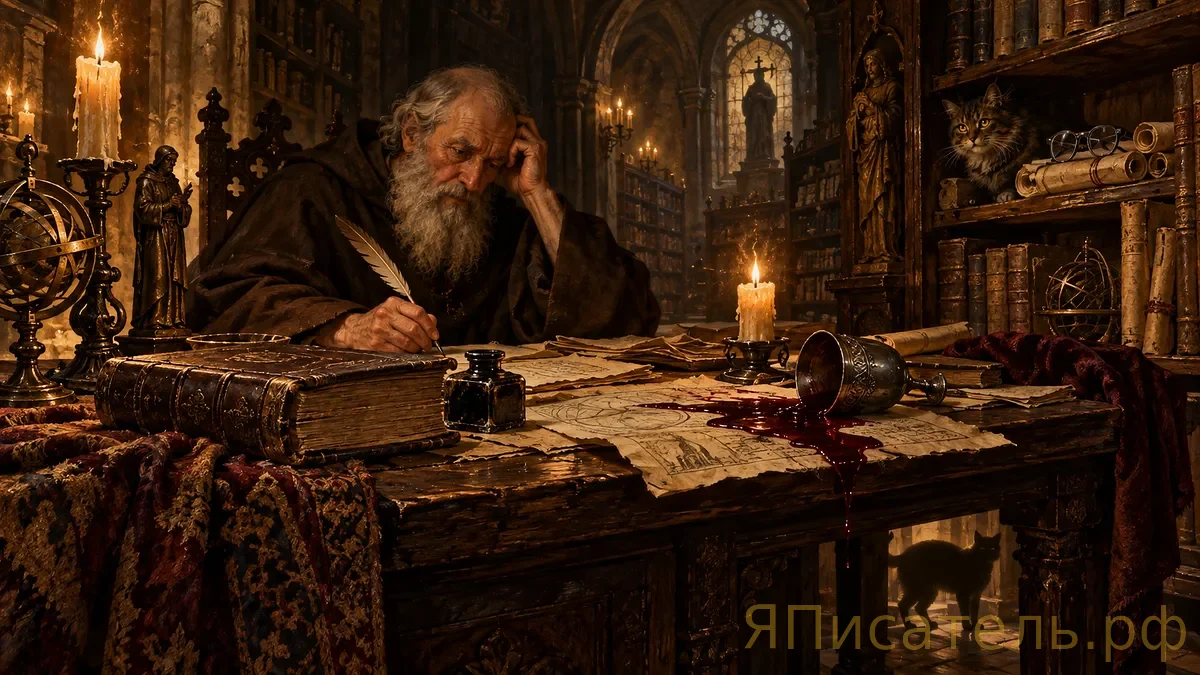
Let's start with the elephant in the scriptorium. The Name of the Rose, published in 1980, is technically about a Franciscan friar solving murders in a 14th-century Italian abbey. Technically. What it's actually about is what happens when institutions decide that knowledge is dangerous and laughter is heresy. The villain — spoiler alert for a 46-year-old book — is a blind librarian who poisons anyone who tries to read Aristotle's lost treatise on comedy. He believes that if people learn to laugh at authority, the whole power structure collapses. Sound familiar? Every time a government bans a book, every time a platform shadow-bans satire, every time someone gets fired for a joke — Jorge of Burgos wins another round.
But here's where Eco gets genuinely prophetic. Foucault's Pendulum, published in 1988, is the novel that should be required reading in every high school on Earth right now. Three bored editors at a vanity press decide, as a joke, to invent a grand conspiracy theory connecting the Knights Templar, the Freemasons, the Rosicrucians, and basically every secret society that ever existed. They feed random historical data into a computer — this is 1988, mind you — and let the machine find connections. The machine obliges. It always does. And then people start believing the made-up conspiracy. And then people start dying for it.
Read that paragraph again and tell me it doesn't describe QAnon, flat Earth theory, and half the content on YouTube with surgical accuracy. Eco understood something that most of us only grasped around 2016: the human brain is a pattern-recognition machine that doesn't come with an off switch. Give people enough data and enough anxiety, and they will connect the dots into any shape that makes them feel like they're in on the secret. Eco wrote this thirty-eight years ago. He wrote it as a warning. We read it as a manual.
What makes Eco different from your average doom-and-gloom intellectual is that the man was genuinely, almost obnoxiously fun. He collected over 50,000 books. He wrote essays about Superman and James Bond with the same rigor he applied to Thomas Aquinas. He once gave a legendary lecture on the semiotics of blue jeans — arguing that tight pants literally change the way you think because you're constantly aware of your body. This wasn't a man locked in an ivory tower. This was a man who believed that everything, from trash television to medieval theology, was worth thinking about seriously.
His concept of the "open work" — the idea that a text's meaning isn't fixed by the author but co-created by the reader — anticipated the entire culture of fan fiction, remix, memes, and participatory media by decades. When someone makes a TikTok reinterpreting a scene from a movie, when fans write alternative endings to their favorite shows, when a meme transforms a politician's quote into something entirely new — they're living inside Eco's theory. He argued for this in 1962. Instagram launched in 2010. The man was operating on a different calendar.
And then there's the essay that haunts me the most: "Ur-Fascism," published in The New York Review of Books in 1995. Eco, who grew up under Mussolini and watched Italy liberate itself, laid out fourteen features of what he called "eternal fascism." Not a checklist — more like a constellation. The cult of tradition. The rejection of modernism. Disagreement as treason. Fear of difference. Appeal to a frustrated middle class. Obsession with a plot. The enemy is simultaneously too strong and too weak. Every few years, this essay goes viral again, because every few years, we look around and realize Eco was describing our Tuesday.
The irony — and Eco loved irony the way some people love oxygen — is that the man who warned us about conspiracy thinking is now himself the subject of a kind of reverence that borders on the conspiratorial. "Eco predicted everything!" people say, as if he were some sort of Italian Nostradamus. He wasn't. He was a semiotician — someone who studied signs and meaning for a living. He didn't predict the future. He understood the present so deeply that the future just kept rhyming with his observations.
There's a quote attributed to him — and this one is actually verified — from 2015, the year before he died: "Social media gives legions of idiots the right to speak when they once only spoke at a bar after a glass of wine, without harming the community. Then they were quickly silenced, but now they have the same right to speak as a Nobel Prize winner. It's the invasion of the idiots." Harsh? Absolutely. Wrong? Open your replies tab and get back to me.
But Eco wasn't an elitist snob, despite what that quote might suggest. His novels are dense, yes — The Name of the Rose has entire passages in untranslated Latin — but they're also page-turners. They have murders, chases, sex in kitchens, buildings on fire. He proved that you could be both intellectually rigorous and wildly entertaining. That you didn't have to choose between being smart and being readable. In a world where literary fiction and popular fiction are treated like rival gangs, Eco walked between them like a man who'd brokered the peace deal.
So what does Umberto Eco mean ten years after his death? He means that the labyrinth is the shape of reality, not a puzzle to be solved. He means that knowledge without humor is tyranny, and humor without knowledge is noise. He means that every time you fall down a Wikipedia rabbit hole at 2 AM, connecting medieval history to modern politics to a half-remembered dream, you're doing exactly what his characters do — and you should be both delighted and terrified by that.
Pick up The Name of the Rose this week. Or Foucault's Pendulum. Read them not as historical curiosities but as survival guides for the age of information overload. Because the library is burning again, and this time it's not a blind monk with poison — it's all of us, scrolling through the flames, looking for the pattern that will finally make it all make sense. Eco knew there wasn't one. That's the lesson. That's the gift. And ten years on, we still haven't unwrapped it.
Paste this code into your website HTML to embed this content.