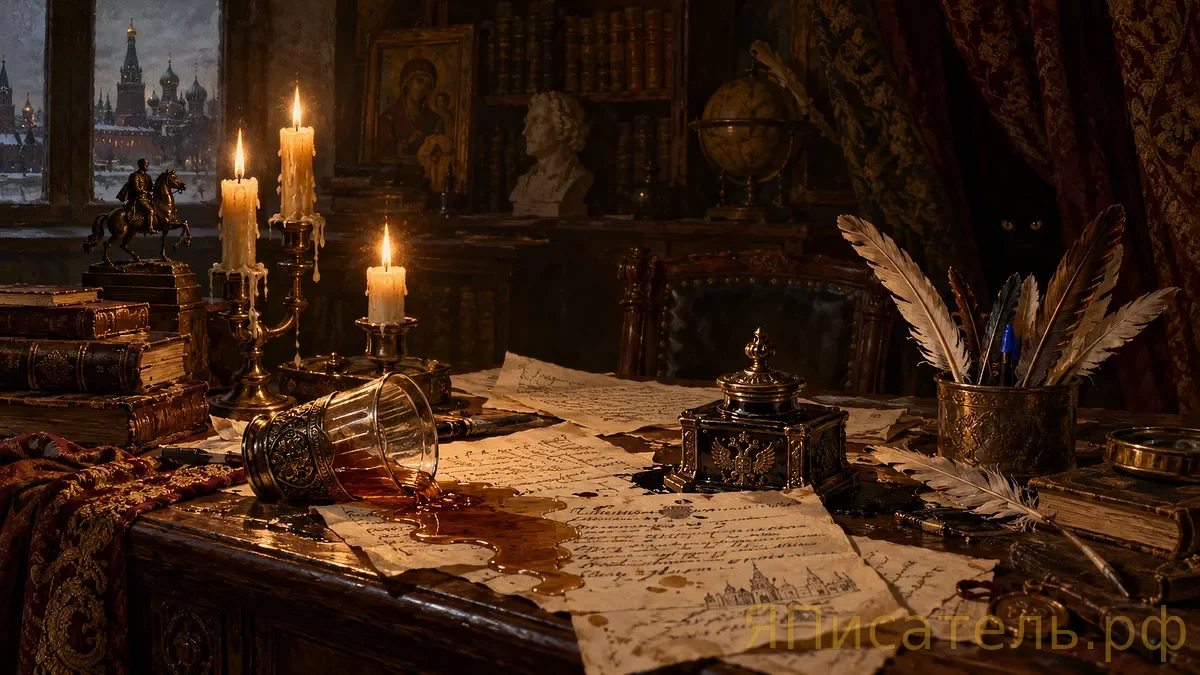
The Man Who Said 'No' to Stalin and 'Maybe' to the Nobel: Boris Pasternak's Wild Ride Through Soviet Literature
Imagine being so good at writing that your own government wants to kill you for it. That's basically the Boris Pasternak experience. Born 136 years ago today, this poet-turned-novelist managed to pull off what might be the most spectacular literary middle finger in history: writing a book so beautiful and so dangerously honest that it got him nominated for the Nobel Prize and nearly executed in the same breath.
Boris Leonidovich Pasternak came screaming into the world on February 10, 1890, in Moscow, into what we might call an embarrassingly talented family. His father was Leonid Pasternak, a Post-Impressionist painter who hung out with Leo Tolstoy like it was no big deal. His mother was Rosa Kaufman, a concert pianist who had performed across Europe. So while most kids were learning to tie their shoes, young Boris was probably composing symphonies and debating the meaning of existence with bearded novelists at the dinner table.
Here's where it gets interesting: Pasternak didn't even want to be a writer at first. He studied music composition, planning to follow in mama's footsteps. Then he switched to philosophy at the University of Marburg in Germany. Philosophy! The man who would eventually write one of the most emotionally devastating novels of the twentieth century was sitting around arguing about Kant and Hegel. But literature kept tugging at his sleeve like an insistent child, and by 1914, he'd published his first collection of poems. The rest, as they say, is extremely complicated Soviet history.
For decades, Pasternak was known primarily as a poet, and not just any poet – he was considered one of the greatest of his generation. His early work was associated with the Futurists, those wild avant-garde types who wanted to throw Pushkin off the steamship of modernity. But Pasternak was never fully on board with any movement. He was too busy being himself, which involved writing verses of such compressed intensity that reading them feels like staring into the sun. His poetry collections – 'My Sister, Life' and 'Themes and Variations' – established him as a major voice, someone who could make the Russian language do backflips.
But here's the thing about being a brilliant poet in the Soviet Union: it's a bit like being a world-class tightrope walker over a pit of crocodiles. The crocodiles are the censors, and they're always hungry. Pasternak managed to survive the Stalin years partly through luck, partly through careful navigation, and partly because he was useful as a translator. When you can't publish your own controversial work, translating Shakespeare and Goethe keeps you fed and, more importantly, alive. His translations of 'Hamlet' and 'Faust' are still considered definitive in Russian.
Then came Doctor Zhivago. Oh boy, then came Doctor Zhivago. Pasternak worked on this novel for over a decade, and when he finished it in 1956, he had created something unprecedented: an epic love story set against the Russian Revolution and Civil War that dared to suggest – hold onto your hats – that maybe the Revolution wasn't entirely a good thing for everyone involved. The Soviet literary establishment took one look at it and said, essentially, 'publish this and you're dead.' So naturally, Pasternak smuggled the manuscript to Italy, where it was published in 1957. The book became an international sensation, was translated into dozens of languages, and won the Nobel Prize for Literature in 1958.
What happened next is both absurd and heartbreaking. The Soviet authorities went absolutely ballistic. The Writers' Union expelled him. Newspapers ran orchestrated campaigns calling him a traitor and a pig. Regular citizens who had never read the book wrote letters demanding his exile. Pasternak was forced to decline the Nobel Prize – becoming the first person in history to do so involuntarily. His famous telegram to the Swedish Academy read: 'In view of the meaning given to this honor in the community to which I belong, I should abstain from the undeserved prize that has been awarded to me. Do not take my voluntary refusal amiss.' Voluntary. Sure.
The novel itself is a masterpiece of psychological complexity wrapped in historical sweep. Yuri Zhivago, the poet-doctor protagonist, is essentially Pasternak's alter ego – a sensitive soul trying to make sense of a world turned upside down by ideology and violence. The love story between Zhivago and Lara Antipova is so achingly beautiful that David Lean turned it into a three-hour film with Omar Sharif and Julie Christie, complete with that balalaika theme you've definitely heard at least once in your life. But the book is more than romance; it's a meditation on individual conscience versus collective demand, on art versus propaganda, on the human spirit's stubborn refusal to be crushed.
Pasternak died on May 30, 1960, just two years after the Nobel debacle, officially from lung cancer but probably also from a broken heart. The Soviet system had won, in a sense – they'd humiliated him, isolated him, and denied him his rightful recognition. But here's the beautiful irony: Doctor Zhivago outlived the Soviet Union by decades. It's still read, still loved, still adapted. The book that was supposed to be silenced became immortal.
What makes Pasternak's story so compelling isn't just the political drama – it's what he represented. In an age of ideological certainty, he insisted on ambiguity. In a society that demanded conformity, he wrote about individual experience. He wasn't a dissident in the traditional sense; he didn't organize protests or write manifestos. He just told the truth as he saw it, which turned out to be the most dangerous thing of all.
So raise a glass to Boris Pasternak on his 136th birthday. Raise it to the poets who refuse to be silenced, to the novelists who smuggle their manuscripts across borders, to the artists who would rather lose everything than compromise their vision. In a world that still struggles with censorship and conformity, his example burns as brightly as ever. As Zhivago himself might have said, art doesn't take sides – but that doesn't mean it can't change the world.
Paste this code into your website HTML to embed this content.