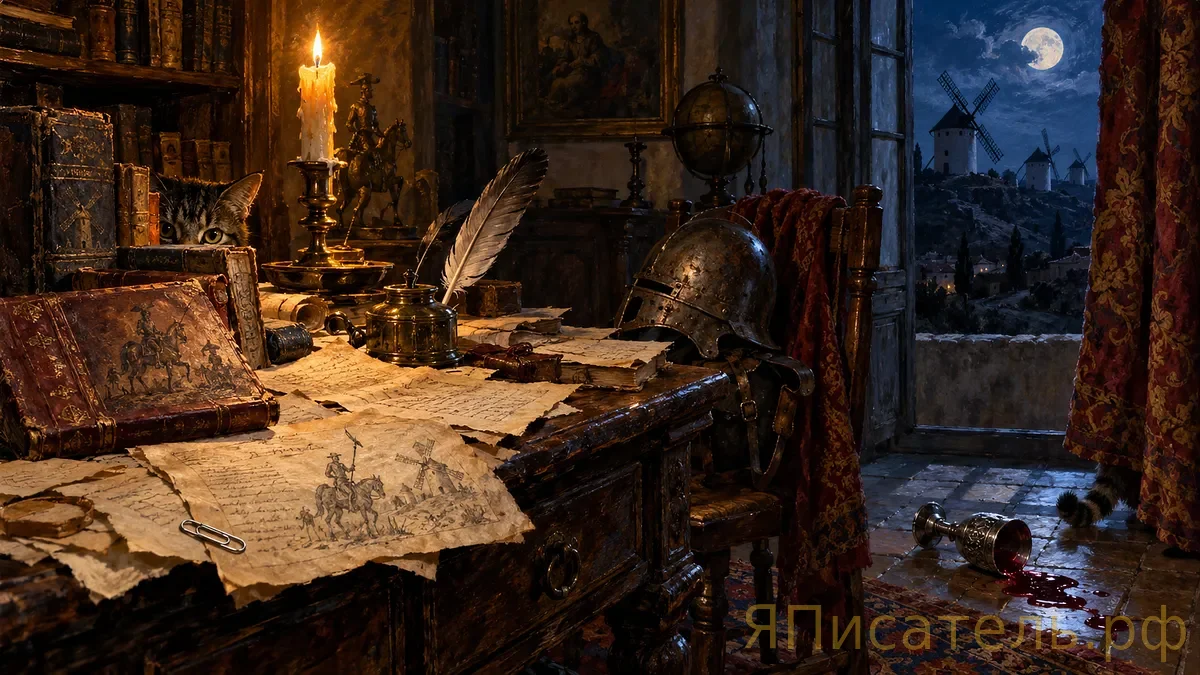
The Knight's Last Dream: A Lost Chapter of Don Quixote
Creative continuation of a classic
This is an artistic fantasy inspired by «Don Quixote» by Miguel de Cervantes. How might the story have continued if the author had decided to extend it?
Original excerpt
For me alone Don Quixote was born and I for him. His was the power of action, mine of writing. Only we two are at one, despite that fictitious and Tordesillesque scribbler who has dared, and may dare again, to write with a coarse and ill-trimmed ostrich quill of the deeds of my valorous knight. This is no burden for his shoulders, no subject for his frozen wit. And if you should chance to meet him, tell him to let the weary, crumbling bones of Don Quixote rest in his grave, and not try to take him off, contrary to all the laws of death, to Old Castile, raising him from the tomb where he really and truly lies stretched out at full length, wholly unable to make a third expedition or new sally.
Continuation
In those final hours, when Alonso Quixano the Good had closed his eyes for what all believed would be eternity, something most wondrous occurred in the chamber where he lay. The candles, which had burned low through the night of vigil, suddenly flared with renewed vigor, casting dancing shadows upon the walls that seemed to take the forms of giants and enchanted castles.
Sancho Panza, who had refused to leave his master's side despite the protests of the housekeeper and the niece, was the first to witness what transpired. The good squire had been weeping silently into his hands, mourning not merely the loss of a master but of a world entire—a world where windmills might truly be giants and where a simple barber's basin could serve as the most magnificent of helmets.
"Your worship," Sancho whispered through his tears, "who shall now set right the wrongs of this world? Who shall defend the honor of distressed damsels and challenge the wicked enchanters who plague honest folk?"
It was then that Don Quixote—for in that moment he was Don Quixote once more, and not the penitent Alonso Quixano—opened his eyes. They shone with a light that seemed borrowed from some other realm, some place where the boundaries between the real and the imagined had never been drawn.
"Sancho, my faithful friend," spoke the knight, his voice carrying a strength that moments before had seemed utterly extinguished, "I have seen such things as would make the adventures of Amadís of Gaul seem but the sport of children."
Sancho leapt from his chair with such violence that he overturned the basin of water the housekeeper had left for bathing the dying man's brow. "Master! You live! The enchanters have restored you!"
"Peace, good Sancho," Don Quixote replied, raising a hand that trembled but did not fall. "I have journeyed to a place beyond the reach of even the most powerful enchanter. I have spoken with knights long passed from this mortal coil—with Sir Lancelot himself, and with the great Amadís, and with champions whose names are written in books not yet composed."
The commotion brought the housekeeper rushing into the chamber, followed closely by the niece and the curate, who had been keeping vigil in the adjoining room. They found Sancho dancing about the bed in a manner most unseemly for a man of his years and girth, crying out, "A miracle! A miracle! The knight errant lives!"
"What madness is this?" demanded the housekeeper, crossing herself repeatedly. "The physician declared him dead not an hour past!"
"The physician," Don Quixote said with something of his old imperious manner, "knows nothing of the matters that concern knights errant. His science extends only to the mortal frame, while we who follow the path of chivalry traffic in immortal things."
The curate, a man of learning and no little wisdom, approached the bed with caution. He had seen his friend renounce his delusions, had witnessed what he believed to be the triumph of reason over madness. Now he saw before him a face transformed—not by the peace of death but by something altogether more troubling.
"Señor Quixano," the curate began carefully, "you have been gravely ill. The physician—"
"The physician may call me what names he pleases," interrupted the knight, "but I know now what I am and what I have always been. In my vision, I stood before a great assembly of all the knights who ever lived or ever shall live. And do you know what they told me, good curate?"
"I tremble to hear it," the curate admitted.
"They told me that my error was not in believing myself a knight—for that I truly am and shall remain—but in allowing the world to convince me otherwise. They showed me that every giant I faced was indeed a giant, though it wore the disguise of a windmill. Every army I charged was an army in truth, though the enchanters had made it appear as a flock of sheep. The enchantment, dear friends, was not in my perception but in yours."
Sancho's tears had dried, replaced by a smile of such radiant joy that it seemed to illuminate the entire chamber. "I knew it, your worship! I always knew that those were true giants! Did I not say, when I was picking wool from my teeth after the battle with the sheep, that there was something most suspicious about the whole affair?"
"You did, my faithful squire. And you were right to question what your eyes reported. For the eyes may be deceived, but the heart knows truth."
The niece, who had been standing in the doorway wringing her hands, now spoke with considerable agitation. "Uncle, you cannot mean to return to those dangerous follies! You have already been beaten, bruised, imprisoned, and mocked throughout all of La Mancha. Must you invite more suffering?"
"Niece," Don Quixote replied with great gentleness, "suffering is the coin with which glory is purchased. I have learned in my journey beyond the veil that every blow I received was transformed in the celestial accounts into a jewel of honor. The enchanters may humble the body, but they cannot touch the spirit that refuses to be humbled."
The curate exchanged a troubled glance with the housekeeper. He had believed his friend cured, had celebrated what he thought was the restoration of a lost soul to reason. Now he saw that the battle was not over—that perhaps it could never be over.
"And what," the curate asked slowly, "do you propose to do now?"
Don Quixote attempted to rise from his bed, and though his body protested mightily, he managed to sit upright. The moonlight streaming through the window fell upon his gaunt features, lending them a noble aspect that even his detractors could not deny.
"I shall not ride forth again," he said, and Sancho's face fell. "No, my body has earned its rest. But there is another manner of knight-errantry that requires no horse, no armor, no lance."
"What manner is that, your worship?" Sancho asked eagerly.
"The knight-errantry of the spirit, good Sancho. I shall write down all that I have learned, all the wisdom imparted to me by the great knights in my vision. I shall compose a book that will serve as a guide for all who would pursue the noble calling, that future generations may know how to see through the disguises of enchanters and recognize giants for what they truly are."
"But master," Sancho said, his brow furrowed with the effort of thought, "there is already a book written about your worship's adventures. That bachelor Sansón Carrasco told us of it himself."
"Ah, but that book," Don Quixote said, "tells only what happened to my body. The book I shall write will tell what happened to my soul. And I shall require your assistance, Sancho, for you have been witness to truths that no other living man has seen."
Sancho puffed out his chest with pride. "Your worship may count on me, as always. Though I confess I know nothing of book-writing."
"You know more than you imagine, my friend. You know that a man may be mocked by all the world and yet stand in possession of a truth the mockers cannot comprehend. You know that loyalty and faith are worth more than all the gold in the Indies. These things I shall need you to help me remember."
The housekeeper, who had been clutching her rosary throughout this exchange, now burst into tears. "He is still mad," she wailed. "The fever has not broken but merely changed its form!"
But the curate was no longer so certain. He looked upon his old friend and saw something he had not seen before—a peace that seemed to come from a place beyond the reach of physicians and philosophers alike.
"Perhaps," the curate said slowly, "perhaps there is wisdom in what Don Quixote says. For what is faith itself but a kind of noble madness? We believe in things we cannot see, trust in promises we cannot prove. Perhaps the knight errant and the man of God are not so different as I once supposed."
Don Quixote smiled and extended his hand to the curate. "You begin to understand, my friend. The world calls me mad because I see what others cannot. But is the dreamer mad, or is it the world that refuses to dream?"
They remained thus for many hours, speaking of things that the housekeeper declared were beyond her understanding and the niece feared would lead to no good end. But Sancho listened with rapt attention, and in the days that followed, he proved a faithful scribe, recording his master's words with a devotion that surprised all who knew him.
And whether Don Quixote truly died that night and was restored by some miracle, or whether the physician had simply been mistaken in his diagnosis, none could say for certain. What is known is that he lived for many months more, dictating to Sancho a treatise on the spiritual dimensions of knight-errantry that was never published but was said to have circulated in manuscript among certain learned men who read it with great interest.
As for Sancho, he never again mounted a donkey without remembering the adventures he had shared with his master, and he never passed a windmill without pausing to look at it very carefully indeed—for one could never be certain, he told his grandchildren, when an enchanter might choose to reveal a giant's true form to those who had eyes to see it.
Thus concludes this chapter that was not written by the original chronicler of Don Quixote's adventures, but which certain scholars maintain was found among papers in Toledo, written in Arabic characters by Cide Hamete Benengeli, who appended to it only this observation: that of all the lies men tell, the most beautiful are those they tell in service of truth, and of all the madmen who have walked the earth, the noblest are those who are mad enough to believe in goodness.
Paste this code into your website HTML to embed this content.