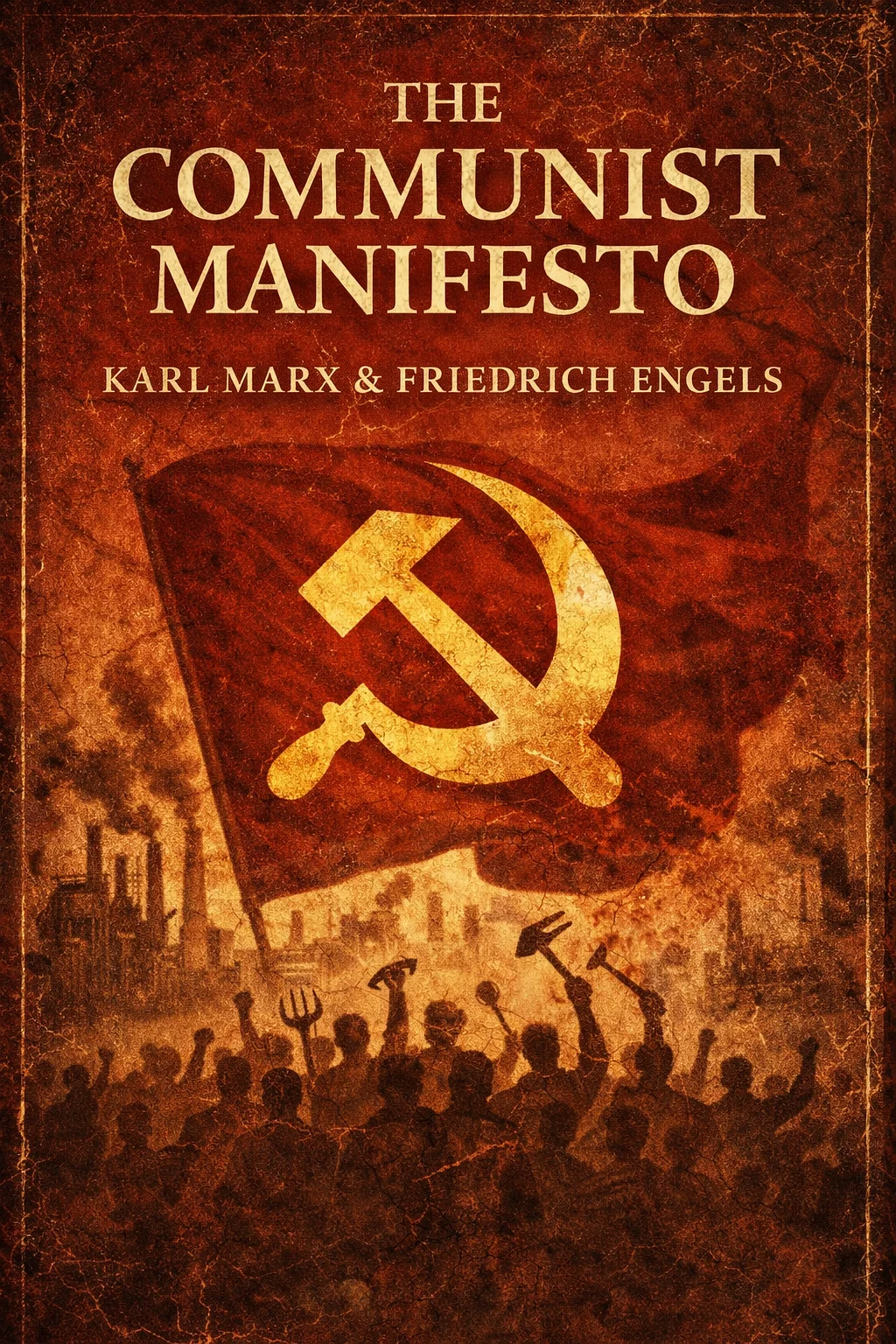
New Book: The Communist Manifesto by Admin User
Karl Marx and Friedrich Engels
Author
The Communist Manifesto is a foundational political treatise written by Karl Marx and Friedrich Engels, first published in 1848. The work presents a comprehensive analysis of class struggle throughout human history and argues that all societies have been shaped by conflicts between oppressing and oppressed classes—from ancient Rome's patricians and slaves to medieval feudal lords and serfs.
The manifesto's central thesis is that modern industrial society has simplified class antagonisms into a struggle between two great classes: the Bourgeoisie (capitalist owners of the means of production) and the Proletariat (the working class who must sell their labor to survive). The authors trace the historical rise of the bourgeoisie from medieval burghers through the discovery of new trade routes, the industrial revolution, and the establishment of the world market.
Marx and Engels acknowledge the revolutionary role the bourgeoisie played in overthrowing feudalism and transforming production through technological innovation. However, they argue that capitalism contains inherent contradictions—particularly the tendency toward periodic economic crises of overproduction—that will ultimately lead to its downfall. The very weapons the bourgeoisie used to defeat feudalism are now turned against it.
The manifesto outlines how industrial development creates and expands the proletariat while simultaneously degrading working conditions, reducing workers to mere appendages of machines. The authors argue that the proletariat, unlike previous revolutionary classes, represents the interests of the vast majority and will eventually rise up to abolish private property and class distinctions altogether.
The text also distinguishes Communist positions from other socialist movements of the era and responds to common objections against communism. It concludes with a call for workers of all countries to unite, as they have nothing to lose but their chains. The manifesto remains one of the most influential political documents in history, establishing the theoretical foundation for communist and socialist movements worldwide.
Related Book
The Communist Manifesto
Karl Marx and Friedrich Engels
About this book
The Communist Manifesto is a foundational political treatise written by Karl Marx and Friedrich Engels, first published in 1848. The work presents a comprehensive analysis of class struggle throughout human history and argues that all societies have been shaped by conflicts between oppressing and oppressed classes—from ancient Rome's patricians and slaves to medieval feudal lords and serfs.
The manifesto's central thesis is that modern industrial society has simplified class antagonisms into a struggle between two great classes: the Bourgeoisie (capitalist owners of the means of production) and the Proletariat (the working class who must sell their labor to survive). The authors trace the historical rise of the bourgeoisie from medieval burghers through the discovery of new trade routes, the industrial revolution, and the establishment of the world market.
Marx and Engels acknowledge the revolutionary role the bourgeoisie played in overthrowing feudalism and transforming production through technological innovation. However, they argue that capitalism contains inherent contradictions—particularly the tendency toward periodic economic crises of overproduction—that will ultimately lead to its downfall. The very weapons the bourgeoisie used to defeat feudalism are now turned against it.
The manifesto outlines how industrial development creates and expands the proletariat while simultaneously degrading working conditions, reducing workers to mere appendages of machines. The authors argue that the proletariat, unlike previous revolutionary classes, represents the interests of the vast majority and will eventually rise up to abolish private property and class distinctions altogether.
The text also distinguishes Communist positions from other socialist movements of the era and responds to common objections against communism. It concludes with a call for workers of all countries to unite, as they have nothing to lose but their chains. The manifesto remains one of the most influential political documents in history, establishing the theoretical foundation for communist and socialist movements worldwide.
Paste this code into your website HTML to embed this content.