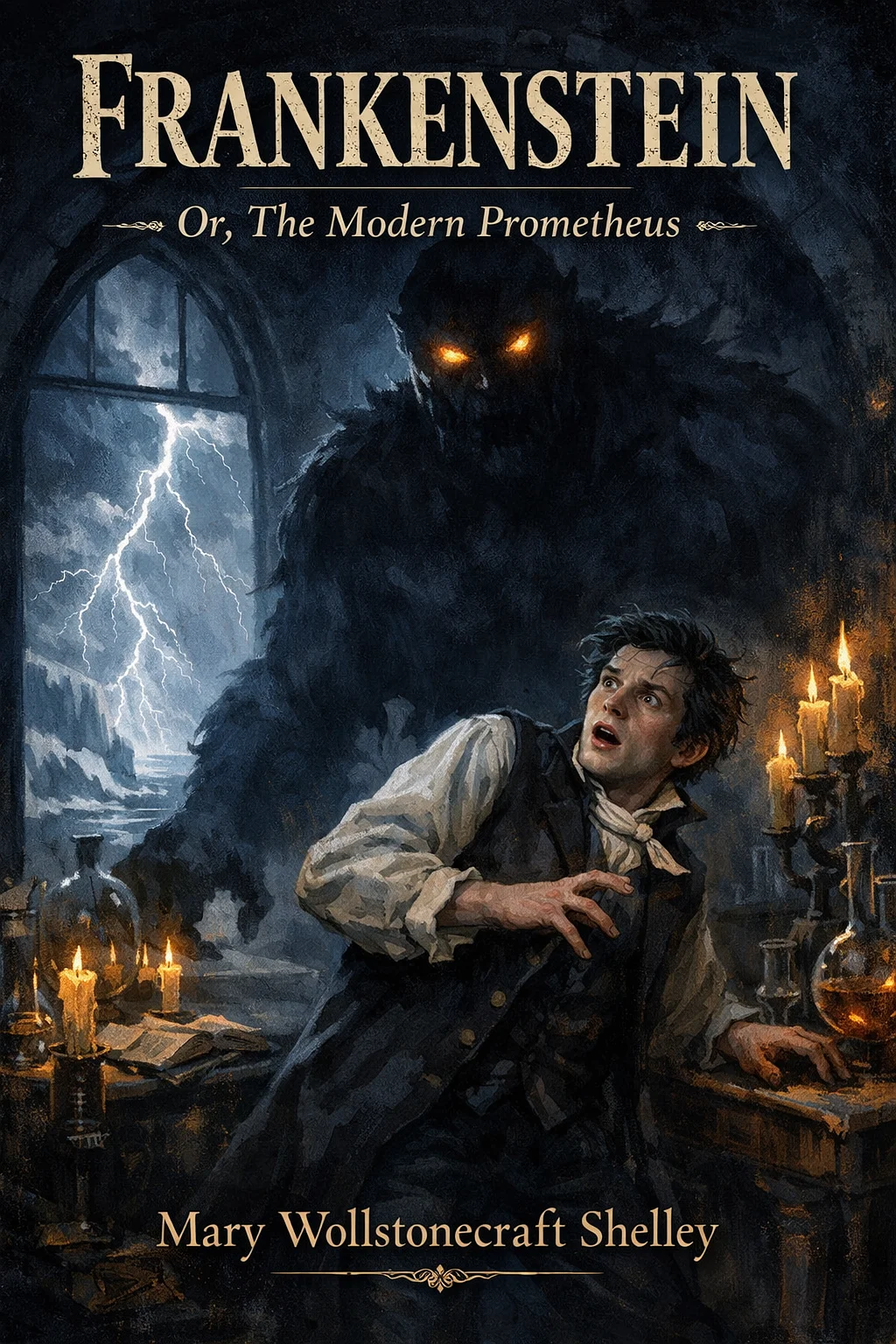
New Book: Frankenstein; Or, The Modern Prometheus by Сергей Черняков
Mary Wollstonecraft Shelley
Author
Frankenstein; or, The Modern Prometheus is a landmark Gothic novel of ambition, creation, and catastrophic responsibility, narrated through the letters of Robert Walton, an obsessive Arctic explorer who rescues a near-dead stranger from the ice. That stranger is Victor Frankenstein, a brilliant young Genevese scientist, who recounts his tragic story as a warning to the equally driven Walton.
Victor grows up in an idyllic Swiss household alongside his beloved adoptive cousin Elizabeth Lavenza and his dearest friend Henry Clerval. From childhood he is consumed by a burning desire to uncover the hidden laws of nature — the secrets of life and death themselves. At the University of Ingolstadt, inspired by the eloquent chemistry professor M. Waldman, Victor abandons all human connection and spends nearly two years in secret, obsessive toil, collecting bones from charnel-houses and dissecting cadavers in a solitary attic laboratory. He succeeds in discovering the principle of life and animates a being assembled from human remains — eight feet tall, physically powerful, yet grotesque in appearance.
The moment the creature opens its dull yellow eyes, Victor's exhilaration collapses into horror and revulsion. He flees in panic. His loyal friend Clerval nurses him through months of nervous fever, unaware of what Victor has done. The creature vanishes into the world alone — abandoned, unnamed, unloved by the one person responsible for his existence.
The horror resurfaces when Victor's youngest brother William is found strangled near Geneva. A beloved family servant, Justine Moritz, is tried, convicted on circumstantial evidence, and executed for the murder — a travesty that destroys Victor from within. He alone suspects the truth: his creation is the killer. He cannot speak it without being thought mad.
In a dramatic Alpine confrontation, the creature speaks for himself. He narrates months of solitary wandering and self-education, his tender secret observation of a kind peasant family, and the devastating rejection he suffered when he finally revealed himself to them. Eloquent, lonely, and brimming with a capacity for love that was met only with violence and disgust, he became what the world had made him — vengeful and merciless. He murdered William and planted evidence on Justine. Now he demands one thing: that Victor create a female companion.
Victor reluctantly begins the work on a remote Scottish island. But at the last moment, horrified by the prospect of unleashing two such beings on an unwilling world, he destroys the unfinished female creature. The creature's response is swift and devastating: he murders Henry Clerval and, on the very night of Victor and Elizabeth's long-awaited wedding, strangles Elizabeth in their bridal chamber.
Victor's father, Alphonse, dies of grief. Victor, his entire world destroyed, becomes a man of one purpose: to hunt and kill his creature. The chase drives him north across frozen seas into the Arctic, where Walton's ship finds him, frostbitten and dying. Victor expires aboard the vessel, his final breath a warning against the unchecked pursuit of forbidden knowledge.
In the novel's devastating final scene, the creature appears over Victor's corpse — not triumphant but tormented, mourning the only being bound to him, and declaring his intention to end his own wretched existence. The book leaves its central questions hauntingly open: who is the true monster — the creator who abdicated all responsibility, or the creation who became monstrous through rejection? Mary Shelley's masterpiece remains one of literature's most powerful meditations on the ethics of ambition, the cruelty of alienation, and the terrible price of playing God.
Related Book
Frankenstein; Or, The Modern Prometheus
Mary Wollstonecraft Shelley
About this book
Frankenstein; or, The Modern Prometheus is a landmark Gothic novel of ambition, creation, and catastrophic responsibility, narrated through the letters of Robert Walton, an obsessive Arctic explorer who rescues a near-dead stranger from the ice. That stranger is Victor Frankenstein, a brilliant young Genevese scientist, who recounts his tragic story as a warning to the equally driven Walton.
Victor grows up in an idyllic Swiss household alongside his beloved adoptive cousin Elizabeth Lavenza and his dearest friend Henry Clerval. From childhood he is consumed by a burning desire to uncover the hidden laws of nature — the secrets of life and death themselves. At the University of Ingolstadt, inspired by the eloquent chemistry professor M. Waldman, Victor abandons all human connection and spends nearly two years in secret, obsessive toil, collecting bones from charnel-houses and dissecting cadavers in a solitary attic laboratory. He succeeds in discovering the principle of life and animates a being assembled from human remains — eight feet tall, physically powerful, yet grotesque in appearance.
The moment the creature opens its dull yellow eyes, Victor's exhilaration collapses into horror and revulsion. He flees in panic. His loyal friend Clerval nurses him through months of nervous fever, unaware of what Victor has done. The creature vanishes into the world alone — abandoned, unnamed, unloved by the one person responsible for his existence.
The horror resurfaces when Victor's youngest brother William is found strangled near Geneva. A beloved family servant, Justine Moritz, is tried, convicted on circumstantial evidence, and executed for the murder — a travesty that destroys Victor from within. He alone suspects the truth: his creation is the killer. He cannot speak it without being thought mad.
In a dramatic Alpine confrontation, the creature speaks for himself. He narrates months of solitary wandering and self-education, his tender secret observation of a kind peasant family, and the devastating rejection he suffered when he finally revealed himself to them. Eloquent, lonely, and brimming with a capacity for love that was met only with violence and disgust, he became what the world had made him — vengeful and merciless. He murdered William and planted evidence on Justine. Now he demands one thing: that Victor create a female companion.
Victor reluctantly begins the work on a remote Scottish island. But at the last moment, horrified by the prospect of unleashing two such beings on an unwilling world, he destroys the unfinished female creature. The creature's response is swift and devastating: he murders Henry Clerval and, on the very night of Victor and Elizabeth's long-awaited wedding, strangles Elizabeth in their bridal chamber.
Victor's father, Alphonse, dies of grief. Victor, his entire world destroyed, becomes a man of one purpose: to hunt and kill his creature. The chase drives him north across frozen seas into the Arctic, where Walton's ship finds him, frostbitten and dying. Victor expires aboard the vessel, his final breath a warning against the unchecked pursuit of forbidden knowledge.
In the novel's devastating final scene, the creature appears over Victor's corpse — not triumphant but tormented, mourning the only being bound to him, and declaring his intention to end his own wretched existence. The book leaves its central questions hauntingly open: who is the true monster — the creator who abdicated all responsibility, or the creation who became monstrous through rejection? Mary Shelley's masterpiece remains one of literature's most powerful meditations on the ethics of ambition, the cruelty of alienation, and the terrible price of playing God.
Paste this code into your website HTML to embed this content.