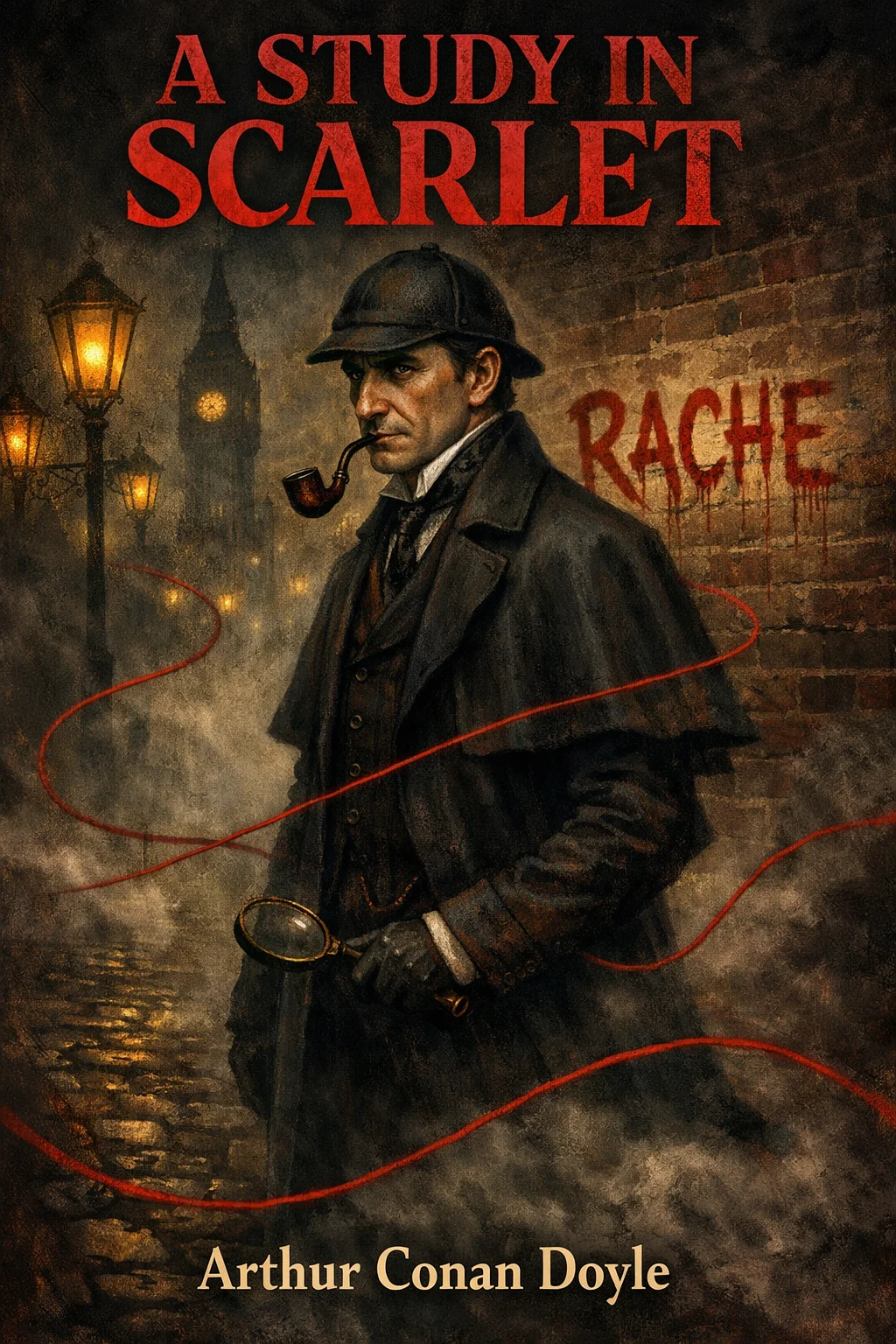
New Book: A Study in Scarlet by Сергей Черняков
Arthur Conan Doyle
Author
A Study in Scarlet is the first Sherlock Holmes novel by Arthur Conan Doyle, narrated by Dr. John H. Watson, a British Army surgeon invalided home after being wounded at the Battle of Maiwand during the Second Afghan War. Adrift in London with dwindling finances, Watson is introduced to the eccentric and brilliant Sherlock Holmes by a mutual acquaintance named Stamford. The two men agree to share lodgings at 221B Baker Street, forging one of the most celebrated partnerships in literary history.
Their first case together erupts when Scotland Yard detective Tobias Gregson summons Holmes to an empty house in Brixton Road, where an American named Enoch J. Drebber has been found dead. There is no apparent cause of death, no signs of struggle, no robbery — only the word "RACHE" scrawled in blood on the wall and a woman's wedding ring left on the floor. Holmes, deploying his legendary powers of observation and deduction — reading footprints, cigar ash, and the victim's physical state — concludes that the killer is a tall, tanned man driven not by greed but by deeply personal vengeance, and that he arrived and fled the scene in a cab.
While the rival Scotland Yard detectives Gregson and Lestrade pursue dead ends — one arresting a naval officer named Arthur Charpentier, the other chasing Drebber's secretary Joseph Stangerson — Holmes springs a trap using the ring as bait. Before Stangerson can be questioned, he too is found murdered in his hotel room. Holmes, however, has already identified his man: Jefferson Hope, a weathered cab driver who has spent years hunting his prey across two continents. The capture, engineered with theatrical precision at 221B Baker Street, is dramatic and violent — Hope is a man of ferocious physical strength — but ultimately successful.
The novel's second half unfolds as a flashback to the American West of the 1840s and 1850s, revealing the true heart of the story. John Ferrier, a lone survivor near death in the Utah desert, is rescued along with a small orphaned girl named Lucy by a great Mormon caravan led by Brigham Young. Ferrier raises Lucy as his own daughter. Years later, Lucy grows into a spirited young woman and falls deeply in love with Jefferson Hope, a bold frontiersman. Their happiness is shattered when Young, acting on behalf of the Mormon council — including Elders Drebber and Stangerson — decrees that Lucy must marry the son of one of these Elders or face the wrath of the secret Danite Band, the so-called Avenging Angels who enforce Mormon law through terror and murder.
Ferrier and Lucy attempt to flee with Hope's help, but the Mormon enforcers close in. Ferrier is killed and buried in the mountains; Lucy is dragged back to Salt Lake City, forced into marriage with young Drebber, and dies of a broken heart within a month. Jefferson Hope, consumed by grief and rage, dedicates his life to tracking down the men responsible. After years of pursuit across America and Europe, he catches them in London, administering justice in his own harrowing fashion: two identical pills, one lethal, one harmless, offered to his victims at gunpoint — forcing fate itself to act as judge.
Captured by Holmes, Hope tells his story without remorse, viewing himself as an instrument of divine justice rather than a murderer. He dies of an aortic aneurism in custody, denied even the public trial that might have let him speak his truth to the world. Holmes, characteristically pragmatic, is more absorbed in the elegant logic of the case than its moral weight — and it falls to Watson's human sympathy to acknowledge the terrible beauty of Hope's long revenge.
A Study in Scarlet is at once a pioneering detective novel that introduces Holmes's "science of deduction," a vivid adventure spanning two continents and two eras, and a dark meditation on religious fanaticism, the nature of justice, and the devastating power of love and loss. The title phrase — Holmes's own description of the case as "a study in scarlet" — captures its essence perfectly: a single crimson thread of murder woven through the grey and unremarkable fabric of Victorian life.
Related Book
A Study in Scarlet
Arthur Conan Doyle
About this book
A Study in Scarlet is the first Sherlock Holmes novel by Arthur Conan Doyle, narrated by Dr. John H. Watson, a British Army surgeon invalided home after being wounded at the Battle of Maiwand during the Second Afghan War. Adrift in London with dwindling finances, Watson is introduced to the eccentric and brilliant Sherlock Holmes by a mutual acquaintance named Stamford. The two men agree to share lodgings at 221B Baker Street, forging one of the most celebrated partnerships in literary history.
Their first case together erupts when Scotland Yard detective Tobias Gregson summons Holmes to an empty house in Brixton Road, where an American named Enoch J. Drebber has been found dead. There is no apparent cause of death, no signs of struggle, no robbery — only the word "RACHE" scrawled in blood on the wall and a woman's wedding ring left on the floor. Holmes, deploying his legendary powers of observation and deduction — reading footprints, cigar ash, and the victim's physical state — concludes that the killer is a tall, tanned man driven not by greed but by deeply personal vengeance, and that he arrived and fled the scene in a cab.
While the rival Scotland Yard detectives Gregson and Lestrade pursue dead ends — one arresting a naval officer named Arthur Charpentier, the other chasing Drebber's secretary Joseph Stangerson — Holmes springs a trap using the ring as bait. Before Stangerson can be questioned, he too is found murdered in his hotel room. Holmes, however, has already identified his man: Jefferson Hope, a weathered cab driver who has spent years hunting his prey across two continents. The capture, engineered with theatrical precision at 221B Baker Street, is dramatic and violent — Hope is a man of ferocious physical strength — but ultimately successful.
The novel's second half unfolds as a flashback to the American West of the 1840s and 1850s, revealing the true heart of the story. John Ferrier, a lone survivor near death in the Utah desert, is rescued along with a small orphaned girl named Lucy by a great Mormon caravan led by Brigham Young. Ferrier raises Lucy as his own daughter. Years later, Lucy grows into a spirited young woman and falls deeply in love with Jefferson Hope, a bold frontiersman. Their happiness is shattered when Young, acting on behalf of the Mormon council — including Elders Drebber and Stangerson — decrees that Lucy must marry the son of one of these Elders or face the wrath of the secret Danite Band, the so-called Avenging Angels who enforce Mormon law through terror and murder.
Ferrier and Lucy attempt to flee with Hope's help, but the Mormon enforcers close in. Ferrier is killed and buried in the mountains; Lucy is dragged back to Salt Lake City, forced into marriage with young Drebber, and dies of a broken heart within a month. Jefferson Hope, consumed by grief and rage, dedicates his life to tracking down the men responsible. After years of pursuit across America and Europe, he catches them in London, administering justice in his own harrowing fashion: two identical pills, one lethal, one harmless, offered to his victims at gunpoint — forcing fate itself to act as judge.
Captured by Holmes, Hope tells his story without remorse, viewing himself as an instrument of divine justice rather than a murderer. He dies of an aortic aneurism in custody, denied even the public trial that might have let him speak his truth to the world. Holmes, characteristically pragmatic, is more absorbed in the elegant logic of the case than its moral weight — and it falls to Watson's human sympathy to acknowledge the terrible beauty of Hope's long revenge.
A Study in Scarlet is at once a pioneering detective novel that introduces Holmes's "science of deduction," a vivid adventure spanning two continents and two eras, and a dark meditation on religious fanaticism, the nature of justice, and the devastating power of love and loss. The title phrase — Holmes's own description of the case as "a study in scarlet" — captures its essence perfectly: a single crimson thread of murder woven through the grey and unremarkable fabric of Victorian life.
Paste this code into your website HTML to embed this content.