He Steals Memories But Left Me Love
I first noticed the gaps on a Thursday. Small things — the name of my childhood dog, the color of my mother's kitchen walls, the song that played at my graduation. They vanished like smoke, leaving only hollow spaces where warmth once lived. But in their place, something else appeared: a feeling. A pull. A gravity that had no source.
And then I saw him.
He stood beneath the flickering streetlamp outside my apartment, his collar turned up against the rain, watching me with eyes that held centuries of someone else's sorrow. Dark hair plastered to his forehead. Sharp jaw. A mouth that looked like it had forgotten how to smile but remembered exactly how to whisper secrets against skin.
I should have been afraid. A stranger, motionless in the downpour, staring up at my window at eleven o'clock at night. But fear wasn't what flooded my veins. It was recognition — deep, irrational, bone-level recognition. As if every cell in my body had been waiting for him without my permission.
I closed the curtain. My hands were trembling.
By Friday, I'd lost the memory of my first kiss.
---
His name was Edris. I learned it not because he told me, but because it surfaced in my mind like a word I'd always known but never spoken. I found him at the café on Merchant Street, sitting alone with a cup of black coffee he never touched. The steam curled and vanished, curled and vanished, a tiny ghost performing for no one.
"You've been watching me," I said, sliding into the seat across from him.
He looked up. Those eyes — dark amber, almost bronze, ringed with shadows that makeup couldn't create. They weren't tired. They were full. Overfull. Like a library with no more shelf space.
"You can see me," he said. Not a question. An observation laced with something I couldn't name. Wonder, maybe. Or dread.
"Of course I can see you."
"Most people don't. Not really. They feel me pass and shiver. They blame the draft." He tilted his head. "But you looked right at me. Through the rain, through the glass. You looked."
My pulse hammered against my throat. "Who are you?"
"Someone you'll forget," he said quietly. "Eventually."
He stood and left. His coffee was still full. The steam had stopped rising, as though even heat abandoned things he touched.
That night, I forgot the sound of my father's laugh.
---
I should have stayed away. Every rational synapse in my brain screamed to close the curtains, change the locks, delete the strange gravity from my chest. But rationality is a language the heart has never learned to speak.
I found him again — or he found me. A bookshop on the corner of Vine and Fifth, the kind with creaking floors and dust motes that floated like lazy constellations. He was reading a volume with no title on the spine, turning pages with long, careful fingers.
"You're stealing from me," I said.
He didn't look up. "Yes."
The honesty hit me like cold water. No deflection, no denial. Just that single syllable, heavy as a stone dropped into still water.
"My memories. You're taking them."
"I don't choose to." Now he looked at me, and the pain in his expression was so raw it made my ribs ache. "It's what I am. Proximity is enough. The longer I stay near someone, the more I absorb — their past, their history, the architecture of who they've been. It feeds me. Sustains me. I've existed this way for longer than your city has had a name."
"Then why are you here? Why stay near me if you know what it does?"
He closed the book. Set it down with the reverence of someone handling a living thing.
"Because for the first time in four hundred years," he said, his voice dropping to something barely louder than breath, "I'm not just taking. You're giving me something back. Something I haven't felt since before I became this."
"What?"
His jaw tightened. He looked away, toward the rain-streaked window, toward the bruised evening sky.
"Longing," he whispered. "You make me long."
The word hung between us like a lit match in a room full of gasoline.
---
We began meeting in the margins of the day — the blue hour before dawn, the violet hour after dusk. Never in full light. He said the sun made the hunger worse, made him ravenous for the things people carried. Darkness softened it. Darkness made him almost human.
We walked along the river where the city lights shimmered on black water like scattered coins. He told me about the memories he carried — thousands of them, millions, a cathedral of stolen moments. A child's first snowfall in 1743. A soldier's last letter in 1918. A woman singing to her garden in a language that no longer existed.
"Do you feel them?" I asked.
"Every single one. They're not mine, but they live in me. I am a museum no one visits."
"That sounds unbearable."
"It was." He paused. His hand brushed mine — a spark, electric and dangerous — and he pulled back as though burned. "Until you."
I felt it too. The charge. The impossible warmth radiating from a man who claimed to be cold to his core. And with each meeting, I noticed what I'd lost: my seventh birthday, the name of my college roommate, the taste of my grandmother's soup. The memories dissolved like sugar in rain, and in their absence, something new crystallized.
Love. Unwanted, unexplainable, unapologetic love.
As if every stolen memory left behind a seed, and the seeds were blooming into something terrifying and beautiful.
---
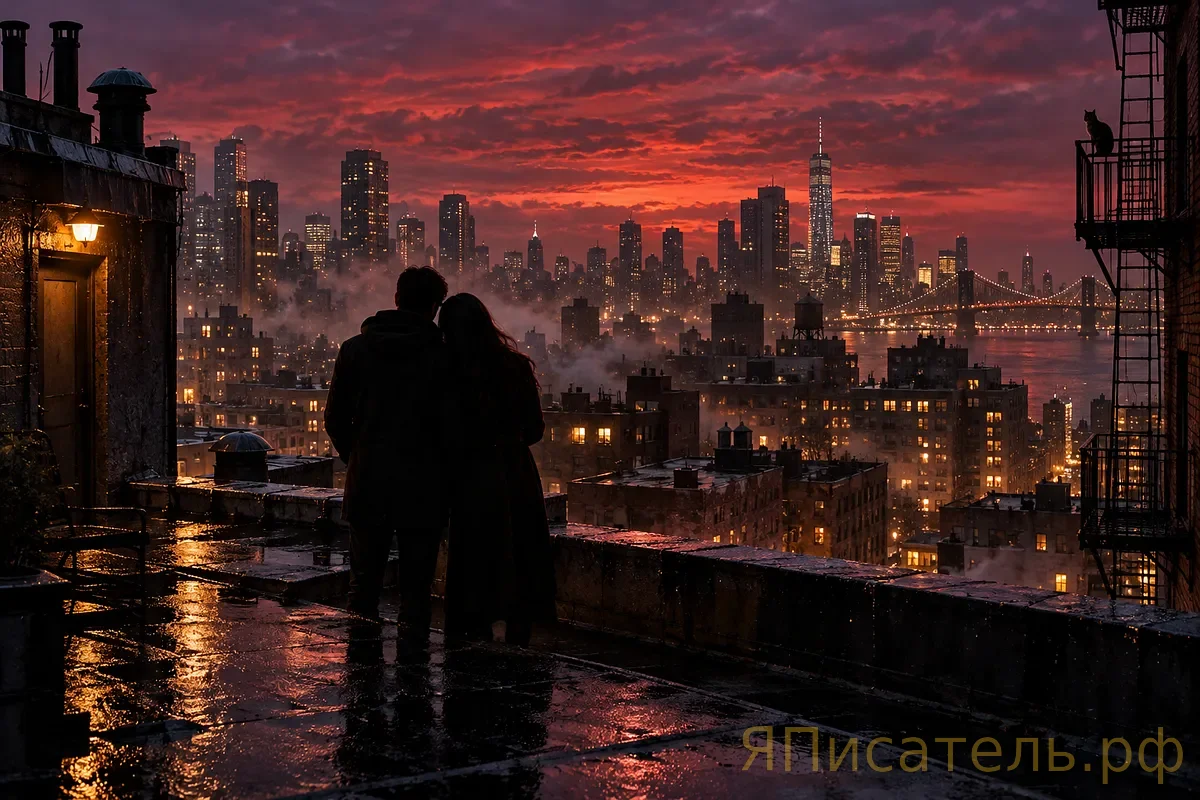
"You have to stop seeing me," he said one evening. We were on the rooftop of my building, the city sprawling beneath us like a circuit board of light and shadow. The wind carried the scent of rain and something older — woodsmoke, maybe, or time itself.
"I won't."
"Naia." The way he said my name — like a prayer caught between reverence and regret — made my chest crack open. "I've already taken so much. Your childhood is full of holes. Your past is becoming a redacted document. If I stay, I will take everything. Your mother's face. Your own name. You'll become a blank page."
"Then write something new on me."
He turned to face me, and in the city's glow I saw something break behind his eyes. The careful, ancient discipline. The walls built over centuries of self-imposed exile. He stepped closer, and the air between us became something solid, something you could press your hands against and feel it pulse.
"You don't understand what you're asking," he breathed.
"I'm asking you to stay."
"Staying will destroy you."
"Leaving will destroy us both, and you know it."
His hand rose — slowly, as though moving through water — and his fingertips grazed my cheek. The touch was devastating. Everywhere his skin met mine, I felt memories lift away like startled birds: my first apartment, the sound of my best friend's voice, a sunset I'd watched from a train window in a country I could no longer name.
But beneath the loss, beneath the evacuation of everything familiar, there was him. His warmth, his trembling, his centuries of loneliness pressing against my present like a tide against a shore.
"I have taken from everyone I've ever been near," he said, his forehead nearly touching mine. "But no one — no one — has ever made me want to give something back."
"Then give."
He kissed me.
It wasn't gentle. It was the kiss of someone who had starved for four hundred years and finally found something that wasn't food but was sustenance nonetheless. His mouth was warm — warmer than it should have been — and tasted like old rain and new fire. The world narrowed to the pressure of his lips, the grip of his hand at the back of my neck, the way the wind wrapped around us as though trying to pull us apart and failing.
When we broke away, I was gasping. Stars wheeled overhead. The city hummed below.
And I couldn't remember my mother's name.
But I could feel — incandescent and absolute — that I was loved.
---
I woke the next morning to an empty rooftop and a folded note tucked beneath my pillow, written in handwriting that looked like it belonged to another century.
*"I left before I could take the last of you. But I couldn't leave without leaving something behind. You'll find it not in your mind, but in your chest — a warmth that doesn't fade, a presence that doesn't diminish. I've given you the only memory that was ever truly mine: the moment I realized I loved you. It's yours now. It will outlast everything I've taken. It will outlast me.
Forget my face if you must. Forget my name. But you will never forget this feeling. I made sure of it.
I am sorry. I am grateful. I am yours, even in absence.
— E."*
I sat in the pale morning light, holding a letter from a man whose face was already beginning to blur in my mind. His name tugged at the edges of my consciousness — something with a vowel, something ancient, something that tasted like old rain.
But the love. God, the love.
It sat in my chest like a second heartbeat, radiant and unshakeable, a lantern in a house where every other light had been extinguished. He had taken my memories — the architecture of my past, the furniture of my identity — and in their place he had left something that no amount of forgetting could erase.
I walked to the edge of the rooftop and looked down at the street where I'd first seen him. The streetlamp still flickered. The rain had stopped. And somewhere in the city — or beyond it, or beneath it, in whatever liminal space a memory thief calls home — I knew he was carrying my stolen past like precious cargo, feeling my childhood, reliving my joys, inhabiting the life I could no longer access.
I pressed my hand to my chest.
The warmth pulsed back.
And I whispered to the morning air, to the absent man, to the impossible love that defied every law of memory and loss:
"I don't need to remember you to love you. I just do."
The wind carried the words away. Somewhere, I was certain, they landed.
Paste this code into your website HTML to embed this content.