News Feb 5, 01:12 AM

Forgotten Library in Prague Reveals Gabriel García Márquez's Secret Correspondence with Czech Dissidents

In a discovery that reshapes our understanding of Cold War literary networks, archivists working in the Strahov Monastery Library in Prague have unearthed a remarkable collection of correspondence between Colombian Nobel laureate Gabriel García Márquez and several prominent Czech and Slovak writers who operated underground during the communist era.

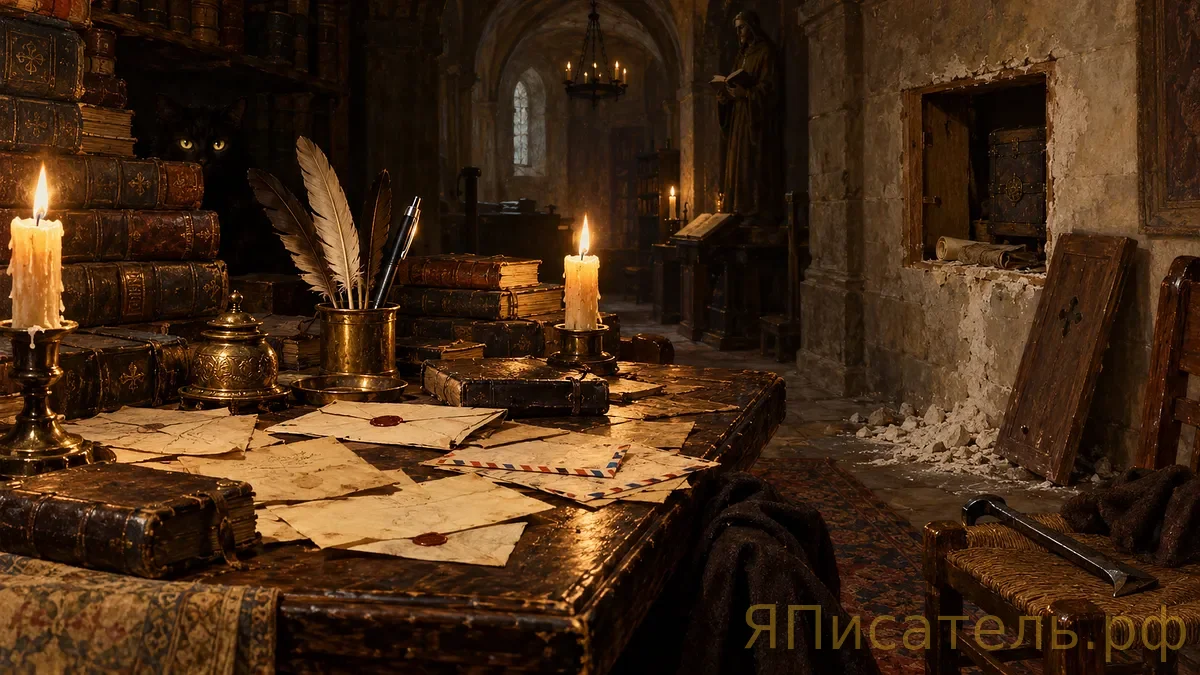
The letters, numbering over sixty and spanning from 1971 to 1983, were found in a sealed compartment behind a false wall in a storage room that had remained unopened since 1989. The chamber appears to have been deliberately concealed to protect its contents from state security services.

Dr. Markéta Vojtěchová, chief archivist at the Strahov Library, described the find as "extraordinary on multiple levels." The correspondence reveals that García Márquez maintained a secret dialogue with writers including Ivan Klíma, Ludvík Vaculík, and the late Bohumil Hrabal, exchanging not only political thoughts but detailed discussions about narrative technique and the role of the surreal in depicting oppressive realities.

"What emerges from these letters is a fascinating cross-pollination of ideas," Dr. Vojtěchová explained. "García Márquez writes extensively about how Eastern European absurdist traditions influenced his approach to magical realism, while the Czech writers express deep admiration for how Latin American literature transformed political critique into universal myth."

One particularly striking letter from 1976 shows García Márquez responding to a samizdat copy of Hrabal's "Too Loud a Solitude," calling it "a mirror held up to our own struggles in Colombia, proving that the crushing of books and minds follows the same cruel logic everywhere."

The García Márquez Foundation has confirmed the authenticity of the letters through handwriting analysis and paper dating. Plans are underway for a scholarly edition to be published jointly by Charles University Press and the Universidad Nacional de Colombia, expected in late 2027.

Literary historians suggest the discovery may prompt a reexamination of magical realism's development, revealing it as a more internationally collaborative movement than previously understood. Professor Elena Poniatowska of the Colegio de México noted that "these letters prove what many of us suspected—that the great literary movements of the twentieth century were built on invisible bridges across iron curtains."

The Strahov Library plans a public exhibition of selected letters beginning in September 2026, coinciding with the centenary of García Márquez's birth.

1x

Comments (0)

No comments yet

Sign up to leave comments

Read Also

The Delayed Reaction: Let Emotions Arrive Late
Tip
about 1 hour ago

The Delayed Reaction: Let Emotions Arrive Late

One powerful technique for authentic emotional moments is delaying your character's reaction to significant events. In real life, people rarely process shocking news immediately—there's a gap between event and response. Instead of having your character cry upon hearing bad news, show them doing something mundane first: making tea or straightening a picture frame. This delayed reaction creates tension and makes the eventual release far more impactful. The reader anticipates the breakdown, building suspense. When emotion finally surfaces—triggered by something small—it feels earned rather than melodramatic. To execute this, identify major emotional beats. For each, ask: what would this character do in the five minutes before they truly process what happened?

0
0
Kill Your Darlings: Why Your Most Brilliant Scenes Are Secretly Destroying Your Book
Article
about 2 hours ago

Kill Your Darlings: Why Your Most Brilliant Scenes Are Secretly Destroying Your Book

That scene you've polished until it gleams like a diamond? The one you read aloud to friends at dinner parties? The passage that made you think, 'Finally, I've written something truly magnificent'? It needs to die. I know this hurts. But here's the uncomfortable truth that every professional writer eventually learns: the scenes we love most are often the ones sabotaging our work.

0
0
How to Build Your Personal Author Brand: A Strategic Guide to Standing Out in a Crowded Market
Article
about 2 hours ago

How to Build Your Personal Author Brand: A Strategic Guide to Standing Out in a Crowded Market

In today's publishing landscape, writing a great book is only half the battle. Whether you're self-publishing your debut novel or have several titles under your belt, your personal author brand is what transforms casual readers into devoted fans. It's the invisible thread that connects your work, your personality, and your audience into something memorable and marketable. But what exactly is an author brand? Simply put, it's the unique combination of your writing style, values, visual identity, and the promise you make to readers about what they can expect from you. Think of authors like Stephen King or Nora Roberts—before you even open one of their books, you have certain expectations. That's the power of branding.

0
0
Writers Who Were Complete Assholes: Literary Geniuses You'd Want to Punch
Article
about 3 hours ago

Writers Who Were Complete Assholes: Literary Geniuses You'd Want to Punch

We worship their books. We quote their wisdom. We name our children after their characters. But here's the dirty little secret English professors won't tell you: many of literature's greatest minds were absolutely insufferable human beings. The kind of people you'd cross the street to avoid. So pour yourself something strong, because we're about to drag some literary legends through the mud they so richly deserve.

0
0

"You write in order to change the world." — James Baldwin