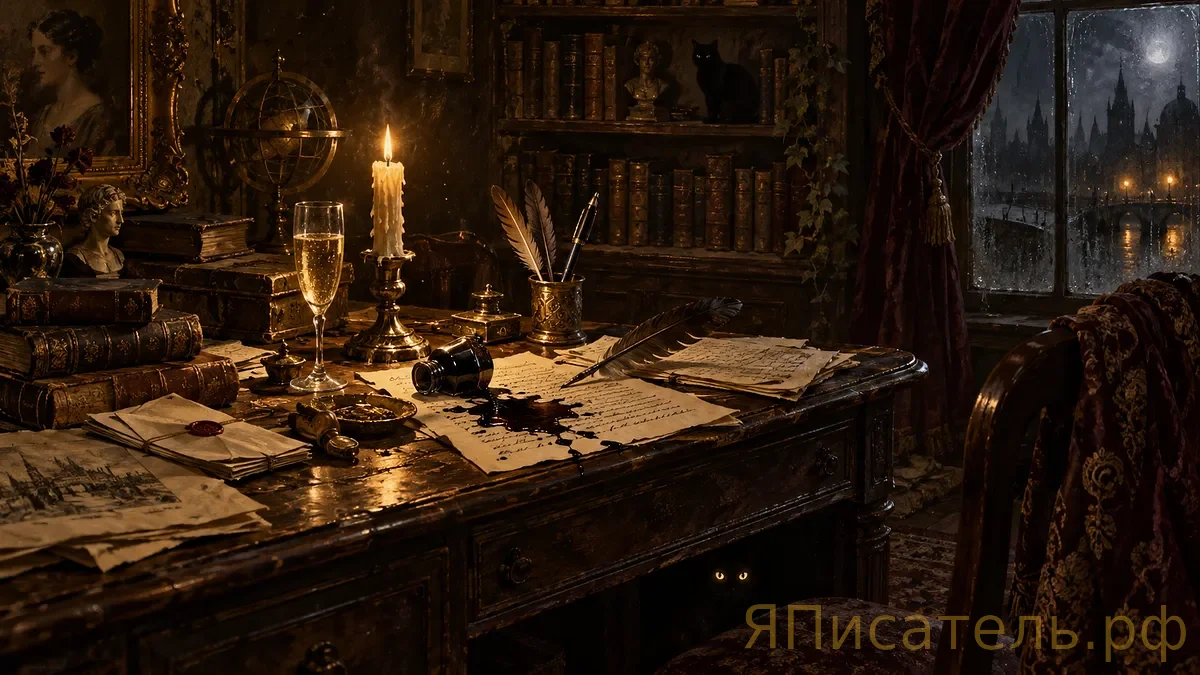
Dying Was the Last Thing They Did — And Some Writers Nailed It
You'd think people who spent their entire lives crafting perfect sentences would save the best one for last. And some did. Others? They went out mumbling about wallpaper, demanding champagne, or simply refusing to die at all — at least verbally. The deathbed has always been literature's final stage, and great writers treated it accordingly: some with devastating wit, others with bewildering absurdity, and a few with a silence more eloquent than anything they ever wrote.
Let's start with the undisputed champion of the literary exit: Oscar Wilde. Lying in a cheap Parisian hotel room in 1900, broke and broken after prison and exile, he allegedly looked at the hideous décor and said, "My wallpaper and I are fighting a duel to the death. One of us has got to go." Whether he actually said it or his friend Robert Ross polished it up afterward doesn't really matter. It's the most Oscar Wilde sentence imaginable — vain, witty, and heartbreaking all at once. The wallpaper won, by the way.
Then there's Henrik Ibsen, the father of modern drama, who in 1906 heard his nurse reassure a visitor that the playwright was doing better. Ibsen sat up, glared, and snapped: "On the contrary!" — and promptly died. You have to admire a man so committed to dramatic irony that he made his own death the punchline. The nurse, one assumes, never gave an optimistic prognosis again.
Not everyone went for laughs. Leo Tolstoy's final moments in 1910 were pure existential agony. He had fled his wife Sophia in the middle of the night, wandered through freezing Russian countryside, and ended up dying at a tiny railway station called Astapovo. His last coherent words were reportedly: "But the peasants — how do the peasants die?" Even at the very end, Tolstoy was worried about everyone except himself. The man who wrote "Anna Karenina" and "War and Peace" died wondering if a simple farmer handled death with more grace than he did. Knowing Tolstoy, the answer he feared was yes.
Contrast that with the spectacular ego of Johann Wolfgang von Goethe, who in 1832 supposedly demanded: "More light!" Scholars have debated for nearly two centuries whether this was a profound philosophical statement about enlightenment or whether the old man simply wanted someone to open the curtains. The German language being what it is — "Mehr Licht!" — leaves plenty of room for interpretation. My money is on the curtains.
Some writers chose silence as their closing act, and none more powerfully than Franz Kafka. In 1924, dying of tuberculosis of the larynx in a sanatorium near Vienna, he literally could not speak. The cruel irony — a writer who spent his life exploring the impossibility of communication, robbed of his voice at the end — seems almost too perfect, as if God had read his novels and decided to add one more chapter. His last written note to his doctor read: "Kill me, or else you are a murderer." He was begging for morphine. Even in agony, Kafka constructed a logical paradox.
Emily Dickinson, recluse extraordinaire, kept it characteristically brief in 1886: "I must go in, the fog is rising." It sounds like pure Dickinson — a nature image that is simultaneously literal and cosmic. Was there actual fog outside her Amherst window? Maybe. Was she describing the boundary between life and death as a weather event? Almost certainly. In six words, she wrote her final poem.
For sheer bathos, nothing beats the exit of Lytton Strachey, the Bloomsbury biographer, who died in 1932 and whose last words were reportedly: "If this is dying, then I don't think much of it." One-star review of mortality. Classic British understatement, and also weirdly comforting — if a professional critic found death merely disappointing rather than terrifying, the rest of us might manage.
Henry David Thoreau offers another masterclass in brevity. Dying of tuberculosis in 1862, he was asked by a well-meaning aunt whether he had made his peace with God. Thoreau replied: "I did not know that we had quarreled." If you can deliver a line that good while your lungs are collapsing, you've earned your place in the pantheon.
Then there are the writers whose last words were gloriously mundane. H.G. Wells, the man who imagined time machines and Martian invasions, died in 1946 saying: "Go away. I'm all right." He wasn't. Anton Chekhov, in 1904, accepted a glass of champagne from his doctor, said "It's been a long time since I've had champagne," drank it, and died. That's not a deathbed line — that's a toast. And honestly, if you have to go, going with champagne on your lips is about as civilized as it gets.
The most disturbing final words may belong to Edgar Allan Poe, who was found delirious on a Baltimore street in 1849, wearing someone else's clothes, and spent his last days in a hospital repeating the name "Reynolds" — a person no one has ever been able to identify. He died saying: "Lord help my poor soul." The mystery of those final days has spawned more theories than any of his own detective stories.
Some writers had absolutely terrible last words. James Joyce, titan of modernism, died in Zurich in 1941 asking: "Does nobody understand?" Given that most people still can't get through "Ulysses," the answer remains: not really, James.
What strikes me most about all these final utterances is how perfectly they match the writers who spoke them. Wilde was witty. Tolstoy was moral. Kafka was paradoxical. Dickinson was enigmatic. It's as if a lifetime of crafting sentences left an imprint so deep that even the approach of death couldn't erase it. Your style, it turns out, is the last thing you lose.
Or maybe that's just the pretty version. Maybe the truth is simpler: we remember these lines because we need them. Death is terrifying and absurd, and if the smartest people who ever lived could face it with a joke, a question, or a glass of champagne, then maybe the rest of us can muddle through too. The last words of great writers aren't really about dying. They're permission slips for the living — proof that even at the very end, a good sentence still matters.
Paste this code into your website HTML to embed this content.