The Works of Edgar Allan Poe — Volume 2
Book Preview
Author
Edgar Allan Poe
Publication Date
February 27, 2026 07:01 PM
Genre
Book Cover
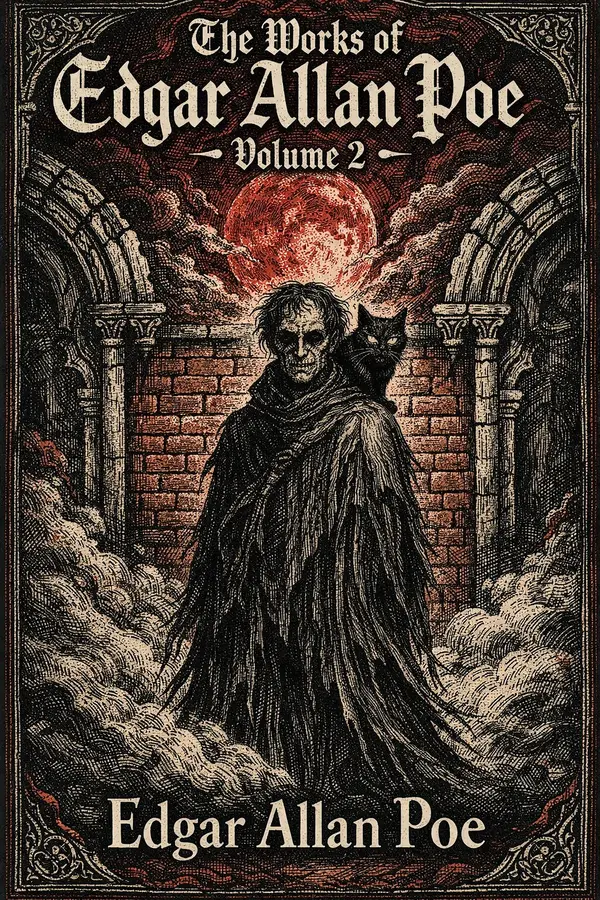
General Book Summary
The Works of Edgar Allan Poe, Volume 2 is a landmark collection of the author's most celebrated tales, showcasing his mastery of Gothic horror, psychological terror, detective fiction, dark satire, and metaphysical speculation. United by themes of death, madness, guilt, and the terrifying permeability of the boundary between life and death, this volume stands as a definitive portrait of American Romanticism's darkest genius. The collection opens with "The Purloined Letter," in which the brilliant amateur detective C. Auguste Dupin recovers a politically dangerous letter stolen by the cunning Minister D——. Where the Parisian police exhaust themselves with physical searches, Dupin triumphs by thinking like his adversary: the letter is hidden in plain sight. With psychological audacity, he substitutes a facsimile and leaves the minister holding the instrument of his own ruin — inventing the modern detective story in the process. "The Thousand-and-Second Tale of Scheherazade" delivers biting satire: Scheherazade's final storytelling describes genuine modern scientific wonders — steam engines, telegraphs, photography — framed as Sinbad's impossible adventures. The king, credulous through a thousand nights of fantasy, refuses to believe these actual truths and orders her execution. Poe's irony is merciless: reality has become too strange for credulity. "A Descent into the Maelstrom" is a tale of sublime terror, as a Norwegian fisherman recounts being swept into the monstrous Moskoe-Ström whirlpool during a catastrophic hurricane. Facing certain death, he transcends panic through scientific observation, engineers an impossible escape, and returns aged white-haired in a single day. "Mesmeric Revelation" and "The Facts in the Case of M. Valdemar" probe the horrifying frontier between mesmerism and mortality. A dying man reveals cosmic truths while in trance before expiring upon awakening. In the Valdemar tale, a subject is suspended in mesmeric stasis at the very moment of death for seven months; when finally released, his body collapses instantaneously into a "nearly liquid mass of loathsome putrescence" — one of literature's most unforgettable horrors. "The Black Cat" traces a narrator's moral disintegration through alcohol, perverse cruelty, and murder. After killing his beloved cat Pluto and murdering his wife, he walls her body in the cellar — only to be betrayed by a second supernatural cat accidentally entombed with her, whose howl summons the police to his crime. "The Fall of the House of Usher" immerses the reader in suffocating Gothic atmosphere as a narrator visits his hypersensitive friend Roderick Usher in an ancestral mansion that breathes with its owner's madness, building toward premature burial, spectral resurrection, and the literal collapse of house and bloodline together. Rounding out the volume are additional masterpieces — "The Masque of the Red Death," "The Cask of Amontillado," "The Tell-Tale Heart," "The Pit and the Pendulum," "William Wilson," "Berenice," and others — each a concentrated gem of dread exploring obsession, guilt, vengeance, and the inescapable verdict of conscience. Together they form an irreplaceable body of work that invented modern horror and detective fiction, and whose psychological depths have never been surpassed.
Table of Contents
Book Excerpt
THE PURLOINED LETTER
Nil sapientiæ odiosius acumine nimio.—Seneca.
At Paris, just after dark one gusty evening in the autumn of 18-,
I was enjoying the twofold luxury of meditation and a meerschaum,
in company with my friend C. Auguste Dupin, in his little back
library, or book-closet, au troisième, No. 33, Rue Dunôt,
Faubourg St. Germain. For one hour at least we had maintained a
profound silence; while each, to any casual observer, might have
seemed intently and exclusively occupied with the curling eddies
of smoke that oppressed the atmosphere of the chamber. For
myself, however, I was mentally discussing certain topics which
had formed matter for conversation between us at an earlier
period of the evening; I mean the affair of the Rue Morgue, and
the mystery attending the murder of Marie Rogêt. I looked upon
it, therefore, as something of a coincidence, when the door of
our apartment was thrown open and admitted our old acquaintance,
Monsieur G——, the Prefect of the Parisian police.
We gave him a hearty welcome; for there was nearly half as much
of the entertaining as of the contemptible about the man, and we
had not seen him for several years. We had been sitting in the
dark, and Dupin now arose for the purpose of lighting a lamp, but
sat down again, without doing so, upon G.‘s saying that he had
called to consult us, or rather to ask the opinion of my friend,
about some official business which had occasioned a great deal of
trouble.
“If it is any point requiring reflection,” observed Dupin, as he
forebore to enkindle the wick, “we shall examine it to better
purpose in the dark.”
“That is another of your odd notions,” said the Prefect, who had
a fashion of calling every thing “odd” that was beyond his
comprehension, and thus lived amid an absolute legion of
“oddities.”
“Very true,” said Dupin, as he supplied his visitor with a pipe,
and rolled towards him a comfortable chair.
“And what is the difficulty now?” I asked. “Nothing more in the
assassination way, I hope?”
“Oh no; nothing of that nature. The fact is, the business is very
simple indeed, and I make no doubt that we can manage it
sufficiently well ourselves; but then I thought Dupin would like
to hear the details of it, because it is so excessively odd.”
“Simple and odd,” said Dupin.
“Why, yes; and not exactly that, either. The fact is, we have all
been a good deal puzzled because the...