The Works of Edgar Allan Poe — Volume 1
Book Preview
Author
Edgar Allan Poe
Publication Date
February 27, 2026 07:01 PM
Genre
Book Cover
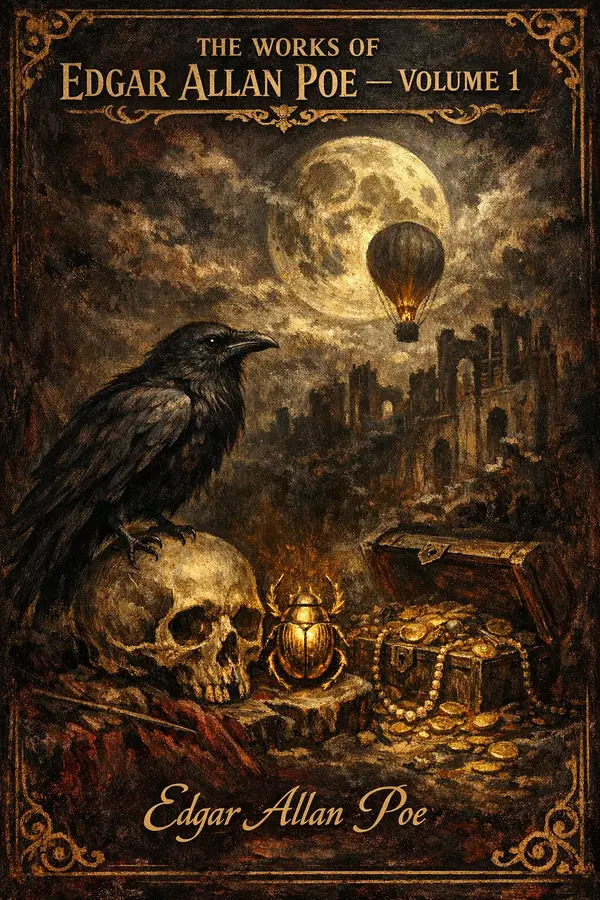
General Book Summary
The Works of Edgar Allan Poe, Volume 1 (The Raven Edition) is a landmark anthology that brings together biographical tributes and some of Poe's most celebrated tales, offering readers both a window into the tortured genius of the author and a showcase of his unparalleled literary imagination. The volume opens with a series of critical and biographical essays. Writers including James Russell Lowell and N. P. Willis paint a vivid portrait of Poe's extraordinary and tragic life: born in Boston in 1809, orphaned at two, adopted by the wealthy merchant John Allan of Richmond, educated at the Manor House School in England, briefly enrolled at the University of Virginia and West Point, and ultimately cast upon his own resources to forge one of the most original literary careers in American letters. His fifteen years of active writing were marked by relentless toil, staggering poverty, and flashes of genius that electrified readers on both sides of the Atlantic. For "The Raven" — perhaps the most famous poem in the English language — he was paid a mere ten dollars. His devotion to his child-wife Virginia Clemm, whom he married when she was thirteen and who died of consumption in 1847, is described as one of the most tender and heartbreaking episodes of his life. Poe himself died under mysterious circumstances in Baltimore in October 1849. The biographical tributes wrestle with the two faces of the man: the quiet, industrious, and gentlemanly professional known to colleagues, and the demon unleashed by even a single glass of wine. Together, they establish Poe not merely as a tragic figure but as the finest and most original genius in the history of American literature. The first major tale in the collection, "The Unparalleled Adventures of One Hans Pfaall," is a brilliant blend of scientific speculation and dark comedy. Hans Pfaall, a bankrupt bellows-mender from Rotterdam, finds himself besieged by creditors and contemplating suicide. After stumbling upon a pamphlet on speculative astronomy, he conceives an audacious plan: to escape his woes by building a balloon and flying to the moon. He lures his three most persistent creditors to assist him, then destroys them with gunpowder charges hidden beneath his launch site. His 19-day voyage through the atmosphere is rendered with astonishing pseudo-scientific detail — he suffers agonizing physical torment as pressure drops, bleeds from his eyes and ears, improvises ingenious solutions to survive, observes the Earth from impossible heights, drifts over the Arctic, and ultimately crash-lands on the lunar surface among a race of ugly, silent, earless inhabitants. The tale arrives in Rotterdam as a letter delivered by a moon-dweller, and its playful conclusion — where observers speculate that the whole thing is a hoax — gives the story a delicious metafictional wink. "The Gold-Bug" shifts the collection into the register of rational deduction that would make Poe the progenitor of the detective story. William Legrand, an eccentric naturalist living in genteel poverty on Sullivan's Island, South Carolina, becomes obsessed with a golden scarab beetle. His friend, the unnamed narrator, fears for his sanity. But Legrand has discovered something extraordinary: a hidden cryptogram on a scrap of parchment that, once decoded through painstaking analysis of letter frequencies and symbol substitution, points to the location of a vast treasure buried by the pirate Captain Kidd. On a tense midnight expedition into the woods — guided by the faithful but superstitious servant Jupiter — Legrand leads the group to dig up a chest of gold and jewels worth over a million and a half dollars. "The Gold-Bug" is a triumph of analytical storytelling: suspenseful, richly atmospheric, and driven by the irresistible forward momentum of a mind reasoning its way from mystery to revelation. Taken together, these works reveal the full range of Poe's genius: his mastery of atmosphere, his proto-scientific imagination, his gift for logical deduction, his dark humor, and his profound understanding of the human mind under extreme conditions. Volume 1 of The Raven Edition stands as an essential introduction to one of literature's most haunted and haunting voices.
Table of Contents
Book Excerpt
EDGAR ALLAN POE
AN APPRECIATION
Caught from some unhappy master whom unmerciful Disaster
Followed fast and followed faster till his songs one burden bore—
Till the dirges of his Hope that melancholy burden bore
Of “never—never more!”
This stanza from “The Raven” was recommended by James Russell
Lowell as an inscription upon the Baltimore monument which marks
the resting place of Edgar Allan Poe, the most interesting and
original figure in American letters. And, to signify that
peculiar musical quality of Poe’s genius which inthralls every
reader, Mr. Lowell suggested this additional verse, from the
“Haunted Palace”:
And all with pearl and ruby glowing
Was the fair palace door,
Through which came flowing, flowing, flowing,
And sparkling ever more,
A troop of Echoes, whose sweet duty
Was but to sing,
In voices of surpassing beauty,
The wit and wisdom of their king.
Born in poverty at Boston, January 19, 1809, dying under painful
circumstances at Baltimore, October 7, 1849, his whole literary
career of scarcely fifteen years a pitiful struggle for mere
subsistence, his memory malignantly misrepresented by his
earliest biographer, Griswold, how completely has truth at last
routed falsehood and how magnificently has Poe come into his own.
For “The Raven,” first published in 1845, and, within a few
months, read, recited and parodied wherever the English language
was spoken, the half-starved poet received $10! Less than a year
later his brother poet, N. P. Willis, issued this touching appeal
to the admirers of genius on behalf of the neglected author, his
dying wife and her devoted mother, then living under very
straitened circumstances in a little cottage at Fordham, N. Y.:
“Here is one of the finest scholars, one of the most original men
of genius, and one of the most industrious of the literary
profession of our country, whose temporary suspension of labor,
from bodily illness, drops him immediately to a level with the
common objects of public charity. There is no intermediate
stopping-place, no respectful shelter, where, with the delicacy
due to genius and culture, he might secure aid, till, with
returning health, he would resume his labors, and his unmortified
sense of independence.”
And this was the tribute paid by the American public to the
master who had given to it such tales of conjuring charm, of
...