The Strange Case of Dr. Jekyll and Mr. Hyde
Book Preview
Author
Robert Louis Stevenson
Publication Date
February 24, 2026 11:44 AM
Genre
Book Cover
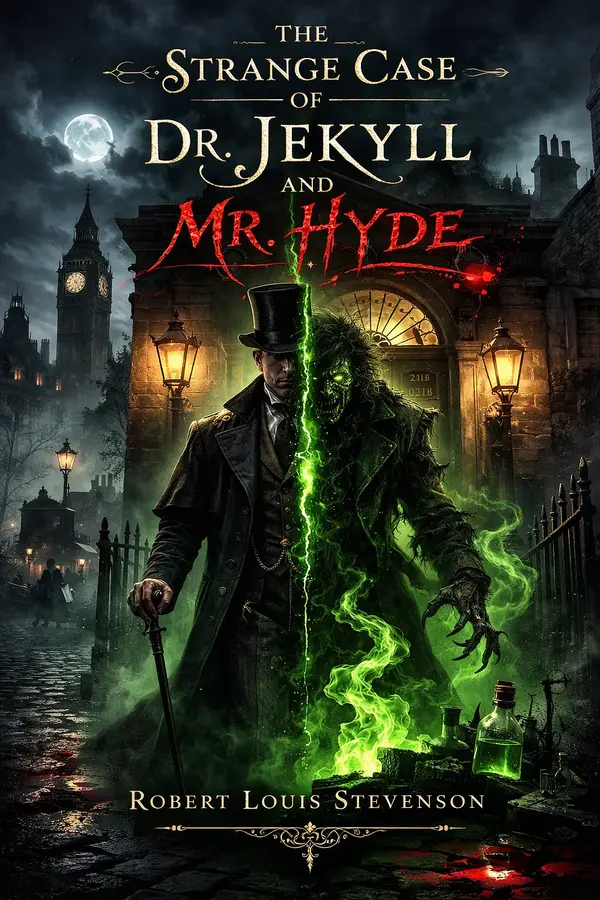
General Book Summary
The Strange Case of Dr. Jekyll and Mr. Hyde is Robert Louis Stevenson's masterwork of Gothic horror and psychological terror, set in the fog-drenched streets of Victorian London. At its heart, the novel is a shattering meditation on the duality of human nature — the coexistence of virtue and vice within every soul — told through the unraveling of one brilliant but tormented man. The story opens through the eyes of Gabriel John Utterson, a reserved and dutiful London lawyer who serves as our moral compass. During a Sunday walk with his kinsman Richard Enfield, Utterson hears a disturbing tale: a small, repellent man named Edward Hyde callously trampled a young girl and paid off her family using a cheque drawn on the account of the eminently respectable Dr. Henry Jekyll. Utterson is troubled further when he reviews Jekyll's will, which bequeaths all of the doctor's estate to Hyde — a man of unknown origin who inspires instinctive loathing in all who encounter him. Utterson's quiet investigation gradually gives way to something far darker. Nearly a year later, Hyde savagely murders Sir Danvers Carew, a distinguished Member of Parliament, beating him to death on a moonlit lane with a heavy cane. The crime shocks London, Hyde vanishes, and Jekyll briefly emerges from self-imposed isolation, apparently reformed. But the respite is short-lived. Jekyll retreats once more into his laboratory, growing ever more reclusive and desperate, frantically ordering pharmaceutical supplies that arrive impure and wrong. When Poole, Jekyll's devoted butler, arrives at Utterson's door in terror — convinced his master has been murdered and an impostor is lurking in the cabinet — the two men break down the laboratory door to find Edward Hyde, dead by his own hand, dressed in Jekyll's clothes. Two documents survive: the confession of Dr. Hastie Lanyon, and Henry Jekyll's full statement of the case. Lanyon's narrative reveals the traumatic night he was summoned to retrieve a mysterious drawer from Jekyll's cabinet and hand it to a midnight visitor. Before Lanyon's disbelieving eyes, Hyde drank a potion and transformed into Henry Jekyll — a spectacle so shattering to Lanyon's rationalist worldview that it broke the man entirely. He died weeks later, his soul destroyed by what he had witnessed. Jekyll's own confession provides the devastating final truth. A man of high aspirations and secret pleasures, Jekyll had long been tormented by the contradiction between his public respectability and his private appetites. His scientific experiments led him to discover that personality itself could be chemically divided. The potion gave physical form to the darkest part of his nature — a small, vigorous, cruel creature he named Edward Hyde. As Hyde, Jekyll tasted absolute freedom from conscience, indulging impulses suppressed for decades. But the balance could not hold. Hyde grew stronger with each transformation, until Jekyll began waking as Hyde without having drunk the potion. The original salt used in the formula could not be replicated; the supply dwindled. Jekyll, trapped in the body of a hunted murderer and writing his final testament in stolen moments, understood the end had come. Hyde — despised, cornered, and doomed — chose poison over the gallows. The man who sought to free himself from his dual nature was consumed entirely by his darker half. Constructed as a mosaic of perspectives — witness accounts, a dying man's letter, a dead man's confession — the novel withholds its central secret until the very end, so that the revelation lands with the force of tragedy. The horror is profoundly human: the monster was not created in spite of Jekyll's respectability, but because of it.
Table of Contents
Book Excerpt
Mr. Utterson the lawyer was a man of a rugged countenance that was never lighted by a smile; cold, scanty and embarrassed in discourse; backward in sentiment; lean, long, dusty, dreary and yet somehow lovable. At friendly meetings, and when the wine was to his taste, something eminently human beaconed from his eye; something indeed which never found its way into his talk, but which spoke not only in these silent symbols of the after-dinner face, but more often and loudly in the acts of his life. He was austere with himself; drank gin when he was alone, to mortify a taste for vintages; and though he enjoyed the theatre, had not crossed the doors of one for twenty years. But he had an approved tolerance for others; sometimes wondering, almost with envy, at the high pressure of spirits involved in their misdeeds; and in any extremity inclined to help rather than to reprove. “I incline to Cain’s heresy,” he used to say quaintly: “I let my brother go to the devil in his own way.” In this character, it was frequently his fortune to be the last reputable acquaintance and the last good influence in the lives of downgoing men. And to such as these, so long as they came about his chambers, he never marked a shade of change in his demeanour.
No doubt the feat was easy to Mr. Utterson; for he was undemonstrative at the best, and even his friendship seemed to be founded in a similar catholicity of good-nature. It is the mark of a modest man to accept his friendly circle ready-made from the hands of opportunity; and that was the lawyer’s way. His friends were those of his own blood or those whom he had known the longest; his affections, like ivy, were the growth of time, they implied no aptness in the object. Hence, no doubt the bond that united him to Mr. Richard Enfield, his distant kinsman, the well-known man about town. It was a nut to crack for many, what these two could see in each other, or what subject they could find in common. It was reported by those who encountered them in their Sunday walks, that they said nothing, looked singularly dull and would hail with obvious relief the appearance of a friend. For all that, the two men put the greatest store by these excursions, counted them the chief jewel of each week, and not only set aside occasions of pleasure, but even resisted the calls of business, that they might enjoy them uninterrupted.
It chanced on one...