The Count of Monte Cristo
Book Preview
Author
Alexandre Dumas
Genre
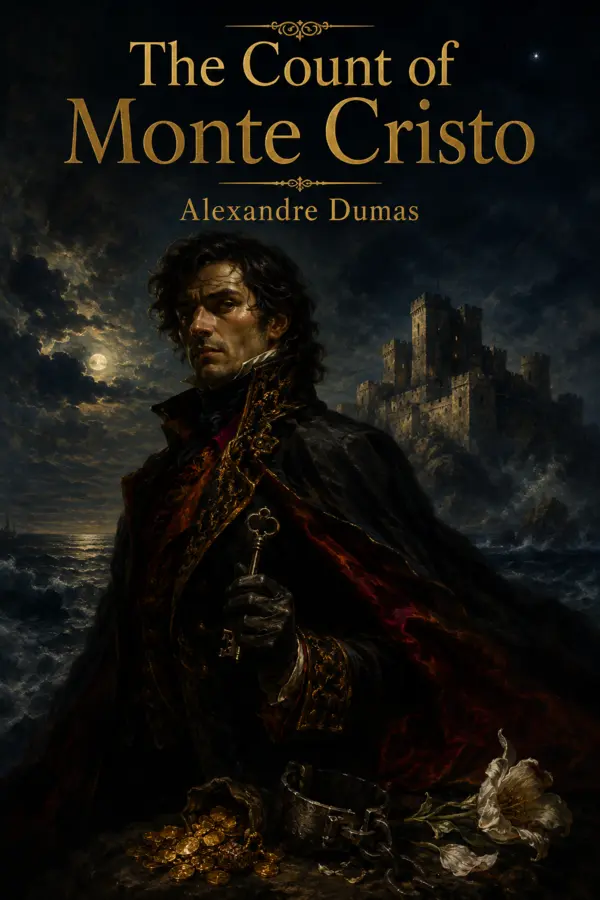
Book Cover
General Book Summary
The Count of Monte Cristo, Alexandre Dumas's sweeping masterpiece of betrayal, imprisonment, and calculated revenge, stands as one of the greatest adventure novels ever written. Set against the turbulent backdrop of post-Napoleonic France, it follows the extraordinary journey of Edmond Dantès — a young, talented, and honorable sailor on the cusp of everything life has to offer: captaincy of his ship, the hand of the beautiful Mercédès, and the love of his aging father. On the very day of his wedding feast, Dantès is arrested on a fabricated charge of Bonapartist conspiracy — the result of a poisonous plot engineered by three men consumed by jealousy and self-interest. Danglars, the scheming supercargo who covets Dantès's captaincy, pens an anonymous denunciation. Fernand Mondego, a Catalan fisherman desperately in love with Mercédès, delivers it. And Gérard de Villefort, an ambitious deputy prosecutor who discovers the letter is addressed to his own Bonapartist father, sacrifices an innocent man to protect his political career. Dantès is thrown into the island fortress of Château d'If, condemned without trial, his name erased from the world. For years Dantès rots in solitary darkness, his youth consumed, his spirit nearly broken. Then fate intervenes in the form of Abbé Faria — an aged Italian priest and brilliant scholar who has spent years secretly tunneling toward freedom, only to miscalculate and emerge in Dantès's cell. The two form an extraordinary bond: Faria becomes Dantès's teacher, transforming the rough sailor into a man of vast learning, languages, sciences, and philosophy. More crucially, before his death, Faria bequeaths to Dantès the secret of a buried treasure of incalculable wealth hidden on the desolate island of Monte Cristo. Dantès escapes by sewing himself into Faria's burial shroud and surviving the sea. He finds the treasure, and with it, he is reborn — not as Edmond Dantès the sailor, but as the Count of Monte Cristo, a figure of mystery, wealth, and inexorable purpose. Armed with unlimited resources and an intelligence sharpened by years of solitude and study, Monte Cristo descends upon Paris society like a god of vengeance, his identity concealed, his intentions inscrutable. The revenge is as intricate as a clockwork mechanism and as devastating as a storm. Danglars, now a powerful Parisian banker, is systematically ruined — his fortune dismantled, his reputation destroyed, his family shattered. Fernand Mondego, who during Dantès's imprisonment married Mercédès and rose to become the celebrated Count de Morcerf through betrayal and war crimes, is exposed before all of Paris society; his son Albert turns against him, and Fernand, stripped of everything, puts a bullet through his own head. Villefort, whose household harbors a secret poisoner in the form of his own second wife, watches his family crumble from within — his past crimes unearthed and read aloud before a courtroom — before losing his sanity entirely. Yet the Count of Monte Cristo is not a simple tale of triumphant vengeance. As Monte Cristo orchestrates the destruction of his enemies, Dumas forces him — and the reader — to confront the terrible human cost of becoming an instrument of fate. Innocent people are swept into the storm: Mercédès, who recognized Dantès from the first and has lived for decades in quiet grief; Albert de Morcerf, a young man guilty only of being his father's son; Valentine de Villefort, a gentle girl caught in a household of crime; and Maximilien Morrel, son of the kind shipowner who once championed Dantès, whose love for Valentine hangs suspended over an abyss. Monte Cristo is ultimately forced to ask whether he has the right to assume the mantle of Providence itself — whether justice and vengeance can ever truly be the same thing. The novel is a towering meditation on fate, identity, transformation, and the price of obsession. It is the story of a man who lost everything, rebuilt himself from nothing, and then had to decide what to do with his own soul once the reckoning was complete. With its labyrinthine plot, unforgettable characters, and moral grandeur, The Count of Monte Cristo endures as a timeless monument to the human spirit's capacity for both suffering and transcendence.
Table of Contents
This book has been reviewed
Read the professional review of this book
Book Excerpt
Chapter 1. Marseilles—The Arrival
On the 24th of February, 1815, the look-out at Notre-Dame de la Garde signalled the three-master, the Pharaon from Smyrna, Trieste, and Naples.
As usual, a pilot put off immediately, and rounding the Château d’If, got on board the vessel between Cape Morgiou and Rion island.
Immediately, and according to custom, the ramparts of Fort Saint-Jean were covered with spectators; it is always an event at Marseilles for a ship to come into port, especially when this ship, like the Pharaon, has been built, rigged, and laden at the old Phocée docks, and belongs to an owner of the city.
The ship drew on and had safely passed the strait, which some volcanic shock has made between the Calasareigne and Jaros islands; had doubled Pomègue, and approached the harbor under topsails, jib, and spanker, but so slowly and sedately that the idlers, with that instinct which is the forerunner of evil, asked one another what misfortune could have happened on board. However, those experienced in navigation saw plainly that if any accident had occurred, it was not to the vessel herself, for she bore down with all the evidence of being skilfully handled, the anchor a-cockbill, the jib-boom guys already eased off, and standing by the side of the pilot, who was steering the Pharaon towards the narrow entrance of the inner port, was a young man, who, with activity and vigilant eye, watched every motion of the ship, and repeated each direction of the pilot.
The vague disquietude which prevailed among the spectators had so much affected one of the crowd that he did not await the arrival of the vessel in harbor, but jumping into a small skiff, desired to be pulled alongside the Pharaon, which he reached as she rounded into La Réserve basin.
When the young man on board saw this person approach, he left his station by the pilot, and, hat in hand, leaned over the ship’s bulwarks.
He was a fine, tall, slim young fellow of eighteen or twenty, with black eyes, and hair as dark as a raven’s wing; and his whole appearance bespoke that calmness and resolution peculiar to men accustomed from their cradle to contend with danger.
“Ah, is it you, Dantès?” cried the man in the skiff. “What’s the matter? and why have you such an air of sadness aboard?”
“A great misfortune, M. Morrel,” replied the young man, “a great misfortune, for me especially! Off Civita...