Eugene Onegin
Book Preview
Author
Alexander Sergeyevich Pushkin
Publication Date
January 14, 2026 08:05 AM
Genre
Book Cover
General Book Summary
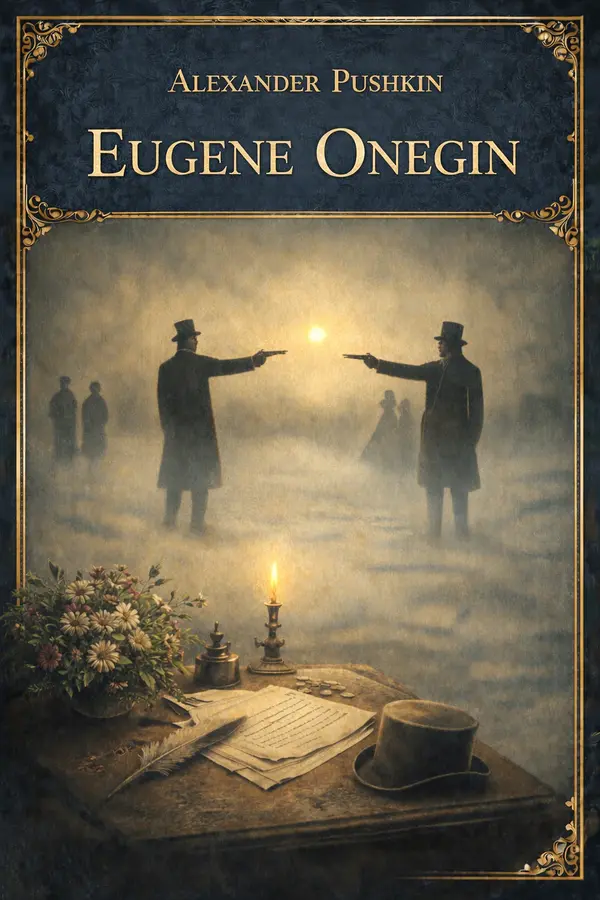
"Eugene Onegin" is a novel in verse by Alexander Sergeyevich Pushkin, one of the greatest works of Russian literature. The action unfolds in Russia in the 1820s and spans several years in the lives of the main characters. The protagonist is Eugene Onegin, a young Petersburg aristocrat, jaded by high society life and suffering from "Russian spleen." Having inherited an estate from his uncle, he moves to the countryside, where he befriends a young romantic poet, Vladimir Lensky. Through Lensky, Onegin visits the home of the landowners, the Larins, where two sisters live—the dreamy Tatyana and the carefree Olga, Lensky's fiancée. Tatyana, raised on novels and far removed from worldly coquetry, falls in love with Onegin and resolves to write him a letter confessing her love—an extraordinarily bold act for a young woman of that time. Onegin, touched by her sincerity but incapable of deep feelings, rejects her, delivering a lecture about the necessity of "self-control." At Tatyana's name-day celebration, Onegin, annoyed that Lensky brought him to a noisy party, flirts with Olga out of spite. The jealous Lensky challenges his friend to a duel. Onegin, understanding the absurdity of the quarrel but fearing public opinion, accepts the challenge and kills Lensky. Shattered by what has happened, he leaves the countryside. Several years pass. Tatyana is taken to Moscow to the "marriage market," where she marries an elderly general—Prince N. Onegin, having returned from his travels, encounters her at a ball and does not recognize the former country girl in the brilliant society lady. Now he passionately falls in love with her and writes her letters, but Tatyana, though she confesses that she still loves him, rejects him: "But I am given to another; I shall be faithful to him forever." The novel explores themes of love and duty, authenticity of feelings versus social conventions, the clash between dream and reality, and the "superfluous man" in Russian society. Pushkin created an "encyclopedia of Russian life," masterfully depicting the daily life and customs of the nobility, rural and metropolitan life in the first quarter of the 19th century.
Table of Contents
This book has been reviewed
Read the professional review of this book
Book Excerpt
Chapter One
And hastens to live, and hurries to feel. Prince Vyazemsky
I
"My uncle of most honest principles, When he fell seriously ill, He made himself be respected And could not have devised better. His example is a lesson to others; But, my God, what a bore To sit with a sick man day and night, Not departing a step away! What base cunning To amuse the half-alive, To adjust his pillows, Sadly bring him medicine, To sigh and think to oneself: When will the devil take you!"
II
Thus thought the young rake, Flying in the dust on post horses, By the supreme will of Zeus The heir of all his relatives. — Friends of Ludmila and Ruslan! With the hero of my novel Without introductions, this very moment Allow me to acquaint you: Onegin, my good friend, Was born on the banks of the Neva, Where perhaps you were born Or shone, my reader; There once I too wandered: But the north is harmful to me.
III
Having served excellently-nobly, His father lived on debts, Gave three balls annually And finally squandered everything. Fate preserved Eugene: First Madame looked after him, Then Monsieur replaced her; The child was lively, but sweet. Monsieur l'Abbé, a poor Frenchman, So the child would not be exhausted, Taught him everything in jest, Did not bore with strict morality, Scolded him lightly for pranks And took him walking in the Summer Garden.
IV
When the time of turbulent youth Came to Eugene, The time of hopes and tender sadness, Monsieur was driven from the yard. Here is my Onegin at liberty; Hair cut in the latest fashion; Dressed like a London dandy — And finally saw society. He could express himself perfectly In French and write; Danced the mazurka easily And bowed without constraint; What more do you need? Society decided That he was clever and very nice.
V
We all learned a little Of something and somehow, So with education, thank God, It's not hard to shine among us. Onegin was, in the opinion of many (Decisive and strict judges), A learned fellow, but a pedant. He had the happy talent Without constraint in conversation To touch upon everything lightly, With the learned air of a connoisseur To keep silence in important disputes And to provoke the ladies' smiles With the fire of unexpected epigrams.
VI
Latin has gone out of fashion now: So, to tell you the truth, He knew enough Latin To decipher epigraphs, To discourse about Juvenal, To put vale at the...