A Sportsman's Sketches
Book Preview
Author
Ivan Turgenev
Genre
Book Cover
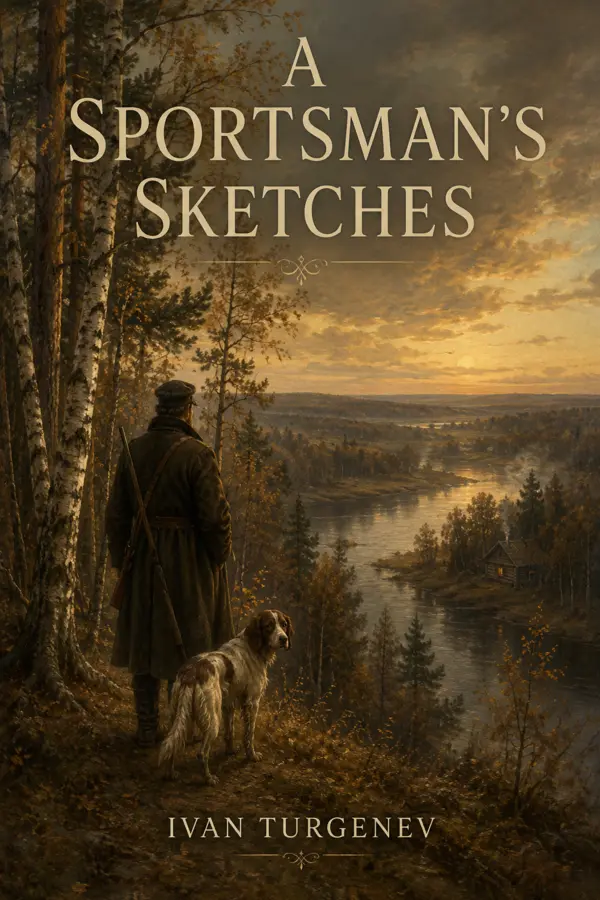
General Book Summary
A Sportsman's Sketches (also known as Notes of a Hunter or Sketches from a Hunter's Album) is Ivan Turgenev's celebrated collection of literary vignettes depicting rural Russian life in the mid-nineteenth century. Through the eyes of an unnamed gentleman narrator — a passionate sportsman who wanders the forests, marshes, and fields of the Orel and Kaluga provinces with his gun, his dog, and an insatiable curiosity about the people he meets — Turgenev paints an intimate and deeply compassionate portrait of serfs, freed peasants, eccentric landowners, and the forgotten souls of provincial Russia. The sketches unfold with the unhurried rhythm of a country walk, each one a self-contained portrait that nonetheless accumulates into a sweeping moral panorama. The opening sketch introduces two contrasting peasants: Hor, a prosperous and philosophically shrewd serf who has quietly grown wealthy while remaining legally bound to his master, and Kalinitch, a gentle, singing soul devoted to nature, bees, and his master's happiness. Their unlikely friendship embodies one of the book's deepest themes — that wisdom, dignity, and inner richness are distributed by nature with no regard for social station. As the narrator roams further, he acquires the companionship of Yermolaï, his disheveled but extraordinarily gifted huntsman — a vagabond of magnificent indifference who can track game by scent, charm nightingales, and cover fifty miles in a day, yet cannot manage to feed himself or treat his long-suffering wife with any kindness. At a riverside mill, they encounter Arina, the miller's wife, whose quietly tragic past as a house-serf — separated from the man she loved by a landlord's casual cruelty — haunts the reader long after the chapter ends. A chance trespass on a neighbor's estate leads the narrator to the melancholic Radilov, a former soldier hollowed out by grief over his dead wife and living in a tenderly ambiguous arrangement with Olga, his wife's younger sister. A fever contracted on the road draws out the confession of a district doctor, who recalls with aching honesty how he fell hopelessly in love with a young dying patient named Alexandra Andreevna — a story of forbidden tenderness, helplessness in the face of death, and an intimacy that could only exist at the very edge of life. The sketches broaden to include Ovsyanikov, a dignified and incorruptible peasant-proprietor of seventy who remembers the old Russia with its arbitrary grandeur and its savage cruelties, and who recounts for the narrator the stories of powerful landlords who could ruin a man with a gesture or charm a province with their magnificence. In the marshy village of Lgov, the narrator meets Vladimir, a freed serf who has polished himself into a simulacrum of a gentleman, and old Sutchok — a weathered man who has served as page, actor, whipper-in, cook, coachman, and fisherman across a succession of masters, his entire identity reshaped by others' whims so many times that almost nothing of his own remains. Throughout all these encounters, two presences are constant: the extraordinary beauty of the Russian countryside — rendered with botanical and atmospheric precision, alive with birdsong, morning mist, and the scent of hay and river water — and the quiet insistence with which Turgenev grants every character, however humble or broken, a full inner life. The book was genuinely revolutionary in its time for its refusal to caricature or condescend to serfs, and it is widely credited with influencing the moral climate that led to the emancipation of Russian serfs in 1861. A Sportsman's Sketches is not a novel with a single plot, but a tapestry woven from dozens of human lives, held together by the movements of a solitary, observant hunter through a landscape haunted by injustice and radiant with beauty. It remains one of the finest examples of the literary sketch form in world literature, and a landmark of empathy.
Table of Contents
This book has been reviewed
Read the professional review of this book
Book Excerpt
Chapter 1. HOR AND KALINITCH
Anyone who has chanced to pass from the Bolhovsky district into the Zhizdrinsky district, must have been impressed by the striking difference between the race of people in the province of Orel and the population of the province of Kaluga. The peasant of Orel is not tall, is bent in figure, sullen and suspicious in his looks; he lives in wretched little hovels of aspen-wood, labours as a serf in the fields, and engages in no kind of trading, is miserably fed, and wears slippers of bast: the rent-paying peasant of Kaluga lives in roomy cottages of pine-wood; he is tall, bold, and cheerful in his looks, neat and clean of countenance; he carries on a trade in butter and tar, and on holidays he wears boots. The village of the Orel province (we are speaking now of the eastern part of the province) is usually situated in the midst of ploughed fields, near a water-course which has been converted into a filthy pool. Except for a few of the ever-accommodating willows, and two or three gaunt birch-trees, you do not see a tree for a mile round; hut is huddled up against hut, their roofs covered with rotting thatch.... The villages of Kaluga, on the contrary, are generally surrounded by forest; the huts stand more freely, are more upright, and have boarded roofs; the gates fasten closely, the hedge is not broken down nor trailing about; there are no gaps to invite the visits of the passing pig.... And things are much better in the Kaluga province for the sportsman. In the Orel province the last of the woods and copses will have disappeared five years hence, and there is no trace of moorland left; in Kaluga, on the contrary, the moors extend over tens, the forest over hundreds of miles, and a splendid bird, the grouse, is still extant there; there are abundance of the friendly larger snipe, and the loud-clapping partridge cheers and startles the sportsman and his dog by its abrupt upward flight.
On a visit to the Zhizdrinsky district in search of sport, I met in the fields a petty proprietor of the Kaluga province called Polutikin, and made his acquaintance. He was an enthusiastic sportsman; it follows, therefore, that he was an excellent fellow. He was liable, indeed, to a few weaknesses; he used, for instance, to pay his addresses to every unmarried heiress in the province, and when he had been refused her hand and house, broken-hearted...